Where has that series gone called 'anti-aging skin care' products? For those new to the series, here is a quick refresher of the series. The point of the series was to demystify the world of cosmetics through discussing the ingredients on the back which make them up. How do ingredients help define the cosmetic product's function? I had to put the series on hold for a while (until now) do to other writing responsibilities. But now I am back. Thank you for being patient with me. I needed to learn how to engage you (the reader) more effectively. And give myself a little practice writing in other forums.
Anyways, I left off with analyzing a journal article about anti-inflammatory agents and skin barrier function. In the next blog post, I will continue where I left off. For now, I wanted to deviate a little and talk about skincare formulations and chemistry behind them. Specifically, I want to touch on 'emulsification.' Emulsifiers have an important role in skincare formulations. Read on below and find out how emulsifiers stabilize solutions of different phases. Enjoy!
A few months ago, I ran across an article (which is below) with a question which dives deep into the molecular interactions involved in an 'emulsifier'.
At this point right now, you may be scratching your head wondering what an 'emulsifier' is?
Fair enough.
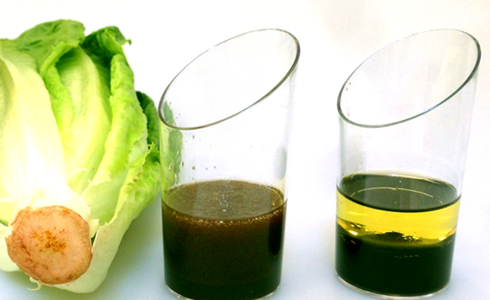
If you think of the following bottle of Salad dressing shown below:
Notice how the Salad dressing on the left contains two distinct (i.e., very different) phases of liquids. The phase on top is 'less dense' (i.e. lighter, less matter per unit volume) than the phase on the bottom.
Phases with two different densities are around us each day. Ice water with ice cubes is the most frequent example. Ice is a phase of water that is less dense than liquid water. Meaning that there are fewer molecules per volume.
Water is a special substance.
Why? Typically, when the molecules in a liquid slow down to form a crystal, the unit density is larger than that of a liquid of the same substance. But I did not write this article to discuss one property exclusively -- i.e., density. If we dig a little deeper, the two distinct phases above can be made into a single phase. Of course, that would require a molecular phase with properties of both phases above.
What is Thermodynamics?
Thermodynamics can be introduced by Wikipedia as follows:
Thermodynamics is the branch of physics that deals with heat and temperature, and their relation to energy, work, radiation, and properties of matter. The behavior of these quantities is governed by the four laws of thermodynamics which convey a quantitative description using measurable macroscopic physical quantities, but may be explained in terms of microscopic constituents by statistical mechanics. Thermodynamics applies to a wide variety of topics in science and engineering, especially physical chemistry, chemical engineering and mechanical engineering, but also in fields as complex as meteorology.
Historically, thermodynamics developed out of a desire to increase the efficiency of early steam engines, particularly through the work of French physicist Nicolas Léonard Sadi Carnot (1824) who believed that engine efficiency was the key that could help France win the Napoleonic Wars.[1] Scots-Irish physicist Lord Kelvin was the first to formulate a concise definition of thermodynamics in 1854[2] which stated, "Thermo-dynamics is the subject of the relation of heat to forces acting between contiguous parts of bodies, and the relation of heat to electrical agency."
The initial application of thermodynamics to mechanical heat engines was extended early on to the study of chemical compounds and chemical reactions. Chemical thermodynamics studies the nature of the role of entropy in the process of chemical reactions and has provided the bulk of expansion and knowledge of the field.[3][4][5][6][7][8][9][10][11] Other formulations of thermodynamics emerged. Statistical thermodynamics, or statistical mechanics, concerns itself with statistical predictions of the collective motion of particles from their microscopic behavior. In 1909, Constantin Carathéodory presented a purely mathematical approach in an axiomatic formulation, a description often referred to as geometrical thermodynamics.
The introduction above may seem confusing. Thermodynamics is concerned with the various forms of energy in a system and its surroundings. Some people find thermodynamics to be confusing and incomprehensible. Terms such as entropy and heat may throw a monkey wrench into a person's understanding of a chemical system. Although, thermodynamics is good at explaining various large scale properties of systems -- such as heat transfer, the entropy within the system, etc. Confused yet?
Anyways, during the learning process, I have scoured the internet for various explanations or clarifications to different concepts. That is part of an investigation into learning about cosmetic products. Incorporating the chemistry behind the product requires a person to think about the energy within a system. How is the system work with its constituent ingredients? How does the system hold itself together? How does thermodynamics achieve this?
Thermodynamics is the accountant for the energy of the system. A person cannot help but investigate thermodynamic properties of a system to understand how the individual molecules mixed into a solution interact such that collectively they form the macroscopic system -- i.e., cosmetic product.
One such concept was that of an "Emulsifying Stabilizer". Below is an example of a question/answer query that I found on a website called "Research Gate":
Question:
How does an emulsifier stabilize an emulsion?
Emulsion can be stabilized by increasing the repulsion between the dispersed phase i.e., by increasing the electrostatic repulsion (which is long range) or steric repulsion (short range). Emulsifiers are amphiphiles that reduce the interfacial tension between the two phases and contribute to the stabilization of dispersed droplets with electrostatic or steric effects.
I wish to know the detailed mechanism by which emulsifiers stabilize an emulsion. References will be of real help.
Thanks.
One possible Answer that intrigued me was the following:
Answer:
When a surfactant adsorbs on the interface the interfacial tension between the two phases decreases. The reduced interfacial tension depends on the concentration of the surfactant according to the Gibbs’ isotherm.
Adsorbed surfactants or solid particles stabilize emulsions via two main mechanisms:
1. steric stabilization
2. electrostatic stabilization
Steric stabilization arises from a physical barrier to contact and coalescence. For example, high-molecular-weight polymers can adsorb on the surface of the dispersed phase droplets and extend significantly into the continuous phase, providing a volume restriction or a physical barrier for particle interactions. As polymer coated particles approach, the polymers are forced into close proximity and repulsive forces arise, keeping particles apart from each other. Surface-active solid particles such as clays have also been shown to sterically stabilize emulsions.
Electrostatic stabilization is based on the mutual repulsive forces that are generated when electrical charged surfaces approach each other. In an electrostatically stabilized emulsion, an ionic or ionisable surfactant forms a charged layer at the interface. For an oil-in-water emulsion, this layer is neutralized by counter ions in the continuous phase. The charged surface and the counter ions are termed a double layer. If the counter ions are diffuse (thick double layer), the disperse phase droplets act as charged spheres as they
approach each other. If the repulsive forces are strong enough, the droplets are repelled before they can make contact and coalesce, and the emulsion is stable.
In general, electrostatic stabilization is significant only for oil-in-water emulsions since the electric double-layer thickness is much greater in water than in oil.
Both electrostatic and steric forces can prevent aggregation or coalescence and hence stabilize emulsions.
Reference: Urrutia P.I., Predicting Water-In-Oil Emulsion Coalescence From Surface Pressure Isotherms, Department of Chemical and Petroleum Engineering, University of Calgary M. Sc. Thesis, 2006.
I hope it was useful for you.
That is what occurs when the mixture is shaken up as shown in the right-hand side. Over time, the emulsifier is not strong enough to stabilize the two phases from forming again. The interactions of repulsion and attraction play a dominant role in all of chemistry. The scale on which these interactions occur is so small that typically we do not see them (or think about them).
Chemists think about them on a daily basis -- especially, formulation chemists at a cosmetic product manufacturing company. The energetics associated with interactions determine whether a reaction will occur or not. Chemistry plays a beautiful role in our world every day. Although, most of us choose not to look or think of these interactions. Which is fine too.
Although, when a consumer goes into a store and purchases a cosmetic product, the questions he/she asks the vendor are involving the interactions of the ingredients. Further, the questions include the interaction of the ingredients with the customer's skin and thermodynamic variables -- temperature, pressure, volume, and environmental conditions. After reading this brief article, I would expect your picture and thinking involving cosmetic ingredients to have widened -- which is great.
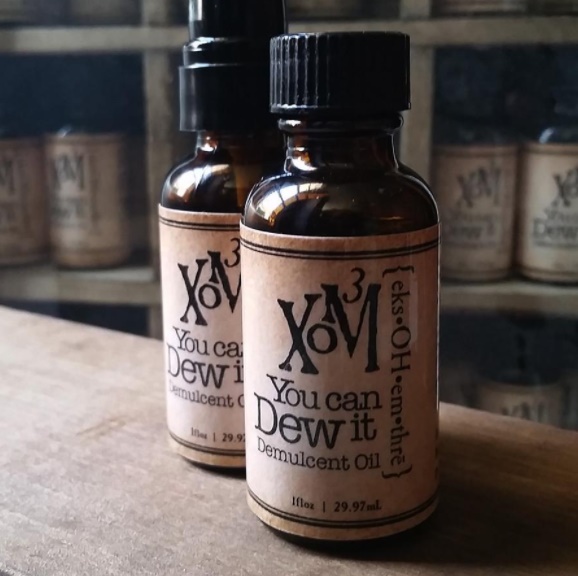
Remember my last post about the great facial product by XoM3 -- You Can Dew It!! -- shown above? That might have seemed like a long time ago. Furthermore, you may have been curious as to what I have been doing in the meantime. Remember, I promised to talk about a science paper which I found regarding topical benefits of plant oils? I have read the paper and am ready to discuss the topic a little. Which means that the science behind the paper will be introduced.
Below, I have included the statements from the scientific paper titled "Anti-Inflammatory and Skin Barrier Repair Effects of Topical Application of Some Plant Oils". The paper is a review of the literature of plant oils and their healing properties with respect to skin inflammation along with wound healing. In total, the paper is around 20 pages with tables and rich in references. Why do I mention this fact? Because, there are a large number of statements made in the paper which need to be further investigated (looking further into their references -- specifically the studies to back up a claim).
As a result, I have had a large amount of difficulty deciding on how to interpret the heavy hitting scientific statements made to the public (or the reader -- you). This has taken me a few weeks of indecision. Finally, I decided to lay out the statements regarding the specific ingredients which are contained in the product by XoM3 product -- You Can Dew It! Further, in the next blog post, I will go deeper into the contents of the paper regarding wound healing, anti-inflammation, anti-aging properties. Feel free to go through this open access paper by yourself. The paper can be found at either this link or here.
With that being said, let's move onto looking at results from a science article regarding the topical benefits of the ingredients in the product -- "You Can Dew It!" by XoM3 as reported in the cited article.
The following plant oils are contained in the facial treatment -- "You Can Dew It": 1) Jojoba Oil and 2) Argan Oil. These two oils are specifically discussed and researched along with others which will be detailed in the next blog post. First, I will list the statements regarding the two oils made in the research article I cite above. The remainder of the ingredients will be listed by their respective 'overview' descriptions from 'WebMD' as shown below:
1) Jojoba Oil:
The section on Jojoba Oil states:
Jojoba (Simmondsia chinensis) is a long-lived, drought resistant, perennial plant. Jojoba oil exhibits a high oxidative stability and resistance to degradation [131]. Jojoba oil is widely used in cosmetic formulas such as sunscreens and moisturizers. It has been shown to be effective in enhancing the absorption of topical drugs [132–134]. The high content of wax esters makes jojoba oil a good repair option for dermatoses with altered skin barriers, such as seborrheic dermatitis, eczematous dermatitis, AD,and acne[98]. Jojoba oil also has a proven anti-inflammatory effect,with potential uses in a variety of skin conditions including skin infections, skin aging, and WH [99,132].
2) Argan Oil:
The section on Argan Oil:
Argan oil is produced from the kernels of Argania spinosa L. Argan oil is composed of mono-unsaturated (80%) and saturated (20%) fatty acids. It contains polyphenols, tocopherols, sterols, squalene,and triterpene alcohols. Traditionally,argan oil has been utilized in cooking,in the treatment of skin infections, and in skin/hair care products. Daily topical application of argan oil has also been shown to improve skin elasticity [81] and skin hydration by restoring the barrier function and maintaining the water-holding capacity [123]. Additionally, topical applications onto skin provide a softening and relaxing effect on the skin, as well as helping to facilitate the accumulation and transdermal delivery of topical drugs such as allantoin [82]. Recently, tocopherol-rich argan oil-based nanoemulsions has been developed as vehicles possessing anticancer activity in murine breast and colon carcinoma cells [83]. Argan oil has also been shown to be effective in enhancing WH created second-degree burns in rats [84].
3) Rose Hip Oil:
The section on Rose Hip Oil:
Rose hip oil is extracted from seeds of rose hip (Rosa canina L.). Rose hip oil contains substantial UFAs. The most abundant fatty acid is linoleic acid (35.9–54.8%), followed by α-linolenic acid (16.6–26.5%), and oleic acid (14.7–22.1%) [141]. An appreciable number of lipophilic antioxidants is present, especially the tocopherols and carotenoids. Rose hip oil also contains high level of phenolic acids, especially p-coumaric acid methyl ester, vanillin, and vanillic acid. Due its high composition of UFAs and antioxidants, this oil has relatively high protection against inflammation and oxidative stress [109]. Shabikin et al. has tested the efficacy of topical rose hip seed oil together with an oral fat-soluble vitamins on different inflammatory dermatitis such as eczema, neurodermatitis, and cheilitis, with promising findings of the topical use of rose hip seed oil on these inflammatory dermatoses [110]
Next, the following ingredients which make up the remainder of the facial moisturizer - 'You Can Dew It!' are the 'overview' statements from 'WebMD' as shown below:
Evening primrose oil is the oil from the seed of the evening primrose plant. Evening primrose oil is used for skin disorders such as eczema, psoriasis, and acne. It is also used for rheumatoid arthritis, weak bones (osteoporosis), Raynaud’s syndrome, multiple sclerosis (MS), Sjogren’s syndrome, cancer, high cholesterol, heart disease, a movement disorder in children called dyspraxia, leg pain due to blocked blood vessels (intermittent claudication), alcoholism, Alzheimer’s disease, and schizophrenia.
Some people use evening primrose oil for chronic fatigue syndrome (CFS); asthma; nerve damage related to diabetes; an itching disorder called neurodermatitis; hyperactivity in children and attention deficit-hyperactivity disorder (ADHD); obesity and weight loss; whooping cough; and gastrointestinal disorders including ulcerative colitis, irritable bowel syndrome, and peptic ulcer disease.
Women use evening primrose oil in pregnancy for preventing high blood pressure (pre-eclampsia), shortening labor, starting labor, and preventing late deliveries. Women also use evening primrose oil for premenstrual syndrome (PMS), breast pain, endometriosis, and symptoms of menopause such as hot flashes.
In foods, evening primrose oil is used as a dietary source of essential fatty acids.
In manufacturing, evening primrose oil is used in soaps and cosmetics.
In Britain, evening primrose oil used to be approved for treating eczema and breast pain. However, the Medicines Control Agency (MCA), the British equivalent of the US Food and Drug Administration (FDA), withdrew the licenses for evening primrose oil products marketed as prescription drug products for these uses. The licenses were withdrawn because the agency concluded that there is not enough evidence that they are effective. The manufacturer disagrees, but it hasn’t published studies yet to prove the effectiveness of evening primrose for these uses.
How does it work?
Evening primrose oil contains “fatty acids.” Some women with breast pain might not have high enough levels of certain ”fatty acids.” Fatty acids also seem to help decrease inflammation related to conditions such as arthritis and eczema.
Yarrow is an herb. The above ground parts are used to make medicine.
Yarrow is used for fever, common cold, hay fever, absence of menstruation, dysentery, diarrhea, loss of appetite, gastrointestinal (GI) tract discomfort, and to induce sweating.
Some people chew the fresh leaves to relieve toothache.
Yarrow is applied to the skin to stop bleeding from hemorrhoids; for wounds; and as a sitz bath for painful, lower pelvic, cramp-like conditions in women. In combination with other herbs, yarrow is used for bloating, intestinal gas (flatulence), mild gastrointestinal (GI) cramping, and other GI complaints. In foods, the young leaves and flowers of yarrow are used in salads. In manufacturing, yarrow is also used as a cosmetic cleanser and in snuff. Yarrow oil is used in shampoos.
How does it work?
Yarrow contains many chemicals that might affect blood pressure and possibly have anti-inflammatory effects.
Calendula is a plant. The flower is used to make medicine.
Calendula flower is used to prevent muscle spasms, start menstrual periods, and reduce fever. It is also used for treating sore throat and mouth, menstrual cramps, cancer, and stomach and duodenal ulcers. Calendula has also been used for measles, smallpox, and jaundice.
Calendula is applied to the skin to reduce pain and swelling (inflammation) and to treat poorly healing wounds and leg ulcers. It is also applied to the skin (used topically) for nosebleeds, varicose veins, hemorrhoids, inflammation of the rectum (proctitis), ear infection, gum disease, peeling lips (exfoliative cheilitis), diaper rash, vaginal yeast infection, and inflammation of the lining of the eyelid (conjunctivitis). Essential oil of calendula has been used as an insect repellant.
Don’t confuse calendula with ornamental marigolds of the Tagets genus, which are commonly grown in vegetable gardens.
How does it work?
It is thought that the chemicals in calendula help new tissue grow in wounds and decrease swelling in the mouth and throat.
Comfrey is a plant. Even though this plant contains poisonous chemicals called pyrrolizidine alkaloids (PAs), the leaf, root, and root-like stem (rhizome) are used to make medicine. The amount of PAs found in comfrey changes according to the time of harvesting and the age of the plant. The roots have 10 times higher amounts of PAs than the leaves. Some products labeled “common comfrey” or Symphytum officinale actually contain the more poisonous “prickly comfrey” (Symphytum asperum) or “Russian comfrey” (Symphytum x uplandicum) species.
Comfrey is used as a tea for upset stomach, ulcers, heavy menstrual periods, diarrhea, bloody urine, persistent cough, painful breathing (pleuritis), bronchitis, cancer, and chest pain (angina). It is also used as a gargle for gum disease and sore throat.
Comfrey is applied to the skin for ulcers, wounds, joint inflammation, bruises, rheumatoid arthritis, swollen veins (phlebitis), gout, and fractures.
How does it work?
The chemicals in comfrey might have a healing effect and reduce inflammation when applied to the skin. However, comfrey contains toxic chemicals that can be absorbed through the skin.
Frankincense is the hardened gum-like material (resin) that comes from cuts made in the trunk of the Boswellia carteri tree. People use it to make medicine.
Frankincense is used for colic and intestinal gas (flatulence). It is sometimes applied to the skin in hand cream.
The essential oil of frankincense is used on the skin and by inhalation as a pain-killer.
How does it work?
There isn't enough information available to know how frankincense works.
Ylang ylang oil is made from the flowers of the herb Cananga odorata genuina.
People apply ylang ylang oil to the skin to promote relaxation, kill bacteria, lower high blood pressure, and increase sexual desire. It is also part of a combination spray used to kill head lice.
In foods and beverages, ylang ylang oil is used as a flavoring.
In manufacturing, it is used as a fragrance for cosmetics and soaps.
How does it work?
There isn’t enough information to know how ylang ylang oil might work.
This concludes the statements from the cited research article above along with the website 'WebMD' for the ingredients of the product by XoM3 -- You Can Dew It!
In total, the scientific paper I introduced only covered 2 ingredients listed on the back of the facial moisturizer -- You Can Dew It! The overall message regarding the scientific research for those two ingredients (chemicals) is as follows:
Jojoba oil: Jojoba oil search returned the results of having a beneficial effect in skin barrier repair along with anti-aging properties. The oil has both anti-oxidant and anti-inflammatory properties as referenced in the cited paper. These benefits are important for a facial moisturizer developed to repair and return healthy looking skin.
Argan oil: Argan oil is beneficial for wound healing and skin barrier repair as cited in the referenced paper. There are questionable data regarding anti-aging properties or anti-oxidant properties. Although, argan oil along with jojoba oil have anti-inflammatory properties when incorporated into a skin care product.
Rose Hip oil: Rose Hip is beneficial as an anti-oxidant and anti-inflammatory agent. According to the table cited in the article, rose hip also contains anti-aging components which contribute to the overall properties of the moisturizer.
Conclusion...
The other ingredients are referenced with information from the website 'WebMD'. In the next blog post, I will go further into the properties and benefits behind the science listed in the cited article. Plants have beneficial properties as noted in the cited papers. How to measure or design an experiment to test these ingredients is difficult, but ongoing. As science moves forward, the knowledge will increase proportionately on the safety of the ingredients used in cosmetic products.
Rosacea is a painful skin condition that runs in my family. Women between ages 30 and 50 with fair skin can suffer from rosacea that is aggravated by sunlight, diet soda, stress and heat. I contacted my friend Sepi from CT Organics in 2016 when my skin was in such a bad state that I was at my wit's end.
I've been using Clinique "Redness Solutions Soothing Cleanser With Probiotic Technology" since around 2007. I also use Clinique "Broad Spectrum SPF 50 Sunscreen Face Cream" and more recently Clinique "SPF 50 Mineral Sunscreen Fluid For Face." They say the mineral sunscreen is virtually invisible, which is to say that it is like wearing clown white makeup. But for days when I'm out in the sun all day, I feel it provides better protection than the face cream.
To treat the skin irritation, Sepi first gave me a sample of pure borage oil to make sure that wouldn't aggrevate the condition. Then she gave me a sample of Borage Pearl Powder cream to try. I've been applying it only to the areas of extreme redness. It's definitely working. The redness in my cheeks is less but I still get irritation on my chin that I'm trying to tame. I think maybe the chin is something that still gets sun even when the rest of my face is covered by a hat. Also, I was using only SPF 30 for awhile but I've gone back up to SPF 50.
Oct 2016
Nov 2016
March 2017
April 2018
I can't say enough wonderful things about the Borage Pearl Powder cream. The only thing I need to do is make sure I have a travel size. Last month, when I went to New Orleans (on a plane) I was limiting myself in terms of how many ounces I brought in my carry-on luggage. 3-1-1 for carry-ons = 3.4 ounce (100ml) bottle or less (by volume) ; 1 quart-sized, clear, plastic, zip-top bag; 1 bag per passenger placed in screening bin. The thing is that I brought a bunch of hair products which left less room for skin care in the 1 quart bag. Priorities~!
March 2018, New Orleans
Every day on top of the Borage Pearl Powder cream, I put Clinique "Dramatically Different Moisturizing Lotion+" and I use that to cover areas outside of the T-zone where my rosacea isn't. I sometimes use Clinique "All About Eyes" but not every day. Especially since I hardly go anywhere without my glasses these days, and then on top of that I wear goggles in lab 5 days a week. So nobody is really looking at my crow's feet. Then I put "Broad Spectrum SPF 30 Sunscreen Face Cream" on top of all that. Or SPF 50 if I'm planning to be outside for more than 20 minutes at a time.
When I've got TOO much sun or TOO much wind or if I've done TOO much gardening and my skin has been hit with dirt, I use Clinique "Moisture Surge™ Intense Skin Fortifying Hydrator" together with Clinique "Repairwear Laser Focus™ Wrinkle Correcting Eye Cream." I keep this on overnight or all weekend (plus staying indoors) to let the skin heal itself.
According to CT Organics website, borage seed oil contains high amount of gamma-linolenic acid (GLA) fatty acids that help reduce inflammation naturally.
I could say more about a BUNCH of other CT Organics products that I love, but that's all the time I have for today AND this product has been a game changer for me.
Happy New Year to everyone!!!! Sorry for the delay in response, I have been busy with other projects. I have been thinking about the direction of the 'Anti-Aging Skin Series' quite a bit over the break. Up until now, the products which I have chosen to deconstruct have been off the store shelf. A few months ago, I met Mandy of XoM3 products. My last blog post was on her and how this year I would incorporate her products into the 'Anti-Aging Skin Series'. Why?
Specifically, because in addition to deconstructing the ingredient list on the bottle of a given product, we can find out exclusive information not yet known to the public about the formulator's (creators) intention in designing the skin care product. Which makes us the consumers feel even a step closer to the process and the product. Without further ado, lets dive into the first product from XoM3 product line: "You Can Dew It" as shown below:
Remember, if you are interested in reading any previous posts contained in the 'Anti-Aging Skin Series' please either choose the hyperlink "Aging" on the cover page (in the right hand corner) or click here.
"You Can Dew It"
First, to put the product into context from her website, Mandy has a product description which I directly quoted below from her website:
Seasonal and dry weather, time, or biology can do a number on delicate facial skin. Handcrafted You Can Dew It Demulcent Oil can help. Lush with organic and ethical ingredients, precious jojoba, rosehip seed, argon and evening primrose oils are infused with skin loving botanicals and essential oils of frankincense and ylang ylang to deliver a velvety, dew kissed finish for glowing results.
Upon asking Mandy for a complete ingredient list, she was super kind to be open with her products. She is interested in bringing awareness to the community of consumers in the skin care industry that she stands by her products and has nothing to hide. She is very knowledgeable regarding the exact reason why a given ingredient is used in one of her products. Which makes her product line even more attractive.
To start with, I will list each ingredient and list the function as I have done in past blog posts. If the ingredients are 'highlighted or hyperlinked' then the reference page is from 'Environmental Working Group'. Otherwise, the ingredient information reference number will be given along with the corresponding reference listed at the end of the blog post in the bibliography. Below is a list of ingredients in "You Can Dew It":
About SIMMONDSIA CHINENSIS (JOJOBA) SEED OIL: Jojoba oil is extracted from seeds of the desert shrub, Simmondsia chinensis, native to California, Arizona and Mexico.
A strong-scented, spicy, wild herb used in astringents and shampoos. (Ref.2)
Note: Astringent: a substance that causes the contraction of body tissues, typically used to protect the skin and to reduce bleeding from minor abrasions. (Ref.3)
3) Argan Oil:
The oil is high in lipids, including the omega-9 oleic acid and the omega-6 linoleic acid as well as vitamin E. Argan oil has anti-inflammatory properties. (Ref.3)
Fragrant component used in skincare products; it can be a skin sensitizer, but is not considered a potent one. There is no research showing frankincense has any benefit for skin. (Ref.4)
That completes the ingredient list for the product "You Can Dew It" by XoM3 Botanical Solutions. On the bottom of the front of the bottle is the label -- "Demulcent Oil" which means -- "(of a substance) relieving inflammation or irritation."
Conclusion...
In the next post, I will provide a little background into the benefits of natural oils based on science. I recently stumbled upon an article which I would like to work through to see the evidence of the benefits aside or along with those listed in the ingredients (functions) list above.
I also promised at the beginning of the series (this year) to include Mandy (the producer, formulator) opinion on the product. I have to rescind that for the present time. We are both looking into the Food & Drug Regulations guidelines on 'interviews' and 'product discussions.' I will hopefully have more on that topic in the near future.
For the time being, I will move onto a new product after I discuss some benefits of natural oils in the next post. Until next time, have a wonderful day.
Have you noticed that more time has past in between posts on 'Anti-Aging Skin Series' lately? I have let too much time in between blog posts past! Yes, but for good reason. I have been determining the path ahead for the series. Remember that I started out with an extremely long blog post regarding the question: Can Science Really Reverse Aging Skin? Out of this grew the need by suggestion from my wife to clarify through many small blog posts -- exactly what I am trying to convey.
From there, an exploration was launched into the basics of the physiology of skin - with the purpose of formulating or deconstructing a skin care formulation. Why is a given ingredient incorporated into a formulation by a manufacturer? Answering that question over the last few posts has been comprised of listing the ingredients in a given skin care product and giving the specific function of the ingredient known in the industry.
Of course, the question as to the intent of incorporating a given ingredient could have been resolved quite easily had I been given access to the formulator. If I could have asked the inventor, why did you put this ingredient into that lotion -- this would have made life much easier. Instead, up until now, I have used the information available online to show you (the reader) how to decode or deconstruct the ingredient list on any skin care formulation.
Meet Mandy...
About a month ago, I had a chance to attend (with my wife) an event at a local garden which is kept up by the public. The event was hosted by the organization SLOLA -- Seed Library Of Los Angeles. The seed library is composed of the seeds collected by the members of the organization. SLOLA hosts all types of events centered around cultivating seeds and sharing tips on growing a variety of plants in a variety of environments. The group is a wonderful resource for anyone experiencing difficulty growing a plant in your garden. I was glad to be able to listen to a talk on 'herbal medicine' that particular Friday. Out of that talk came an interest in exploring the 'herbal chemistry' of the components in a given skin care solution.
Remember the last skin care solution which was deconstructed on this site -- Lush. There were a whole host of natural ingredients which (could potentially) have 'herbal qualities' to them. Additionally, that might have been the dominant reason for incorporating them into the formulation. Anyways, at the talk which I attended I was honored to meet another herbalist -- Mandy. Mandy is a super cool lady who is deeply interested in understanding the chemistry of skin care ingredients from a herbal medicine perspective. She makes her own products which can be viewed and purchased at the website: https://.xom3.com. Check them out.
As I mentioned above, I have been taking a little time to write and think in between the last two posts. This is due to my interaction with Mandy. Mandy and I met and started brainstorming on learning more about the chemistry in a given product. She is aware of the reason why she incorporates a given ingredient into her product. And that seem to hit home in my mind. I told her about this blog series. She was interested in explaining the back of her ingredient list. Yes.
Now, we can explore a skin care product and hear from the formulator why a given ingredient is incorporated into the formulation. Additionally, this will set the stage to continue to deconstruct other skin care products aside from Mandy's and have an idea as to the reason for the ingredient on the back of the product. That is the plan.
Conclusion...
I will choose a product off of her site and write about the ingredient list soon. I will ask her questions in the form of an interview and write about the answers. Stay tuned and get ready to get the "low down" on the wonderful products at XOM3. Have a great day!!!
Time has past since my last post on the "Anti-Aging Skin Series" -- too much time -- you might say. What have I been up to? During that time, I have been thinking about "natural ingredients" which are used in skin care products. What are their true function? Are they legitimate? Specifically, I have been thinking about the last skin care product which I deconstructed in post #11 - which can be found here. The front and rear of the package are shown below:
... And the backside with the ingredient list:
In this product, there are a whole assortment of "natural" ingredients. The manufacturer went to great length to include even their 'latin' name to specify plant species. Before I move onto another "natural" product from this manufacturer -- "Lush" -- I thought that a closer examination of the ingredients might be of use. In the last post, I show an ingredient list. Some of the ingredients have little to none information regarding the function (of the ingredient relative to the skin care product) which causes skepticism in my mind.
After all, a manufacturer should be able to list an ingredient with a proven or known function. Otherwise, the ingredient could be included just for show or to indicate that a number of "natural" ingredients make up the facial moisturizer. As I mentioned, the major driving force behind the sales and success of any cosmetic product is the customer's opinion/experience. Meaning, regardless of what sound science can be illustrated about the skin care product, the driving force behind sales/use is the customer experience. Unfortunately, as a result, the customer is given a tremendous amount of misinformation about a product which results in money spent and improving the corporate 'bottom line' - i.e. company sales.
Not all manufacturers aim at sales with this intent. There are legitimate skin care product companies which aim to give the customer a scientifically sound experience along with moist - soft - skin. An example of this is my colleague and friend's company 'C&T Organics'. I am not just saying this because she is a friend. I scrutinize her products just as much as any other. I ask the reasons (with a scientific basis) for adding various ingredients. She has produced scientific journal articles with data as a result of our discussions. Why do I bring her up at this time?
Minimum Number Of Ingredients?
The minimum number of ingredients needed to make a "natural moisturizer" are: emulsifier, water, oil, and a preservative. This makes sense from the standpoint of the fact that in order to keep good and healthy skin - a protective layer (i.e. oil) is needed along with the hydration layer (water). The preservative is needed or the product will deteriorate after a short amount of time...why? Because, natural pathogens and dirt will accumulate inside of the product and cause degradation. Either by the accumulation of dirt or the growth of a microbial community.
Now that the minimum number of ingredients are known to be around 4, we can revisit the number of ingredients listed on the backside of the "Lush" facial moisturizer cream. According to the last post which listed the functions of each ingredient in the product, there were 24 different ingredients. To start with, lets list the four ingredients that are the minimum in the paragraph above as categories: water, oil, emulsifier, and preservative.
Since, water is only a single molecule, water will not have any other molecules listed underneath it.
Preservatives
Next are the preservatives that are included in moisturizers. The purpose of which is to preserve the formulation from attack by foreign entities (microbes) or degradation by impurities. The preservatives that are contained in the formulation are listed below:
1) Methyl Paraben
2) Methyl Paraben
3) Benzyl Benzoate
Some of the ingredients above have a variety of uses. Providing stability in the form of preserving the initial formulation is extremely important. Although, if you cannot provide long term preservation, the next step is to add a perfume to mask the growth of microbes or the impurities which will inevitably collect inside of the formulation.
Fragrance
An easy category which is not necessarily required but added to mask the onset of degradation early in use of the product is 'fragrance' or 'perfume'. The following ingredients are molecules that serve as perfume molecules in the formulation:
1) Farnesol
2) Linalool
3) Geraniol
4) Triethanolamine
5) Vanilla
6) Cocoa butter
Oils
In an earlier post, I introduced the "hydrophobic" concept for molecules which are 'non-polar' and incorporated into skin care formulations. Feel free to go back and read before proceeding. Here is a list of the oils contained in the facial moisturizer explored in this blog post:
1) Almond Oil
2) Wheat Oil
3) Coconut Oil
4) Jajoba Oil
5) Cocoa Butter
Common Ingredients
Ingredients which are used commonly across formulations usually are synthetic. They are not naturally made, but synthesized and have been found to have the necessary functions needed to incorporate into a skin care formulation. Of course, the list is constantly changing (or being updated). Here is a list of the 'common ingredients' of products deconstructed in the series:
1) Glycerin
2) Cetearyl Alcohol
3) Stearic Acid
Emulsifiers
How do you get two distinct phases of chemicals (oils and water) to merge into a single layer? The answer is to use an 'emulsifying agent' -- a molecule which is composed of both properties. If we think of detergents used to wash clothes, emulsifiers are built into the molecular structure in order to attach water to fatty molecules. Hydrophobic molecules can be removed with the Hydrophobic portion of the emulsifier -- while water (which is hydrophilic) will attach to the corresponding hydrophilic end of the detergent molecule. Chemistry is amazing. Here is a list of the ingredients that emulsify the two separate phases -- hydrophobic and hydrophilic:
1) Cocoa Butter
2) Bladderwrack Seaweed (Alginates)
These are the ingredients (all 24 of them) which are contained in the "Lush" 'natural facial moisturizer'. As you can see, certain molecules (ingredients) have multiple functions in the formulation. Upon inspection, there will be certain ingredients which might be perceived as "extra" or "non-essential". In the section below, I examine the "extra" ingredients in a little more detail.
Function of Natural Ingredients
As I stated above, I usually wonder why a given ingredient is added to a product formulation. Why add unnecessary ingredients? Does the addition of 'natural' sounding names signify that the product is better than one formulated with synthetic names? Not necessarily. In some cases, adding 'natural' components together can make a formulation more toxic. Why? Because each ingredient might be tested individually, although, when combined with other natural ingredients, the intended action might not occur. In any instance, customer feedback will eventually shed light on these product formulations.
My job is to lay out for the reader the supposed health benefits with references or links to references for the ultimate decision on whether to continue or begin use with any given product. The decision is yours. Below is a list of ingredients with various links to search for more information regarding possible health benefits:
1) Triticum Vulgare (Wheat) Germ Oil: According to 'cosmeticsinfo.org', wheat germ oil contains small amounts of 'vitamin E' -- which can act as an 'anti-oxidant'. Of course, in order to act as an 'anti-oxidant' in the body, the vitamin E must get into the body. This means that in the current formulation, the vitamin E must diffuse through the various layers of skin into the body.
2) Viola Oderata: According to 'Wikipedia', there are supposed health benefits -- including sleep and breathing benefits from viola. There are skeptics, although a post on 'webmd' confirms health benefits.
3) Bladderwrack Seaweed (Alginates): The health benefits listed on WebMD is that Alginates lower the cholesterol entering the body. Whether the alginates actually enter the body through the skin is the question that resides in my mind. Although, Jojoba oil is known to diffuse deep into the skin and could carry chemicals with it into contact where absorption occurs. Which means that the stated health benefits might be useful. The main purpose behind alginates is that the main benefit within a skin cream is the action as an 'emulsifier' between hydrophillic and hydrophobic phases.
4) Primrose Oil: According to a few sources listed below, primrose oil seems to have a few benefits, including reducing pain with arthritis and the skin condition - eczema.
5) Beeswax (cera alba): WebMD states that the benefits of Bees Wax is "anti-inflammatory".
6) Aloe Vera: There are many benefits stated on WebMD for Aloe Vera. Check them out.
Conclusion
The "Lush" formulation seems to have a large amount of ingredients listed on the backside. Although, when the latin name is removed or the excessive naming (redundant), there appears to be 24 ingredients. As I mentioned above, 4 essential ingredients are required to make up a skin care moisturizer. The remaining should be accounted for. I have supplied the links and sources for you to run with and decide for yourself whether or not they should be incorporated into the formulation. There is one ingredient which is not natural which was incorporated into the product that must be mentioned -- shown below:
Benzyl Salicylate: One purpose of adding this ingredient is mainly to act as a UV Absorber -- to absorb various wavelengths in the Ultraviolet region. Although, certain cosmetic formulators warn that rashes might arise when exposed to sunlight -- which is counter intuitive to the first sentence. A fragrant smell is associated with this molecule and is oily which might help in stabilizing the product.
The products listed must be inspected by each consumer. Especially, when dealing with natural products. Just because the product is composed of natural ingredients does not mean that your body will not have an adverse reaction to the formulation. Check with your dermatologist if you have any questions before use or after a rash appears. Chemical safety is the utmost importance for chemists. Each consumer should strive to learn more about each product to ensure their own safety.
What is next on the "Anti-Aging Skin Series"? Has that question been on your mind lately? If so, I am here to give you some insight into the next few posts. Over the last few months, three skin moisturizers have been broken down by ingredient list. Additionally, certain insight was given in some cases to the reason why each ingredient is in each product. I have experimented with writing different ways to blog about a given product. I have yet to find a method that works for me.
In light of that, I will continue down the current path of introducing a skin care product with an ingredient list in an introductory post. Next, I will follow up with insight into the ingredients and briefly compare to previous blog posts. If you have any suggestions contact us through twitter or Facebook. And after the current product is analyzed, I will break the series with a brief discussion regarding science research that sheds light on using DNA as a sunscreen. Yes, I mean DNA - Deoxyribonucleic Acid -- the genetic code of life. First, lets move onto another skin care product which has claims which differ from the previous products discussed in the series so far.
Without further ado, I chose to sway off of the previous path of analyzing "mainstream" products made by large corporations and chose to try to go small. The product I chose to look at in this post is made by "Lush Cosmetics" which claims to be all "hand made cosmetics". Specifically, a facial moisturizer called "Shangri LA". You might be wondering how I chose this product. I was walking in the mall and spotted the store (in the Galleria in Glendale, CA, USA) - and could not help but stop by to check out the products and their claims. In this first post, I will list the ingredients with their function in the product. The definitions and functions are taken from the Environmental Working Group's "Skin Deep Data Base". I use this data base to illustrate the fact that you can use the same data base to get answers regarding other products which I might be looking at presently.
Here is the front of the 'Facial Moisturizer' shown below:
And here is the backside of the moisturizer with the ingredient list shown below:
Below is the ingredient list of functions:
1) Sweet Almond Oil:
About PRUNUS AMYGDALUS DULCIS (SWEET ALMOND) OIL: Almond oil is extracted from the seed kernels of the sweet almond plant, Prunus Amygdalus Dulcis.
About SIMMONDSIA CHINENSIS (JOJOBA) SEED OIL: Jojoba oil is extracted from seeds of the desert shrub, Simmondsia chinensis, native to California, Arizona and Mexico.
About TRITICUM VULGARE (WHEAT) GERM: Triticum Vulgare (Wheat) Germ is a natural product obtained from the embryo of the wheatkernel separated in milling.
About GLYCERIN: Glycerin (also called glycerol) is a naturally occurring alcohol compound and a component of many lipids. Glycerin may be of animal or vegetable origin. This ingredient is listed in the PETA's Caring ... read more
Function(s): Denaturant; Fragrance Ingredient; Hair Conditioning Agent; Humectant; Oral Care Agent;Oral Health Care Drug; Skin-Conditioning Agent - Humectant; Skin Protectant; Viscosity Decreasing Agent; PERFUMING; SOLVENT
7) Stearic Acid:
About STEARIC ACID: Stearic acid is a naturally occurring fatty acid. It is listed in the PETA's Caring Consumer guide as a substance of animal origin, since stearic acid is primarily derived from rendered fat of farm.
Function(s): Fragrance Ingredient; Surfactant - Cleansing Agent; Surfactant - Emulsifying AgentSurfactant-Cleansing Agent is included as a function for the soap form of Stearic Acid.; EMULSION STABILISING; MASKING; REFATTING
8) Cocoa Butter:
About THEOBROMA CACAO (CACAO) SEED BUTTER: Cocoa Butter is extracted from the roasted seeds of Theobroma cacao, a tree native to the Americas.
About TRITICUM VULGARE (WHEAT) GERM: Triticum Vulgare (Wheat) Germ is a natural product obtained from the embryo of the wheatkernel separated in milling.
About LANOLIN: Lanolin is a refined derivative of the fat-like sebaceous secretion of sheep. This ingredient is listed in the PETA's Caring Consumer guide as an animal-sourced product.
About BEESWAX: Beeswax is the purified wax from the honeycomb of the bee, Apis mellifera. This ingredient is listed in the PETA's Caring Consumer guide as a substance of animal origin.
Other LOW concerns: Ecotoxicology, Endocrine disruption
About BENZYL SALICYLATE: Benzyl Salicylate is an ester of benzyl alcohol and salicylic acid; this ingredient has been associated with allergies and contact dermatitis.
Other LOW concerns: Ecotoxicology
About GERANIOL: Geraniol is a naturally occurring scent ingredient found in various essential oils such as rose oil and citronella oil.
Function(s): Fragrance Ingredient; MASKING; TONIC
20) Benzyl Benzoate:
Other HIGH concerns: Occupational hazards; Other LOW concerns: Ecotoxicology, Endocrine disruption
About BENZYL BENZOATE: Benzyl benzoate is used as solvent and preservative; associated with allergies and contact dermatitis.
About FARNESOL: Farnesol is a flavor and perfume ingredient found in nature and also manufactured synthetically; associated with allergies and contact dermatitis.
Other HIGH concerns: Endocrine disruption; Other MODERATE concerns: Biochemical or cellular level changes; Other LOW concerns: Data gaps
About METHYLPARABEN: Methylparaben is in the paraben family of preservatives used by the food, pharmaceutical, and personal care product industries. Parabens mimic estrogen and can act as potential hormone (endocrine) system disruptors.
Function(s): Fragrance Ingredient; Preservative
24) Propylparaben:
Other HIGH concerns: Endocrine disruption; Other LOW concerns: Data gaps, Ecotoxicology
About PROPYLPARABEN: Propylparaben is in the paraben family of preservatives used by the food, pharmaceutical, and personal care product industries. Parabens mimic estrogen and can act as potential hormone (endocrine) system disruptors.
The ingredient list is full of interesting names which inspires curiosity as to their 'healing' efficacy. I thought that the ingredient list was cleverly written. I was exhausted in reading the list. Which caused me suspicion of the manner in which the ingredients were listed. In the next post, I will dive in further into the list and compare to the claims of the product manufacturer. Your assignment (yes, the reader - you) is to review the list of the other three products and find differences. This will help you understand the importance of each ingredient in the Shangri LA above.
I had a realization the other day while writing the next blog post for the ongoing "Anti-Aging Skin Series". While making a reference to a previous blog post in the series, I tried to look for that blog post. When a user to our site clicks on the button on the "right hand side" of the web page titled "Anti-Aging Skin Series" the result is a list of all of the previous blog posts. I will update the list as a new blog post is written.
Note: The blog posts are from most recent to oldest.
Here is a simple question for you to ask yourself:
Are you content with your life?
If the answer is no, then ask yourself what part of your environment needs to change. I recently had the experience of changing environments and realized the great difference that such a change can provide. If you want to understand why the recent blog posts in the series "Anti-Aging Skin Series" then read this short post. Of course, to read my new entry into Mike's Mental Awareness Journey, you will have to click on the following link -- click here.
If you are looking to change your environment and need to see if the time is correct, then read what happened to me. Remember to have an open mind and be willing to change to accommodate a new environment. Push forward and the future will be better if the change is correct for you. I look forward to continuing the "anti-aging skin series" very soon. Stay tuned.
Over the weekend, I was lazy. Can you relate to this feeling? I had planned to write and catch up on a few articles and ended up doing nothing of the sort. What did I do? I binge watched old seasons of the popular show "Grey's Anatomy". Kayla is into the show. I was reading while she was watching the show on Saturday. I asked her to turn up the volume....she said "Mike, If I turn up the volume, you might get sucked into the show?" I responded "probably not...." From then on, for the remainder of the weekend, I was a couch potato watching the show. Why am I admitting this to you? Well...
There was a scene where two surgeons were talking small talk in the doctor's lounge on the show. Who they were is not necessarily important. At one point in the conversation, one holds up a bottle of lotion and says, "We are doctors and we don't even know what the chemicals are listed on the back of this lotion....What is dimethicone?" At that point, I perked up and thought of the blog that I was in the process of writing for the "Anti-Aging Skin Series" which originated out of the long article that Kayla asked me to simplify titled "Can Science Really Reverse Aging Skin?". The chemical dimethicone is an ingredient that was discussed in a previous blog post. I decided to scrap the first draft that I had and start over. We last left off with a glossary of terms which would help us in understanding the ingredient list on the backside of a bottle of lotion -- Jergen's Skin Firming Moisturizing Lotion (previous blog).
The above introduction proves that an interest does exist for an understanding of the chemicals which are listed on the back side of products. Even if the interest was stated on a Hollywood set in "Grey's Anatomy". In the next blog post, I will tell you a real story about a chemist with a similar medical experience.
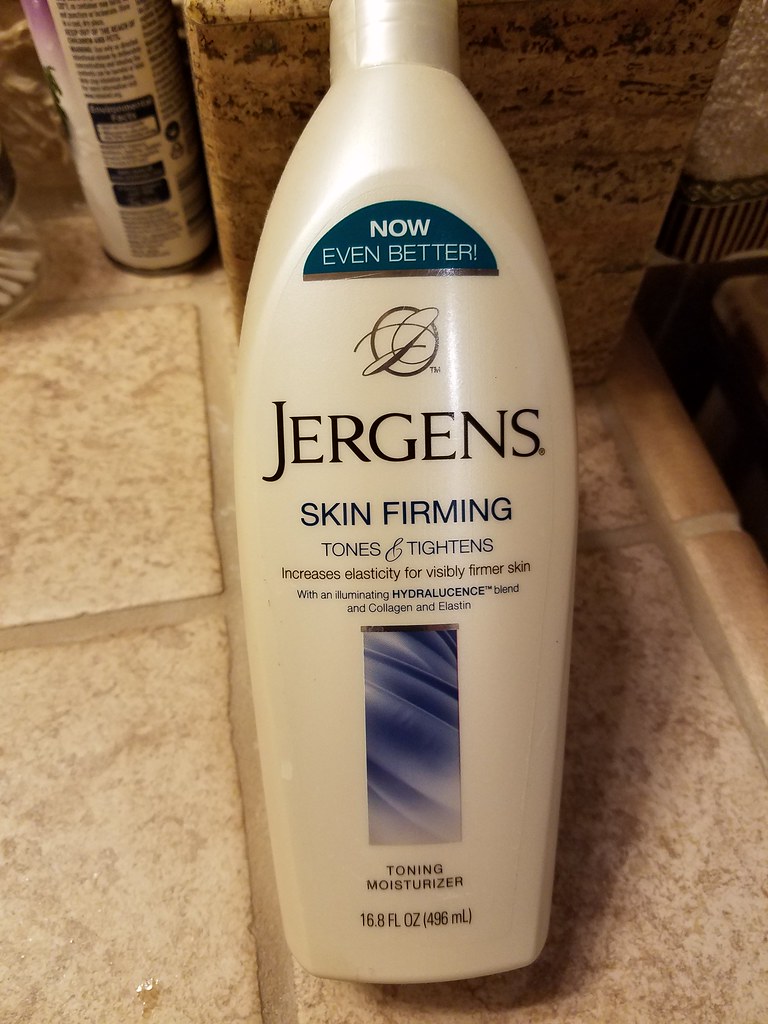
With this in mind, lets explore the backside of the ingredients which were listed in the previous blog post for the moisturizing lotion made by Jergen's -- which supposedly leaves a younger and healthier looking skin after use. A picture of the front side of the bottle is shown below:
Ingredients
To start out with, I must admit that I have had difficulty in trying to decide the format of these blog posts with the ingredients listed on the back of the container and their associated toxicities. In light of this revelation, bear with me through the next few blog posts. I am finding my way in terms of design and information layout. My plan is to lay out the ingredients in this blog with the chemical structures shown along with a brief discussion of the grouping/function of them relative to the product description. In the next blog post, I will discuss briefly a few aspects of the associated toxicology of the ingredients. The learning curve was much longer (took me way longer than I had imagined -- a month and a half) to find my way. But we are here now and lets get started.
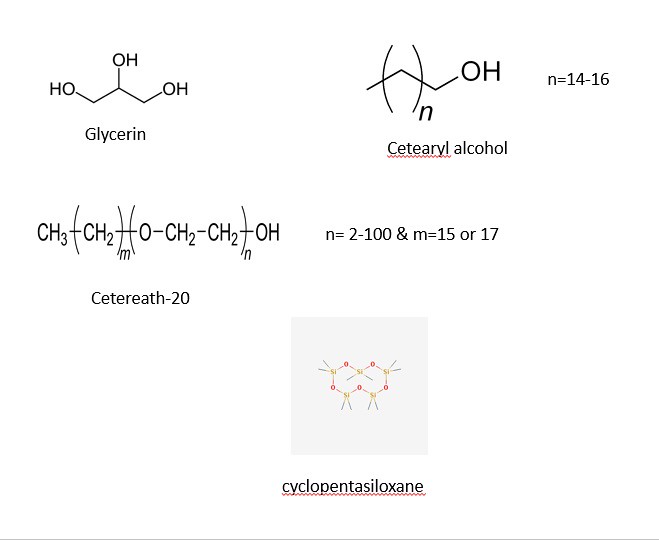
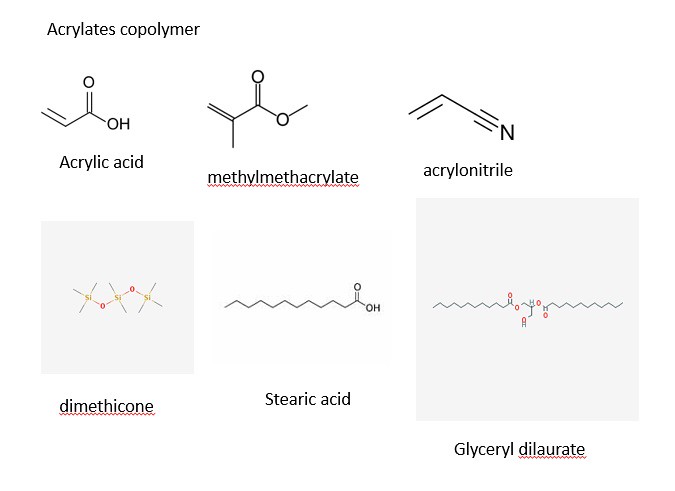
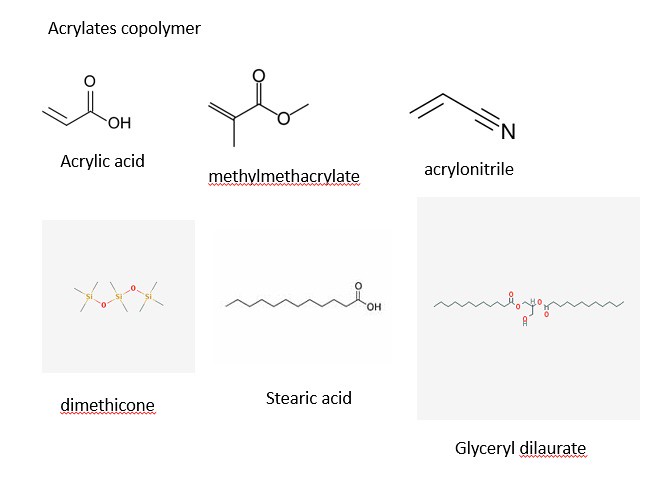
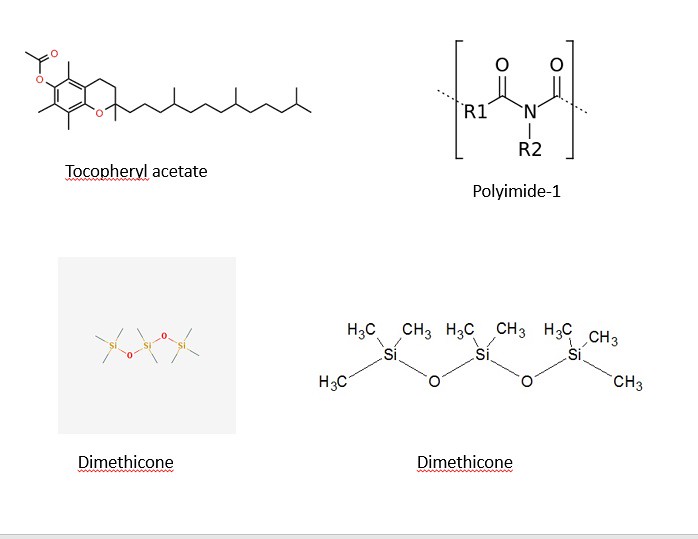
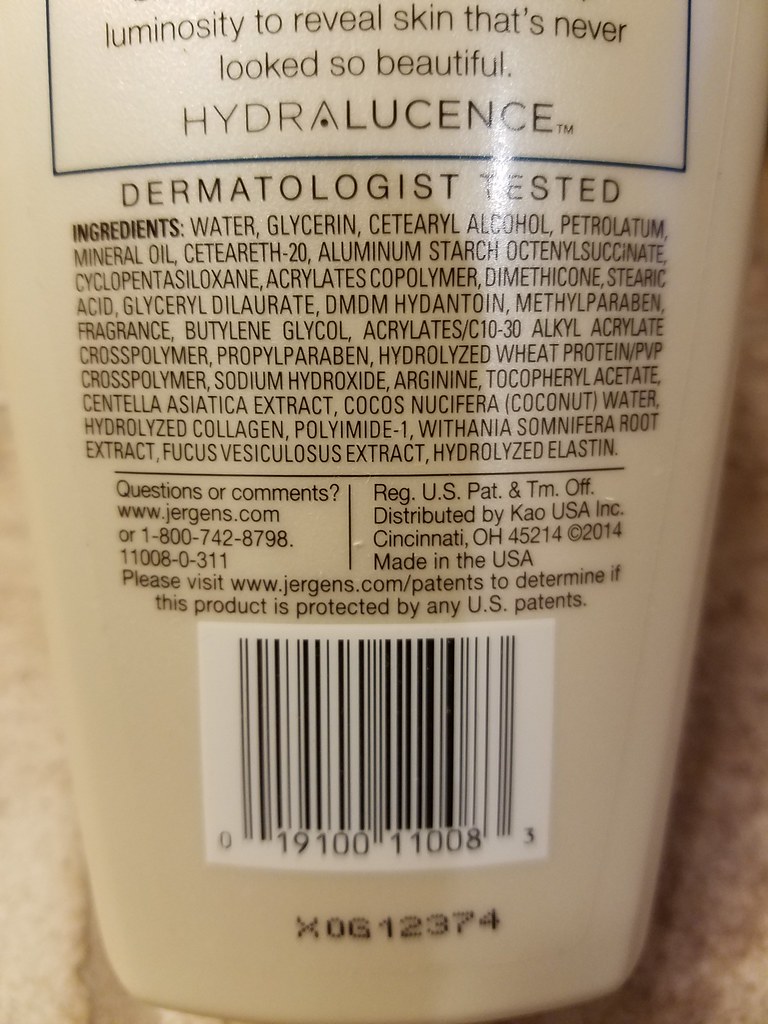
The structures of most of the ingredients are shown in the three panels below. Initially, I decided to take structures from two main websites: Wikipedia and the Environmental Working Group. After some time, I decided to learn a program (that I have no used in quite a while) to draw the chemical structures myself. The advantage of drawing the images myself with a chemical sketch program is that I am allowed to orient the molecules my own way to illustrate the point of function. With that being said, the four images below contain the chemical structures listed in the ingredients section on the back side of a bottle of Jergen's Skin Firming Moisturizer Lotion as shown below:
The three panels above show a variety of chemical structures. Some of which might be recognizable and others that are not. Note: the structures above were taken from different sources and might appear different. I will discuss that shortly for clarification purposes. I will be discussing the function of the ingredients in the product and talking periodically about the chemical structure, so feel free to scroll the mouse back up to the picture to view the structures as we move along.
These are some of the ingredients listed on the back of the bottle of lotion as shown below:
To start with, figuring out the function of the ingredient is relatively easy. In the previous post, I listed the function and definition of each ingredient. The important connection is to make between the function and the reason why the manufacturer chose to incorporate the ingredient into the lotion.
Two questions can be offered at the start in order to understand the ingredients:
1) Why is the ingredient in the product?
2) What is the concentration of the ingredient in the bottle?
These questions might seem redundant, but in actuality, chemists ask themselves these two questions before starting the research and development phase. Further, during the testing phase, these questions come up arise again if the product does not meet the intended purpose. For instance, does the cream spread smoothly over the surface of your skin without 'caking up'? Part of the answer lies in understanding the concept of "hydrophilic" and "hydrophobic". The concept of "hydrophobic" and "hydrophilic" is sometimes difficult to convey. Here are two videos taken from YouTube that are each less than 5 minutes in length and might help clarify the distinction between the two terms.
The video above is just one of many different explanations of the two terms: "hydrophilic" and "hydrophobic". I would encourage you (the reader) to search the internet on your own for an example that taps into your learning style. The easiest way that I can visualize the difference is to look at a bottle of Italian salad dressing whose components have separated into the hydrophobic layer along with the hydrophilic layer. An image is shown below:
As you can see, the two components have separated completely. If you were to shake the bottle up, the two layers would mix for a short (a few minutes) duration until the two layers. Here is a short explanation of how salad dressing works from our website. There are numerous explanations out online to clarify the distinction. One explanation that I found helpful was from an episode of the wildly popular show called "Science Friday". The episode was called "Salad Dressing Science." Here is a very simple explanation:
Most vinegars are solutions of acetic acid and water (plus some other acids and alcohols, depending on the type of vinegar you are using). Water, acetic acid, and alcohol are all examples of polar molecules—molecules that have a slightly negative charge at one end, or pole, and a slightly positive charge at another end. These slightly charged poles arise because one or more atoms in the molecule are electronegative, meaning that they tug electrons—which are negatively charged—towards them, creating an uneven distribution of charge within the molecule. Polar molecules are generally attracted to other polar molecules because their slightly negative poles have an affinity for their slightly positive poles. Polar molecules are attracted to water molecules—which are also polar—and are called hydrophilic, which means “water loving.”
Oils are a different story. Oils are a type of fat (like butter, shortening, and lard) and are considered non-polar. Fats and oils are composed primarily of long molecules called fatty acids (usually bound together by glycerol molecules into groups of three called triglycerides). Most of the atoms in a fatty acid molecule share electrons evenly and are neither negatively nor positively charged (although fatty acids do contain small regions of polarity—just not enough to make the whole molecule polar.) Non-polar molecules love other non-polar molecules and will glom together when mixed with water. You can observe this phenomenon by placing a few drops of oil on the surface of a bowl of water—eventually the drops will form a single large oil slick. Oils repel polar molecules such as those found in vinegar. Because oils also repel water, they are called hydrophobic, which means “water-fearing.”
The natural question arises when considering how the two layers stay together for a short time:
What holds the two layers together?
Obviously, whatever chemical that holds the two layers together will have to contain both properties. That is a long chain molecule could serve as the linker. Although, the linker (or emulsifier) molecule has to have a hydrophobic end along with a hydrophilic end too.
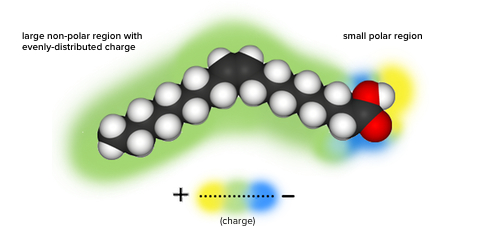
What does a molecule that serves as an "emulsifier" look like?
Here is a photo of the linker molecule shown on the webpage below:
Notice how the molecule in the picture has both a polar and a non-polar end. Again, from the website "Science Friday" for the episode "Salad Dressing Science" -- a short excerpt explaining the function of an "emulsifier":
How can we bring together polar and non-polar molecules to make something delicious like mayonnaise (which is essentially a combination of water and oil) or salad dressing? We need an emulsifier. Emulsifiers are the hand-holders of the molecule world. They contain both hydrophobic and hydrophilic regions and are able to attract and “hold hands” with polar and non-polar molecules simultaneously, pulling them together to form a special type of mixture called an emulsion. For instance, after adding an effective emulsifier to oil and vinegar and mixing thoroughly, separation of the oil from the vinegar will take much longer or won’t happen at all.
At this point, you are probably thinking the following question:
What does salad dressing science have to do with producing a cosmetic formulation?
Actually, from a chemist's standpoint, there is no difference. Both are mixtures of chemicals. Furthermore, each chemical has a distinct purpose (or supportive purpose) in the product formulation. Lets start with the categories that each chemical is partitioned into. In certain instances, some chemicals will play a dual role. This will become clear shortly in the next section.
A) Categories: Hydrophobic, Hydrophilic, Emulsifier, and Surfactant:
Above, there was a brief introduction into the 'hydrophobic'(water fearing) and 'hydrophilic'(water loving) chemicals. This distinction is very important since a large amount of chemicals are thought of in these terms in product formation. Additionally, there are 'linker' molecules which have both properties -- 'hydrophobic' and 'hydrophilic' -- which are extremely important to make a mixture appear to be uniform. This class of chemicals is known as 'emulsifiers'. I will refer to the previous post with the dictionary for more information.
Note: the categories listed below -- hydrophobic, hydrophilic, and emulsifier are used for simplifying purposes. Depending on the professional settings and synthesis, the degree of each categorical placement can be argued. I use these categories to help the reader understand that a certain amount of cosmetic formulations have a fatty component (nonpolar), a hydrophilic component (glycerin) and an emulsifier (cetearyl alcohol) to make a mixture. Other chemicals are present to assist in stabilizing the mixture to hold together along with other attributes (properties) which will be highlighted below.
A.1: Hydrophobic Ingredients
The first category will be the 'hydrophobic' compounds (i.e., non-polar, oils, fats, starch, etc.) shown below:
1) Mineral Oil
2) Petrolatum
3) Cyclopentasiloxane
4) Acrylates Copolymer
5) Dimethicone
6) Stearic Acid
7) Glyceryl Dilaurate
8) Fragrance
9) Methyl Paraben
10) Butylene Glycol
11) Acrylates/C10-C30 Alkylacrylate Crosspolymer
12) Propyl Paraben
13) Hydrolyzed Wheat Protein/PNP Crosspolymer
14) Tocopheryl Acetate
15) Centella Asiatica Extract
16) Cocos Nucifer (coconut oil)
17) Hydrolyzed Collagen
18) Withania Somnifera Root Extract
19) Fusus Vesiculosus Extract
20) Hydrolyzed Elastin
Upon inspecting the ingredients in the list above, you will notice that some of them do not have chemical structures shown in the image panels above. Which raises the following question:
Why are their chemical structures not shown?
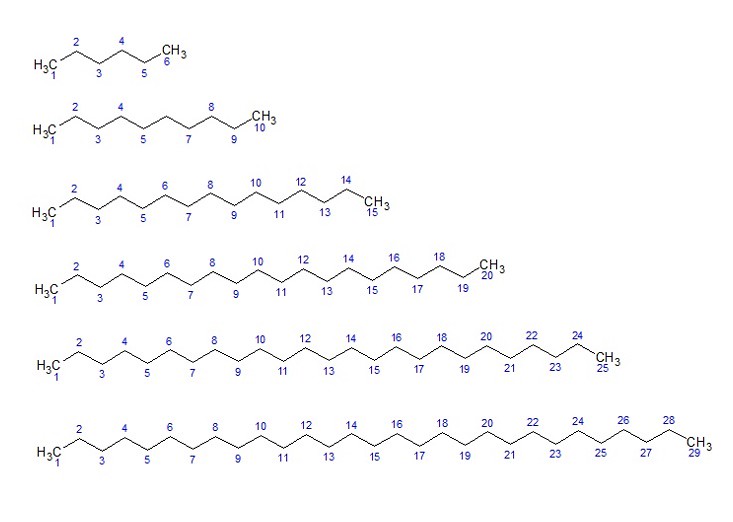
The reason is that oils contain mixtures of fats along with other long chain carbon molecules. The chains are nonpolar and are repeating carbon atoms with hydrogen atoms attached in most cases. In the image below, I show a distribution of carbon chains of varying length to illustrate my point:
An example of such a mixture of carbon chains is Petrolatum. Petrolatum is a jelly with viscous properties. The viscosity can be controlled by the distribution of chain lengths in the mixture. For a mixture with a high viscosity, the chain length might be greater than 25 carbons in length. Whereas, for a less viscous mixture, the carbon chains might be in the range of less than 25 carbons in length.
In the image above, I show carbon chains
A.2 Hydrophilic Ingredients
The next category is the opposite of the first in properties -- the 'hydrophilic' compounds (i.e., polar, ionic molecules, water, short chained alcohols, etc.) are shown below:
1) Water
2) Glycerin
3) DMDM Hydantoin
4) Sodium Hydroxide
5) Arginine
6) Polyimide-1
A.3 Emulsifier Ingredients
Finally, last but not least, the category of the 'linker' molecules -- 'emulsifier' compounds (i.e. surfactants, soaps, detergents, etc. ) are shown below:
1) Cetearyl Acohol
2) Acrylates/C10-C30 Alkylacrylate Crosspolymer
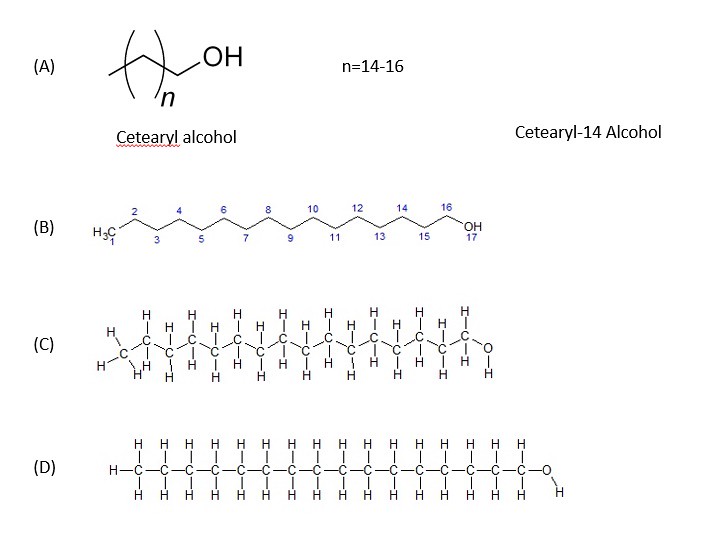
In this mixture, there are few emulsifiers present. I must note that the structure for cetearyl alcohol is rather ambiguous in the picture above. You probably do not understand what chemical structures with parenthesis () mean? In the image below, the chemical structure is expanded to the chemical cetearyl alcohol-14:
Shown above are 4 different illustrations of cetearyl alcohol. Since the length of the alkyl (carbon chain) can vary based on the index (the number outside of the parenthesis), cetearyl alcohol has many different structures. Meaning that the length of the carbon chain will vary. As you can probably guess, the longer the carbon chain, the more that the molecule will acts as a 'nonpolar' one rather than a polar molecule. short chained cetearyl alcohols are 'polar'.
In the structure (B) above, cetearyl alcohol-14 chemical structure is shown without the hydrogen molecules attached. This representation is referred to as the 'line structure.' Often chemists will use the 'line structure' to simplify the representation to focus on other aspects of the molecular structure. Structure (C) has all of the hydrogen atoms attached to the structure. Structure (D) shows the full structure flattened out for clarity of the numbers and types of atoms present. In future blogs, I might just use line formulas to simplify the case in point of ingredients in a given product formulation -- be aware!
A.4 Surfactants
Note: these are not the only three categories of ingredients. There are other main categories which are slightly separate from the above three categories. One such category is surfactants -- which are listed below:
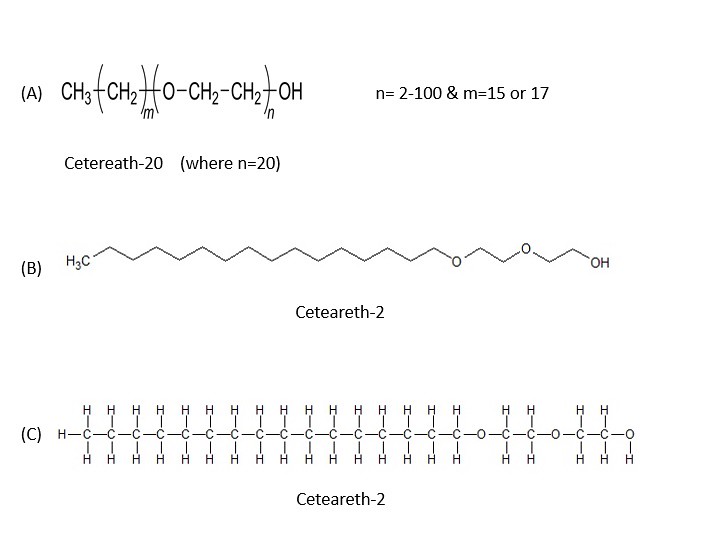
1) Ceteareth-20
2) Aluminum Starch Octenyl Succinate
Here is the structure of ceteareth-2 shown in the image below:
Again, shown above are 4 different structures for ceteareth-2. Notice in the structure (A) that in parenthesis there is one "O" on the chain? If the index 'n' is two, there will be two as shown in the line structure (B). If the index 'n' was 20 as in ceteareth-20, then there would be 20 "O" (oxygen atoms) and the molecule would run off of the page of the screen. Therefore, I used an example of ceteareth-2 to show the chemical structure.
B) Additional Categories: Skin Conditioning Agent, Skin Protectant, Humectant, and Emollient:
B.1 Skin Conditioning Agent
1) Glycerin
2) Mineral Oil
3) Cyclopentasiloxane
4) Dimethicone
5) Glyceryl Dilaurate
6) Butylene Glycol
7) Arginine
8) Tocopheryl Acetate
9) Centella Asiatica Extract
10) Hydrolyzed Collagen
11) Withania Somnifera Root Extract
12) Fucus Vesiculosus Extract
13) Hydrolyzed Elastin
Inspecting the list above and comparing it to the three additional lists below, some chemicals will serve two purposes. This multifaceted nature of the chemical gives rise to the distinction of definitions of these categories. Meaning that a skin-conditioning agent is also an humectant and an emollient in certain products. The important take-away message is that in order to interpret the function of various ingredients, look at the product. Ask yourself the following question:
What is the purpose of adding the ingredient into the product?
To determine the function, the website EWG gives the categorical function (i.e., skin-conditioning agent, skin protectant, humectant, etc.). In this blog post, the product is a 'skin firming moisturizing lotion' from the manufacturer Jergen's. The list above gives a few ingredients that will not be common across various lotions (products) from different manufacturers. Alternatively, the majority of the chemicals are common ingredients. This will become apparent in the future posts which look at different products.
Skin conditioning agent is defined in the previous blog as:
A skin conditioning agent and an essential fatty acid that helps maintain optimal skin health and function. Lipid Organic products found in living systems that are insoluble in water, like fats. Cell membranes are made of lipids.
The nonpolar nature of the chemicals will serve as a 'skin-repleneshing agent' to the lotion under inspection. As I mentioned in the very first post 'anti-aging' post is that there is very little in terms of regeneration of collagen by external chemical means possible. Therefore, the purpose of adding a distribution of lipids, oils, and fats will serve as a "coating" to adhere to the upper layer of the Stratum Corneum (the outer layer of the epidermis). If you were to add a highly polar liquid as the major ingredient to the lotion, the consistency would change and possibly not stick to the outer layer of the epidermis. Remember the following rule:
Like loves Like!
If you apply this principle in formulating products, then formulation will be much easier. As I mentioned, some ingredients serve many different purposes. Adding oils, fats, lipids that will adhere to the skin will produce a layer which might be perceived as 'new skin' or 'moisturized skin'. Really, the layer is just sitting on your skin. How do you ensure that the layer will stay on the skin?
In order to make that happen, you will need to add a binder and a skin protectant. Before moving to the next section of skin protectant, remember that skin conditioning agents will diffuse down into the top few layers of the skin -- but mostly sit on the outer layer.
One ingredient to highlight out of the skin-conditioning agent list is: Fucus Vesiculosus Extract. Research from 2002 suggests that the extract might have anti-aging properties as highlighted in the abstract to the research article shown below:
Recently the researchers found that an extract of Fucus vesiculosus, which is a type of seaweed, promotes the contraction of fibroblast-populated collagen gels through increased expression of integrin molecules. In this study, they investigated the effects of topical application of an aqueous extract of this alga on the thickness and the mechanical properties of human skin. A gel formulation that included 1% of the extract was applied topically to human cheek skin twice daily for five weeks. A significant decrease in skin thickness measured by B-mode ultrasound was elicited, as was a significant improvement in elasticity measured with a Cutometer as compared with controls. In cheek skin, the thickness normally increases and the elasticity usually decreases with age. These results suggest that the Fucus vesiculosus extract possesses anti-aging activities and should be useful for a variety of cosmetics.
The exact mechanism is not known. The research results were preliminary and more research has to be done to decipher into the exact mechanism of the Fucus Vesiculosus extract. This is a chemical that stands out. Other chemicals listed above will be redundant in other products. Next, I will comment on skin protectants below.
B.2 Skin Protectant
1) Glycerin
2) Petrolatum
3) Mineral Oil
4) Dimeticone
The list above are common ingredients which function as skin protectant. The purpose of adding a skin protectant is to ensure that the layer of lipids, fats, oils, long carbon chains to form a film on the top layer of the skin. Additionally, the purpose is to hold the moisture inside the upper most layer of the skin (to hydrate) which promotes the appearance of 'healthy and younger' looking skin. Using these ingredients does not actually change the physiology of the skin. Basically, the skin protectant serves as the outer layer of the skin -- i.e. fake layer.
Another purpose of having a skin protectant is to hold in the moisture in the top layer of the skin. The chemicals that promote moisture build up are 'humectants.' Humectants are chemicals which are 'hydroscopic' in nature. Hydroscopic means that the chemical will absorb water. Incorporating humectants into a moisturizing lotion serves two purposes: attracts water (keeps moisture in) and prevents the lotion from drying out (and cracking). Below is a list of humectants found in the Jergen's Skin Firming Lotion:
B.3 Humectant
1) Glycerin
2) Butylene Glycol
3) Hydrolyzed Collagen
B.4 Emollient
1) Cetearyl Alcohol
2) Petrolatum
3) Mineral Oil
4) Cyclopentasiloxane
5) Dimethicone
6) Glyceryl Dilaurate
7) Hydrolyzed Collagen
The list above contains the chemicals which act as Emollients. What is confusing to me is the vague distinction between the categories. This is the reason why I chose the distinction of 'hydrophobic' 'hydrophilic' and 'emulsifier'. These distinctions make more sense in formulating a cosmetic product. Here is the definition of an 'emollient' from the previous blog post below:
Moisturizers or emollients are complex mixtures of chemical agents specially designed to make the external layers of the skin (epidermis) softer and more pliable. They increase the skin's hydration (water content) by reducing evaporation. Naturally occurring skin lipids and sterols, as well as artificial or natural oils, humectants, emollients, lubricants, etc., may be part of the composition of commercial skin moisturizers. They usually are available as commercial products for cosmetic and therapeutic uses, but can also be made at home using common pharmacy ingredients.
As you can see, certain chemicals that are categorized as 'skin conditioning agents' are also 'emollients.' Confusing? Yep. Again, the idea is to return to the overall purpose of the skin firming lotion -- i.e. make the skin tighter, younger looking and moist. All of these chemicals work in concert to form the formulation at hand. Adding in various chain lengths of carbon (i.e., short chain - less viscous, long chain - very viscous) changes the properties of the product. Formulating a cream or lotion is making a mixture.
Last but not least, these chemicals will not work together over time. Spoiling might happen. Degradation of lipids, oils, and long chain molecules when the product is exposed to the atmosphere will inevitably happen. The following chemicals are incorporated to act as a preservative:
1) DMDM Hydantoin
2) Methyl Paraben
3) Propyl Paraben
Conclusions
Wow, that was a lengthy list of structures and functions -- right? Although, now you have a better
understanding of the nature of the chemicals or at least should have. Chemistry is about exploring structure and function. Especially, since the two are intricately related. In the above ingredient analysis, you were able to see how structure gives rise to play a part in function. There are gaps left in the explanation -- some of which are intentional and others which are not. Education is an ongoing process. Remember that each of you hold the power to explore the chemicals in question on your own. That is why I try (as much as possible) to stick to 'open source' without paywalls -- explanations.
In the paragraphs above, I have introduced you to the ingredients used in one product. That product was Jergen's Skin Firming Moisturizing Lotion. Since this was my first deconstruction of a product, the blog post was sort of all over the place. If you would like to see more or less of certain content, please tell me in the comments. This was a learning experience for me. In the next post, I will continue with a brief analysis of the toxicology of the ingredients in the same products. Then, I will move onto a new product which claims 'anti-aging' properties too. At that point, the ingredients which are essential will start to become completely apparent.
Until next time, Have a great day! References are below for the sources of the material above.