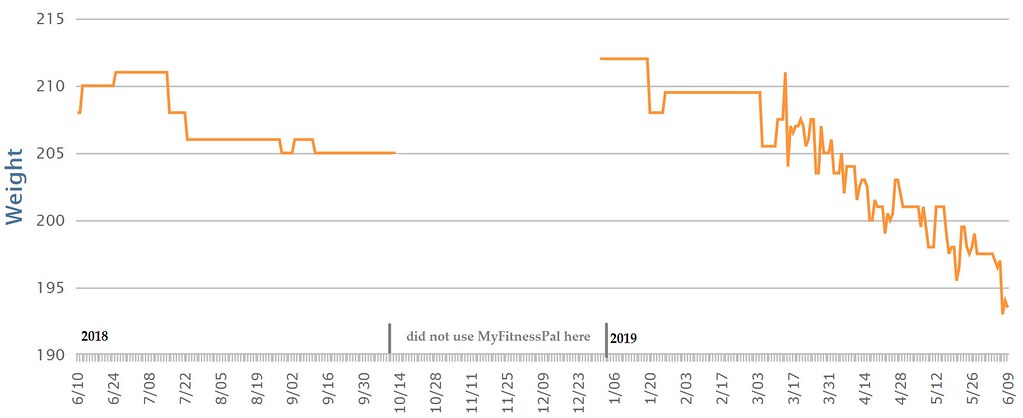
I asked myself this question exactly 6 months ago. I started using MyFitnessPal (a free app for tracking what you eat, drink and do). I did not have an answer to that question at the time, because I was not experiencing success. But since I am having success now, I want to tell you what I am doing that is working.
Full disclosure, I am a 38-year old woman with a BMI between 35 and 40. Although I was intaking 1700 calories per day, working out, and taking vitamins (micronutrients), I was not considering macronutrients. I did not imagine that balancing protein, carbs and fat would have any impact. After taking a break from MyFitnessPal tracking due to a software issue that did not allow me to log in, I restarted using it in the new year.
We got Fitbit watches about 10 months ago, which initially I thought was a great way of tracking steps without having to carry my phone everywhere. Previously I was using Google Fit, but after they changed their interface to this weird circle thing that I can't seem to understand, I kind of quit paying attention to it. The good thing is that you can sync these apps so that the data is shared among them. That way, you can visualize it in any of the apps.
I find it interesting seeing how Fitbit (Alta HR) tracks heart rate and sleep. What I really wanted was just a rechargeable watch. The battery life is really good, I only recharge it maybe once a week. Yet with MyFitnessPal, Fitbit and Google Fit together, I was not able to lose weight like I needed to.
We are on a project now to get pregnant. One of the pieces of advice given was to adjust the macronutrient intake to greater than 25% protein and less than 40% carbohydrates. I had never paid that much attention to "macros" but it seems to have helped my body shed fat. The way it was explained to me is that you log everything you are eating into the MyFitnessPal app and then, click on the diary. Add your foods, then click on the pie chart icon.
MyFitnessPal: Nutrition, Macros, Day View
If you have not had enough protein before dinner, be sure to have a protein-heavy meal as your last meal of the day. But definitely consider adding protein to EVERY meal otherwise it will be impossible to achieve this result. I was relying on my own inspiration and creativity for a brief time in mid-March. It was getting disgusting trying to eat a chicken breast and 5 hard-boiled eggs every day.
Then we got a book in the mail called The IVF Diet, but I also refer to it as the "Garden of Eden" diet. You are taking lots of nuts and berries. At first glance, it seemed too complicated. There were too many ingredients. But I think that is why it is working. It is a diverse array of foods, with an emphasis on lean protein, medium-chain triglycerides (MCTs), omega-3 fatty acids, and colorful fruits and vegetables.
The IVF Diet: Week 1 Shopping List
The first week, we went to Whole Foods and filled up 2 shopping carts. It cost $350 which we thought would be too expensive to continue. What we found is that each subsequent week got easier. Many of those items last for a month or longer. We actually lowered our monthly food spending since we are eating at home and not getting takeout.
I would say that this could be a diet for anyone. When my doctor told me to "eat healthy," I did not know what that meant. I was so frustrated and disappointed with my unsuccessful attempts to lose weight by caloric restriction and exercise alone. So if you are stuck at a weight that is unsatisfactory for you, maybe it is time to consider tracking your macros.
I aim to keep this post simple, but also to reflect on what I've done with my "summer off." I had a fear that if I turned down work, I would never be offered work again. This all-or-nothing type of thinking is not healthy. I also had a stigma associated with collecting unemployment. But this financial safety net has allowed me the freedom to buy and do things to make our lives better. This in turn makes us happier and better members of our community.
1) old mail = shred
I have a bad habit of letting mail pile up on our dining room table and then putting it in a bag and then putting that bag in the garage. I did this for years. Then I watched "hoarders" on netflix and got in gear. I started shredding this stuff by hand and then remembered that I could just as well take it to school. Plus side, I found some unused gift cards!
2) old papers = shred
I have a habit of keeping all student work and fearing throwing it out either because I thought I would forget what I've done in the classroom and also for reasons of confidentiality. Our mail services at CSUN has a program where you can request a trashcan for shredding and they do it for you. So I purged out so many old papers.
3) craft supplies = organized
I think it's every crafting diva's dream to have a 'craft room' where all the supplies are organized and accessible and projects can be started and stopped with ease. I can't say I have a 'craft room' but I do have a 'craft closet' and an oversized guest bedroom where I can do my papercrafts. Husband says no needles on carpeted floors, which I get, so the sewing machine is still in the garage.
4) bike supplies = organized
I'm sure it's also every gearhead's dream to have an organized garage where they can do maintenance and cleaning, to keep their equipment in tip top shape for the next adventure.
There's a funny store here in Northridge called "Mr. Stuff" and they have some really random inventory. One thing we bought there is this cart on wheels, which works really nicely for bike stuff. We've had it for 10 months now and I would say it is one of the best purchases I've made in the last year. It holds inner tubes, bike lights, helmets, locks, gloves, hats, bandannas, pumps, bags, all the things you need to grab and go. We built a bike rack to hold all our bikes and we have a bike stand to use when we need to clean or fix the bikes. These investments have lowered our stress and anxiety to make living a bikelife more enjoyable.
5) medicines = returned to pharmacy
I'm not sure if you have old prescription medications in you medicine cabinet, but I did. I had three bottles from 2008 and one from 2012. I knew that you can't flush them down the toilet because they can contaminate the municipal water supply or end up in the ocean, but I didn't know what was the best thing to do with them. Turns out Walgreen's pharmacies in California have a dropbox for this purpose. Not every location has one, so check online before you go.
6) electronics = recycled
We had two old cell phones, two old digital cameras, and a bunch of batteries that we dropped off at the Solvents/Automotive/Flammables/Electronics (S.A.F.E.) center. Now that I'm re-reading their flier, I should have also taken some old spray paint. Even though dear husband points out that landfills are sealed so that toxic wastes do not escape, I feel like this option may lead to reclaiming the trace amounts of rare earth elements that are present in our devices.
7) work office = organized, purged
This is an every semester thing, but it's important. I go through the stacks of chaos and rearrange important items into 3-ring binders. What paper can be recycled is put into a recycling bin. What paper must be shredded is sorted into the shredding bin. What supplies can be diverted into other chemical storage areas are moved from the office to the "Chem Club Room."
8) bedroom = new pillows & sheets
Not that this would bother everybody, but it bothered me. Our fitted sheets kept coming off the mattress. We had one set of cheap sheets, which didn't work at all. We went back to buy a more expensive set of sheets, which also didn't work but we tolerated them for over a year. Finally, I took those gift cards that I found going through the old mail and converted them into very expensive Martha Stewart sheets from Macy's. I also got new pillows. There are some things that you just can't buy used and I believe that pillows are one of those things.
9) home office = new bookshelf
There's a bookshelf that was in our garage when we moved in over a year ago. It's really nice and I always felt that it should be upstairs in the "library" a.k.a. guest bedroom a.k.a. craft room. But it was really heavy. Luckily, since we've been doing a new workout program, we're stronger. We finally carried that upstairs and it's just beckoning me to fill it with books.
10) computer = backed up
The cost of removable hard drives has come down so far. I got a new computer and used a removable hard drive to transfer files from the home computer to the new work computer. There's something satisfying about using a new, fast computer to search your old files.
11) bills = auto pay
It sounds so silly, but I've been paying bills each month manually over the phone. I finally got the monthly bills on autopay and it feels so great.
12) vitamins = restocked
I haven't been a big believer in vitamins, or maybe I should say that I go in phases. Anyhow, I threw all the expired vitamins out and bought new ones. Yeah, one could argue that calcium doesn't go bad like acetaminophen goes bad, but you never know what coatings and inert ingredients may do when left unattended or worse in hot storage units or in a hot garage.
13) contact lenses = restocked
I am not sure why I'm so averse to doctor's offices, maybe it's the cost or the fear of finding out there's something seriously wrong with me. I also don't like to face the idea that I should get new glasses (for me a $600 investment). But I finally found a new optometrist in our new neighborhood and got the exam to get the new 1-year inventory of contact lenses.
I should say that part of simplifying your life involves adulting. Tasks such as sorting out what your insurance covers like ob-gyn, dental and vision. We've delved into doing this and although scary and intimidating, it's important to know what you don't know (known unknowns and unknown unknowns). That way when you really need it (in an emergency) it's already sorted.
14) seeds = harvested
Not everyone has a garden, and I get that, but I do. I feel so great now that my seeds are sorted. I use old cosmetic bags to sort them into families, that way when I want to share seeds or plant something I don't have to dig through the entire library.
15) car = washed, oil changed, registered, insured
Living a bikelife tends to lead to neglecting our car. We only have one car and it's very tiny. I swear I haven't taken it to a car wash in like 5 years until recently. Also, it was important to establish a new relationship with a service station for oil changes. The DMV has a kiosk where you can pay your car registration, and now there's even one of those kiosks at the grocery store!
16) junk email = unsubscribed
This may sound like a silly thing, but instead of spending idle time deleting junk emails, I spent a few hours (while waiting for the oil change and at the optometrist) unsubscribing from all the email lists that I am on. I got this idea from my students years ago (before I got a smartphone) and I finally spent the time doing it. Now when I check my inbox, it's all stuff I actually want to look at.
17) podcasts = subscribed
I spent time (and energy) looking for stuff to listen to on long drives (where there is not good radio reception) and now I'm on the podcast bandwagon. I downloaded an app called Castbox which automatically downloads podcasts I've subscribed to so that I can listen to them offline. I also want to say that Hoopla has changed my life. I listen to audiobooks there, which can also be downloaded.
18) laundry = washed
I love my laundry situation now. I finally got around to cleaning the washer and dryer (which used to live outside) and I bought more laundry soap. There's a luxury that I don't take for granted in having W/D hookups and the space for my drying racks. I have a fabulous clothing rack on wheels that is so easy to move around the garage. And hot days are perfect for drying laundry.
19) closet = sorted, purged, updated
What I have done in my closet is simplify, label and keep lean. Labeling all my drawers and bins helps dear husband contribute to putting away his and hers laundry.
20) bathroom = cleaned, purged, organized
Finally, cleaning the bathroom involved throwing away old lotions and cosmetics that are expired. See also 5, 12 and 13. It was fun going to the drugstore to get new contact lens solution and sunscreen and vitamins knowing there are empty spaces which they can go to. I read that one of the reasons people don't like dockless bikeshare in cities is because the bike seem like they are never "put away." Now I didn't grow up in a house where things got put away, we had quite a cluttered upbringing, and some say that clutter is a symptom of creativity, but also I've read that when things are put away it brings a sense of calm and peace. I like the sound of that.
Let's say you are dorkin' out on your fitness tracking. Or maybe the technology you have isn't helping you stay fit. That's what happened to me. I still use the GoPro Hero4 but not as much as I did when we first got it (3 years ago).
I really enjoyed my Nike+ sport band for tracking runs (9 years ago). That is when I actually went for runs. Its limitation was that it was limited to step counting. Then dear husband bought me a Garmin Forerunner (7 years ago), which could track both runs and bike rides. Its limitation was that over time the plastic band got worn down so that I had to safety pin it to my handlebars, and during one bike ride (2 years ago) it fell off. Shortly thereafter, we upgraded our phones and I started using apps to track fitness.
We had the Samsung Galaxy S7 for two years and have now upgraded to Samsung Galaxy S9. We didn't get the S9+ because it was even bigger. Honestly, your technology is only as good as it is useful. The phone is powerful but kind of large and definitely doesn't fit into most of our bike bags. My sister-in-law bought me a product called buddy pouch, but the phone is so heavy I feel like it will pull my yoga pants down if I tried to run with it.
I'm actually enjoying the REI Co-op Trail 2 Waistpack quite a bit more. The waistband is sufficiently wide and doesn't cut into my skin, it's long enough to fit my circumference. I can fit my phone, wallet, keys and poop bags for dog walks in there. I have also stuffed a light jacket or pants extenders if I have to. It's not really large enough for a water bottle, so I carry that in my hand. I wear it rollerskating ALL THE TIME.
We purchased a Lenovo ThinkCentre M72e Tiny Desktop with Intel i3-3220 CPU @ 3.30GHz and 8.00 GB RAM running Windows 10 Home 64 bit with 2 TB hard-disk space and LG 24M38H-B Monitor (1920 x 1080 resolution) from Fry’s. It makes my home computer (5 years old) seem clunky. I'm sure it doesn't help that the 5 year old computer is completely full of GoPro footage and other photos that should probably be uploaded to the cloud. One good thing about the new computer is that I edit video using Camtasia. I screen-capture video directly OR use the webcam on my AsusT100 OR use my Samsung S9 phone.
I used to use my teeny mp3 player, Sansa Clip (6 years old) to record audio files, but now that's completely unnecessary. From my phone, I can record audio and get a transcript, then email those files to myself and I don't even need a cable to transfer it. I bought the Sansa Clip to use with my Smart Car audio (there's a USB input in the glovebox) but the car doesn't recognize it. I haven't tried to interface the Samsung S9 with the car yet, maybe I'll try that soon.
Strangely enough, the car will recognize my super-old SanDisk mp3 player which sadly only holds 128kB of data (14 years old). In case you're wondering, that's like 2 albums of music or 12 podcasts nowadays. It's so passe to download files now anyway, most people use streaming services like Spotify to get their music. I have an older Pandora account (8 years old) that I still use when I really need to buckle down and get something done that does not require writing, such as housework. I do use the Pandora app on my phone for stair-climbing workouts.
I bought this handlebar bag to hold the phone on bike rides (2 years old) and one of the two zippers recently broke. The thing I like about it is that it can be worn as a purse or fanny pack, which is definitely something I looked for. When you lock your bike and walk away, it's convenient to take your valuables with you. I also detach the GoPro from my handlebars and slip it in here. I liked that it has some reflective detailing and there are mesh pockets on the outside for holding used Kleenex or sticky Clif bar wrappers. It's a great size for holding sunscreen, snacks, sunglasses, wallet, keys, phone and it is large enough for a 500mL water bottle. One drawback, besides the cheap zipper, is that when you have the bag facing you, the sun reflects off the plastic and can be blinding. I am considering making a fabric cover for the plastic part. Also, when you try to run Strava or Google Maps during your ride and the sun is shining, the phone will overheat and shut off. When the phone is inside the bag, this doesn't happen, but it's not always handy for navigating when you want to see the map on your phone as you ride. I have used the plastic window for a printed routeslip, so if you don't mind using old fashioned paper, this bag is great. On some bikes I Velcro the bag to the handlebars on the same side as the top tube and on other bikes I do it the other way. It depends on how close your knees are to the handlebars and your body position when climbing hills. It was originally designed for a folding bike.
One last item I'm obsessed with is the BESKYDDA safety vest from IKEA. When you don't need it, the vest folds up into its own pocket making a cute little sachet. When unfolded, you can put your phone in the pocket with the speaker facing out and let the Google Maps tell you where to turn. As long as you don't need to look at the map and the traffic isn't too loud, this works great. I'm not a fan of using headphones while walking, biking, cycling or rollerskating. I am a big fan of wearing safety yellow and reflectors.
The data will be in a zip folder, which you need to unzip. Then look in the following directory: Takeout\Fit\Daily Aggregations\Daily Summaries
After that, you can delete any rows/columns that aren't useful to you. The default units are meters and milliseconds for distance and time, which I thought was kind of strange.
I used Strava and Google Photos to remember what some of those workouts were, unfortunately Google Fit doesn't automatically create any kind of description of what you did. Also, you have to manually log things like our Commit To Be Fit (CTBF) program. I guess that would be one advantage to going back to a watch-based activity tracker. What do you use and what are the benefits and limitations?
Adapting to the drought was difficult, since I have a desire to grow edible fruits and vegetables in my (front and) backyard. I picked up mainly succlents and cacti in 2016. But then we got to the start of 2017, which turned out to be the sixteenth wettest stretch in Southern California since World War II.
Take for example, this container I planted several years in a row with California and New Mexico native wildflowers. This year, a spray of Lasthenia californica (common name: goldfields) & Eschscholzia californica (common name: golden poppy) appeared. The photo above was taken on March 31, two weeks after settling in our new location in Northridge, CA.
The container garden made the move with us, and all the plants have survived relocation. Many of my succulents are flowering, Graptopetalum paraguayense (common name: Ghost plant) has pretty grey leaves with a pinkish cast and a delicate little flowers on an extended stem. You can see a bit of Senecio mandraliscae (common name: Blue chalk sticks) below.
I love the chocolatey color of Echeveria compressicaulis leaves and it looks like it's putting out an impressive raceme. I can't wait to see how the flowers look when they open. It is framed in this photo by Crassula tetragona (left), Crassula argentea (right), Sedum pachyphyllum (upper right), and Portulacaria afra (above).
I love how this photo makes it look like the perimeter of each leaf is hand-stitched. This is Crassula pellucida subsp. marginalis 'Variegata' (nickname: Calico Kitten). If that's not one of the sweetest things you've ever seen, I don't know what's wrong with you. You get just a glimpse of Graptopetalum paraguayense to the left.
The beauty above started flowering before we moved. Sedum clavatum is comprised of frosty blue-green rosettes named for 'clava' meaning "club" for the baseball shape of the sepals. The complexity of these tiny flowers is mesmerizing. A compact inflorescence of many white star-shaped flowers appears in spring to early summer that take a pink hue with age.
I always know the end of the school year is near when I see my Echinopsis chamaecereus (common name: peanut cactus) flowering (see prev. post). You can also see a handy pollinator. I've already had good luck with harvesting seeds, so I know the winged creatures are doing good work. We've also seen many of the crane fly this season, but they are not attributed with much pollination work.
I love the more squat Rebutia krainziana and its bold orange flower. I've been reading about the sacral chakra and the mantras associated with it: I am inspired.I am creative.I am joyful.I am in control.I am unique.I am special.I Feel. RIP to my Opuntia basilaris and Gymnocalycium mihanovichii. One got too much water and I'm not sure what happened to the other, but they're both shriveled up and dead now.
Last but not least, I will leave you with a flower of Capsicum annuum. Three out of the seven pepper plants I had last year survived the winter. However, I won't really know which is which until they produce fruit! The tomato (Solanum lycopersicum) 'Cosmic Eclipse' is still producing as well. I don't know how they'll fare in the heat of the summer, but I'll enjoy them for as long as they live.
Have you ever considered taking a vacation without a car? Yes, I mean without a car. No rental car when you arrive at a destination. Oh My Goodness!! Yep. If you are not a seasoned cyclist who engages in these types of trips, then the following sites might be of interest to you. We are not seasoned cyclists -- although, we are becoming seasoned cyclists. Did this happen over night? No. Have we tried various trips and learned different lessons on each. Yes.
Engaging in a bicycle adventure trip is easy. First, you have to make up your mind that you are going to try to go on one. Second, decide where you would like to travel to. Some bloggers suggest going on an overnight trip to a local hotel near your house on your bicycles with a couple of panniers to start out with. This is one strategy.
Another strategy is to decide to go further. If you decide to do this, the learning curve is steeper. But you adjust very quickly -- which is a good thing. We started by taking trips down to the beach near family (around 60 miles away) and staying in a hotel. This trip was simple in that the whole trip involved a bicycle and a hotel (easy to plan).
Next, we extended this toward taking the train which we ride daily to the beach to camp last year. You can read about that experience in the following blog post -- written by Mike. Adding a train component to a bicycle vacation is not difficult. But remember, the train usually has limited times of departure and arrival. Be sure to consider these schedules while planning a vacation departure or arrival time and date.
Recently (as in last week), we took a bicycle trip up north to Grover Beach and stayed in a hotel. The bicycles served the purpose of a rental car. We were able to explore the town car-free and stress free with a bicycle. Part of the journey is the bicycle trip. Most of the time on vacation, people are trying to get to a destination to enjoy the destination (such as a beach). When riding a bicycle to a destination, the journey is part of the enjoyment of the destination. With all of this being said, you might be wondering what to pack for such a trip.
If you are considering a car-free vacation, you may find the following links to our previous trips useful. Each contains suggestions for packing.
We hope that you enjoy reading the above sites packed with the lessons that we have learned evolving over time while learning how to bicycle adventure. The photos below are of the recent trip to Grover Beach which we just returned from. Additionally, we hope to see you out on the road on a bicycle vacation. Have a great day!
Day 1: Waiting for the Amtrak
Day 1: On Board the Amtrak
Day 2: View from our Hotel Balcony
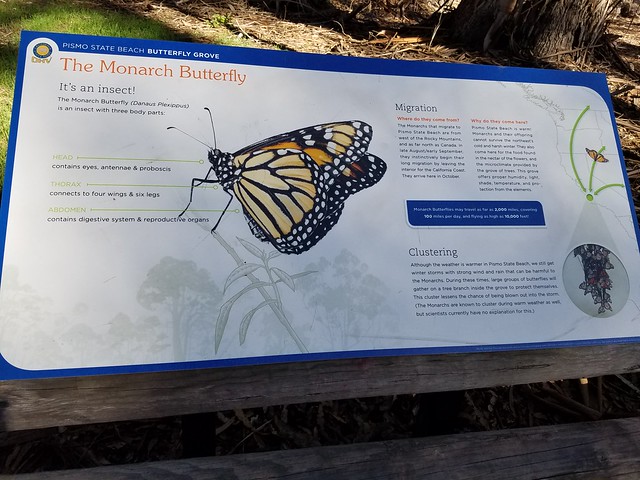
Day 2: Monarch Butterfly Grove (FREE)
Day 3: Bike Ride to Avila Beach (FREE)
Day 3: Bicycle Parking in Hotel Room (FREE)
Day 4: Tour of the Mission San Luis Obispo de Tolosa (FREE)
Day 4: Riding San Luis Obispo County Transit ($5 Day Pass)
After exploring (by listing) all of the ingredients in the last blog post for the skin care product made by Jergens -- "Jergens Skin Firming Lotion," I promised to address the ingredients more "in detail" and provide a greater insight into the toxicity associated with them. The task has proven to more difficult than I initially thought to it would be. No Worries -- Not to say insurmountable.
In the last post, I listed all 29 ingredients of the lotion. As I look over the list of functions which I listed from the website "EWG" -- I see many terms which can be further defined under the category "Function" of the ingredient. Therefore, I will start by composing a small glossary of terms like "Skin Conditioning Agent" or "Emollient" in the next post. This will assist us in future posts on "anti-aging" skin care products. Additionally, this glossary will help with other skin care products by providing better insight into the actual function. After I publish the glossary, we will pick back up with the previous blog post on "Jergens Skin Firming Lotion."
For those readers just joining us, the blog post is part of the ongoing skin series on anti-aging stemming from the initial blog post which can be found here. The series is titled "Anti-aging Skin Series." By clicking on the hyperlinked text, past blog posts can be found.
With that in mind, I will return to composing the glossary from which we can explore other products in the future in greater detail. If you (the reader) have any preferences on the layout of the information which would clarify the subject matter in any light, please leave a comment below. I am always open to suggestion. Part of the issue at hand currently, is that I am approaching the subject from a chemist's standpoint and want to deconstruct the ingredients in the easiest way possible for everyone to understand.
The last post in the "Anti-Aging Skin Series" was tying up loose ends regarding the "function of skin". In order to proceed to evaluate the effectiveness of a given anti-aging skin care product, we have to be able to validate the product first. A given product will have claims associated with it that provide clarity as to the treatment on your skin. Further, the ingredient list will provide the evidence that chemists can use to validate the claims. Above all, to begin with, we must distinguish between a cosmetic product and other products. What are the "other products"? The other products are those whose claims fall outside the range of cosmetics. Usually, these have to have approval by various agencies such as the "Food and Drug Administration."
Usual Disclaimer:
For some readers the material might be too elementary ( or too much detail). I would challenge you to think deeply about the simplicity of the descriptions and also I will include links for you too (on the side with greater detail).
Overall Effect/Aim Of A Cosmetic Product
The overall aim of a cosmetic product is to provide the following:
1) Sense of effect
2) Desired effect
3) Manufacturer's claimed effect
After reading the above three effects you might be somewhat confused. The following question might emerge as a result:
Why are all three not the same or a combined effect?
The reason lies within the claim of the product. If I (a scientist) were to use a product with a claim, I would be looking to validate the claim. Evidently, according to the "Chemist's Corner" that is only part of the achieved mission. Why? The most important statement from a cosmetic chemist is the following:
If the product does not make the person feel better, then the product designers of the product have failed.
Really?
Yes. Even if the product fulfills the claim listed on the container (marketed as) and validated by the ingredients list?
Alternatively, the cosmetic industry understands this and can extend the claims (in fraudulent cases) in order to achieve the overall goal: satisfy the customer. Once a customer is satisfied, then the message spreads about the success of the product and sales increase as a result. Meanwhile, harm done to consumer propagates without understanding the nature of the fraudulent claim causing alarm. There are regulatory procedures for a cosmetic product. In the section below, the differences between a cosmetic product and a drug are highlighted.
What Is A Cosmetic Product?
To answer the question in the simplest terms, lets consult 'Wikipedia' for a definition of 'Cosmetics'. An excerpt is shown below taken from the page:
Cosmetics, also known as make-up, are substances or products used to enhance the appearance or fragrance of the body. Many cosmetics are designed for use on the face and hair. In the 21st century, women generally use more cosmetics than men. They are generally mixtures of chemical compounds; some being derived from natural sources (such as coconut oil), and some being synthetics.[1] Common cosmetics include lipstick, mascara, eye shadow, foundation, rouge, skin cleansers and skin lotions, shampoo, hairstyling products (gel, hair spray, etc.), perfume, and cologne.
In the U.S., the Food and Drug Administration (FDA), which regulates cosmetics,[2] defines cosmetics as "intended to be applied to the human body for cleansing, beautifying, promoting attractiveness, or altering the appearance without affecting the body's structure or functions". This broad definition includes any material intended for use as a component of a cosmetic product. The FDA specifically excludes soap from this category.[3]
Relatively simple right?
Depending on who you ask, the definition can vary slightly or to a large extent. A cosmetic product is a mixture of compounds. Further, the "active ingredient" involved in the product is not necessarily correctly indicated on the label of the product. Why do I mention this last statement?
Further, the FDA definition of a cosmetic product as indicated in the excerpt above specifies that the product CANNOT change the body's structure or functions. That is extremely important to understand about skin care products. Why? Because, the claim may be specifying a change that falls into the category. Can I point out an example of this? Yes!
In the very first blog post which motivated the "Anti-Aging Skin Series," an excerpt was presented by Dr. Zoe Draelos regarding the efficacy and mode of action for "glycan skin care creams":
Dr. Draelos said the goal of glycan creams is to provide sugars or transform existing sugars to allow older cells to behave like younger cells. In theory, this would allow the skin to produce more collagen and heal better after injuries, including burns and cuts. Dr. Draelos notes one added benefit of glycan creams is that they are considered safe to apply to the skin because sugars are the body’s fuel.
However, Dr. Draelos notes current research has not shown if glycan creams can impact the skin to the extent that skin cell glycans begin to act more youthful. “The theory behind glycans’ impact on anti-aging is very much in its infancy,” said Dr. Draelos. “Currently there are other more proven treatments on the market, such as retinoids, but new research will provide additional targets for anti-aging strategies.”
You will recall that in the first part of the excerpt, Dr. Zoe Draelos describes the loss of glycans as a natural part of aging. For the moment, a glycan is the intermediate (attached to the outside of the cell) toward making collagen. As we age, the glycan levels vary and this reduction is thought to be responsible for the loss or reduction in collagen production.
Here is where a skin care product manufacturer might run into difficulty with product claims. If the manufacturer states that the product enhances the production of collagen, then the product is not a "cosmetic product" and would be classified as a "drug" with different regulatory procedures to jump through to get to market.
Take home message?
The clear distinction between a cosmetic product and a drug is necessary for each of us (as consumers) to understand when seeking to purchase a product for an intended purpose. Here are two excerpts taken from the "Food and Drug Administration's" website regarding the distinction. First, the strict definitions of both a "drug" and a "cosmetic product" are shown below:
How does the law define a cosmetic?
The Federal Food, Drug, and Cosmetic Act (FD&C Act) defines cosmetics by their intended use, as "articles intended to be rubbed, poured, sprinkled, or sprayed on, introduced into, or otherwise applied to the human body...for cleansing, beautifying, promoting attractiveness, or altering the appearance" [FD&C Act, sec. 201(i)]. Among the products included in this definition are skin moisturizers, perfumes, lipsticks, fingernail polishes, eye and facial makeup preparations, cleansing shampoos, permanent waves, hair colors, and deodorants, as well as any substance intended for use as a component of a cosmetic product.
How does the law define a drug?
The FD&C Act defines drugs, in part, by their intended use, as "articles intended for use in the diagnosis, cure, mitigation, treatment, or prevention of disease" and "articles (other than food) intended to affect the structure or any function of the body of man or other animals" [FD&C Act, sec. 201(g)(1)].
Furthermore, it is important to understand that both a "drug" and a "cosmetic product" have completely different "approval" routes. Here is another excerpt taken from the FDA website regarding the approval routes for the two types of products:
How approval requirements are different ?
Under the FD&C Act, cosmetic products and ingredients, with the exception of color additives, do not require FDA approval before they go on the market. Drugs, however, must generally either receive premarket approval by FDA through the New Drug Application (NDA) process or conform to a "monograph" for a particular drug category, as established by FDA's Over-the-Counter (OTC) Drug Review. These monographs specify conditions whereby OTC drug ingredients are generally recognized as safe and effective, and not misbranded. Certain OTC drugs may remain on the market without an NDA approval until a monograph for its class of drugs is finalized as a regulation. However, once FDA has made a final determination on the status of an OTC drug category, such products must either be the subject of an approved NDA [FD&C Act, sec. 505(a) and (b)], or comply with the appropriate monograph for an OTC drug. (A note on the term "new drug": Despite the word "new," a "new drug" may have been in use for many years. If a product is intended for use as a drug, it must comply with the requirements outlined above.)
Having the knowledge above will allow you as a consumer to understand the various claims of the cosmetic product's manufacturer. Further, the information above allows you to ask knowledgeable questions as a consumer into the efficacy and justifiable claims made. And last but not least, you can now help the rest of the world by reporting false claims to the FDA to have the products removed from the market. Especially, if a given product is causing consumers harm.
Conclusion ...
Over the course of writing the initial blog post which was lengthy, I have now come to realize that the skin care product business is varied in the amount of information presented on the back of each product container. This will become apparent to the reader (you) in the weeks to come as we continue the series in investigating "anti-aging" products. Additionally, I am surprised that consumers have so much trust in the cosmetic product market. When all is said and done, at the end of the day, the consumer is both the market and the safety advocate.
What do I mean by this?
The cosmetic market is run by years of highly successful consumers passing on opinions regarding various products. These opinions have been unmatched by scientific safety information. Only after a problem is reported does a product get scrutinized. Yes, certain ingredients have been approved to incorporate into cosmetic products. Therein lies the large range in which these companies have to operate and market in.
As we move forward, examples will be shown of "anti-aging" products and the ingredients/claims will be further investigated. I look forward to having the reader provide input where necessary (or interested) to enhance the quality of the material presented.
A little over a week ago, I wrote the first part of the "Skin -- Function" in the continuing series: "Anti-Aging Skin Series." In that post, I briefly introduced the top layer of skin -- the Epidermis. Generally speaking, there are two main layers of interest to designers of cosmetic formulations and skin care products -- the top two: Epidermis and Dermis. The last post was concerned with the Epidermis since this layer is made up of 5 critical layers (each with a specific function).
In the interest of Kayla's advice of breaking down the initial blog post on "Anti-Aging," I chose to divide up that last post into two parts. This post will be the second part of the function of skin concerned with the deeper layer below the Epidermis -- the Dermis. Without further delay, lets explore the Dermis in regards to the function that it plays in the overall purpose of skin.
Usual Disclaimer:
For some readers the material might be too elementary ( or too much detail). I would challenge you to think deeply about the simplicity of the descriptions and also I will include links for you too (on the side with greater detail).
How Important Is The Dermis?
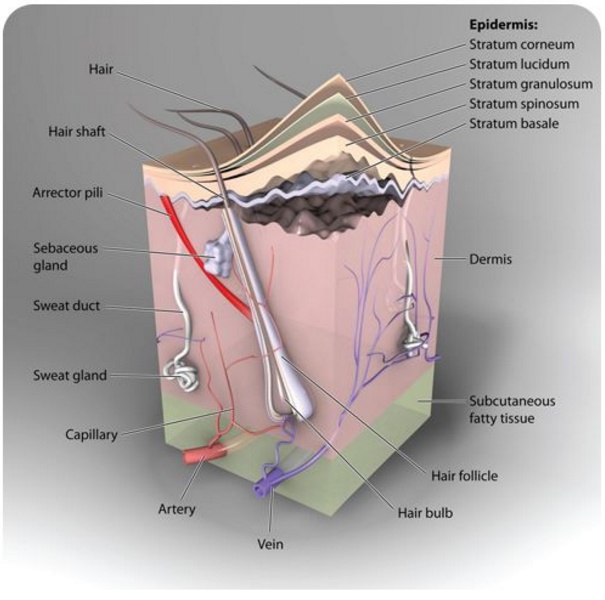
I decided to start off this part with the question of "How Important Is The Dermis?" Why? In order to answer these questions, lets revisit the diagram of the structure of human skin. A diagram of the structure of human skin taken from a book authored by Dr. Zoe Draelos and Dr. Peter Pugliese titled "Physiology of the Skin" is shown below:
As you can see the top few layers of the skin make up the epidermis and were discussed in the previous post. From the diagram above, the first assumption of the function of the dermis in relation to the entire "skin" as an organ might be to serve the epidermis. In the last post, we learned that the epidermis is not static and is quite dynamic (evolving over time). Since there is no vascular layer in the epidermis, a supply of some sorts needs to come from somewhere. Where is that "somewhere"? The dermis layer of the human skin organ.
What are some of the other functions of the dermis layer?
If "Wikipedia" is consulted to answer the question above, here is the response in the form of an excerpt:
The dermis is a layer of skin between the epidermis (with which it makes up the cutis) and subcutaneous tissues, that primarily consists of dense irregular connective tissue and cushions the body from stress and strain. It is divided into two layers, the superficial area adjacent to the epidermis called the papillary region and a deep thicker area known as the reticular dermis.[1] The dermis is tightly connected to the epidermis through a basement membrane. Structural components of the dermis are collagen, elastic fibers, and extrafibrillar matrix.[2] It also contains mechanoreceptors that provide the sense of touch and thermoreceptors that provide the sense of heat. In addition, hair follicles, sweat glands, sebaceous glands, apocrine glands, lymphatic vessels and blood vessels are present in the dermis. Those blood vessels provide nourishment and waste removal for both dermal and epidermal cells.
The dermis appears to play a large role in the production of skin. Stem cells start forming here and move up into the Epidermis to proceed further into the five layers -- which were discussed in the previous post. Above all else, the dermis plays a critical role in thermal regulation. Controlling the body temperature along with providing the sense of touch, reaction to heat, and housing the glands to secrete toxins makes the dermis layer critical to having healthy skin.
Upon inspection of the dermis layer in the diagram above, the layer appears to be quite heterogenous. Heterogenous means that there are multiple components that make up the dermis -- which have many different functions -- such as those highlighted in the excerpt above. In order to control the body temperature, the ability to sweat is critical. Sweating is the main avenue toward "cooling down" the body. Along with the hair follicles and blood vessels are sweat glands.
How many sweat glands are needed across our entire body?
In a previous post that I wrote on my personal (Mike Thinks) site, the number was set at around 2.5 million strategically spread throughout the human body surface. These sweat glands are mixed with a system of blood vessels that differ in size and range in function -- from providing oxygen to the epidermis (lower layers) to providing oxygen and nutrients to the dermis. Remember, the dermis makes up around 90% of the skin (three layers: Subcutaneous, Dermis, and Epidermis). The temperature control and shock/strain control are a major function.
How Does The Dermis Produce Healthy Skin?
In the previous post on the epidermis, the outermost layer of the skin was essentially the "defining layer" toward the appearance of healthy skin. Although, there are five layers of the epidermis that are continuously changing. Over the course of two months, stem cells formed in the dermis layer move up through the epidermis and go through the following processes. As the layers move toward the surface, the cells start to die out and flatten out.
At the same time, the body produces a "glue" called the "natural moisturizing factor" to hold the flattened out 'corneocytes' together. This layer of the epidermis is responsible for holding in water and helping to regulate the body temperature. At this point, you may be wondering the following question:
Why are you talking about the epidermis when the post is about the dermis layer of the human skin?
The reason is because the dermis and epidermis work in synchronization with one another. Collagen, the "cushy" part of the skin -- giving skin the volume or body is produced in the dermis and then moves into the epidermis -- which ultimately flatten out.
As people age, their skin tends to lose collagen. Additionally, as the "natural moisturizer factor" is depleted over time and not replenished by our body, then the skin tends to dry out and become irritable and flaky. Other descriptions include "crepey" skin. This is where the importance of using skin conditioners -- moisturizing factors become important. That is one way of keeping healthy skin along with not smoking, drinking enough water, and staying out of the sun.
Do not fall for the scams!!
Now that you have knowledge of the process by which skin is produced, try not to fall for any scams. For instance, if a cosmetic product has a "promise" or "claim" written on the bottle that the formulation contains "chemicals" or "ingredients" that will replenish the "collagen" in your skin -- do not fall for the scam. The only way to produce more collagen is the genetically enhance the production. If that were possible, the cosmetic product would still fall out of the reach of the skin care business -- and would need to be FDA (Food and Drug Association) regulated. The product would have to be treated like a pharmaceutical product. Be careful what you believe in a product's claim.
Conclusion...
Over the past three blogs, I have introduced the structure and function of the human skin. Along the way, I have raised questions which should remind you (the reader) to be wary of the claims on a given cosmetic products brand. At the same time, when a cosmetic product is being used to enhance the appearance of your skin, be sure not to interfere with the skin's natural progression (of producing new skin) to shed old skin. Any good cosmetic product should enhance the appearance of your skin while allowing the skin to regulate body temperature and feel wonderful touches.
Remember as we traverse the landscape of anti-aging claims and products that above all, your opinion is most important. Looking back on questions such as: "What does healthy skin look like for me?" -- are critical to consider when deciding which cosmetic product is right for you. Alternatively, do not forget that the human skin is a living organ. Despite the corneocytes that have died and flattened, there is a whole other layer -- dermis to consider with the vast networks of blood vessels and sweat glands along with the nerves to consider. Quite possibly, a cosmetic product could damage the 'dynamic' nature of the skin or process. Normally, cosmetic chemists aspire to achieve the correct formulation for a given result. But each of us should be wary of the method by which the result is achieved.
A couple of weeks ago, I wrote a short little blog post introducing the "structure of skin" in the first blog post on the "Anti-Aging Skin Series" which is a break down of a long post titled "Can Science Really Reverse Aging Skin?". With the basics of the "structure of skin" in hand, the next obvious blog post should be on the "function of skin." Why - you might ask? Well, as with most scientific advances, "structure" and "function" are the critical components of any new scientific advancement. Many consumer products make wild claims. Additionally, many consumer products claim to "possess" ingredients (chemicals) which will perform (in a certain way) or heal specific diseases. With regard to chemistry and chemicals found in consumer products, understanding the "function" of a chemical based on the "chemical structure" is critical to understanding any benefit or disadvantage.
Usual Disclaimer:
For some readers the material might be too elementary ( or too much detail). I would challenge you to think deeply about the simplicity of the descriptions and also I will include links for you too (on the side with greater detail).
With this in mind, lets explore the "function of the skin." To understand the function each macroscopic layer plays, the easiest way is to start from the outside and work our way down - inside. I use the term "macroscopic" to emphasize that the cellular picture is too specific for the discussion and will be referred to when needed. The outermost layer of the skin is referred to as the "Epidermis." If we continue down inside the organ (skin), the next two layers would be: Dermis, Hypodermis. Since the purpose of the "Anti-Aging Skin Series" is to break down a long post into edible bites, I think in the current post, introducing the function of the Epidermis will be more than enough for one reading. Enjoy!
What is the function of the Epidermis?
A diagram of the structure of human skin taken from a book authored by Dr. Zoe Draelos and Dr. Peter Pugliese titled "Physiology of the Skin" is shown below:
In the first chapter of the book, the content is captured appropriately by the title of the chapter -- "Behavior of Normal Healthy Skin." Of the three types of skin mentioned in the introductory post about skin (access here), the two types of skin that are relevant to the cosmetic industry are the outer two layers: epidermis and dermis.
I am a big believer in not "reinventing the wheel" -- meaning, I like to cite other authors work and use their explanations when better understood than mine. From the first chapter of the book, here is a description of the epidermis that captures the function in a simple but complex manner:
The epidermis is the outer skin layer that forms a outer barrier to the outer world. This barrier keeps out water, sunlight, insects, germs, heat and cold, dirt and gases. It keeps in fluids such as water and blood, and holds safe minerals, vitamins, hormones, proteins and heat. An incredible self-renewing system, the epidermis provides replacement of the outer cells lost to the environment. It provides a water proof outer layer, yet permits internal water to carry nutrients to the outermost living cells. It provides a tough outer layer to resist friction, abrasion and pressure, yet is sensitive to the lightest touch or softest breeze. Less glamorous, but equally as important, the skin serves as a vast waste disposal system, ridding the body of many toxic substances.
I had to read that excerpt a few times before comprehending the entire range of the skin. Remember when your older sister or brother use to grab onto your arm skin and twist it -- to cause a sudden escalation of pain along with the outcry...."stop that you bully..." Well, I had my fair share with dispensing a few to my younger brother. Yet, at the time, the last idea running through my head was the dynamic range of the skin.
To be able to withstand abrasion, yet feel the softest breeze. The body is amazing. From the diagram above, a person would never have been able to ascertain the many functions that the outer layer of skin provided. At least, I would not have been able to (I cannot speak for anyone else).
Here is a short -- 2 minute video worth watching to give you a basic idea about the epidermis that was taken from the website "Chemist's Corner" titled "What Is Skin For?" shown below. I highly recommend viewing the short video before reading further into the blog post:
The producers did a great job of listing the relevant steps in the process of producing the various layers of the epidermis. If I had just started with the weird names such as "stratum corneum" you might have been asleep already, right?
The Epidermis can be split up into five layers which are of importance. Especially, when formulating a product. The outermost layer of the epidermis is the "stratum corneum" and for functional purposes is the hardest. Keeping foreign invaders out is just one purpose along with the many others listed in the excerpt above. The four layers underneath the stratum corneum serve to different steps in production of the outermost layer -- as you will see shortly. The video above illustrates the point just made that the bottom few layers manufacture the final outer layer of skin. Lets take a look at the stratum corneum below.
Function of the Stratum Corneum
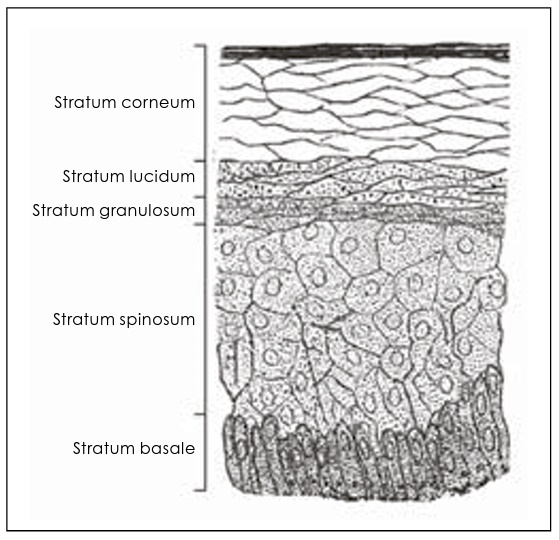
As I just mentioned, the stratum corneum is fueled by the layers underneath. Below is a brief breakdown of the layers along with an excerpt to clarify a few key terms which will help us understand anti-aging products claims and effects in later blogs. Further, at times, the Stratum Corneum will be referred to in abbreviated form -- "SC". Here is a diagram of the Stratum Corneum taken from the book above -- "Physiology of the Skin" shown below:
Working our way to the top from the bottom, a few points about each layer should be understood by a cosmetic chemist or a consumer. There are many claims that originate out of the "marketing" or "Public Relations" departments in product lines that have no or very little scientific basis. After reading about the various layers, as a consumer, you might have a different perspective toward your next purchase.
Without further ado, starting with the Stratum Basale:
Cells known as keratinocytes start forming in the stratum basale layer. Additionally, another type of cell of importance is made here -- melanocytes which produce the chemical pigment melanin. Melanin is devoted to skin color but also contributes as a defense mechanism again harmful UV rays.
An important note about the various layers of the epidermis is that there is an upward movement of the layers. Think of a reptile like a snake which over time will shed it's skin or the teeth of a shark which produce a new set every weeks. Similarly, the keratinocytes and melanocytes that are made in the basale layer will eventually make their way up to the outer stratum corneum layer.
Note: But first, on their way, transformations will occur. These transformations will be a change of polarity in the proteins itself, death (cells will flatten out and dry out/die), and production of natural moisturizer factor. That is to say, cells that arise in the basale layer will eventually die when they reach the stratum corneum.
Next, the Stratum Spinosum:
In the stratum spinosum, the keratin cells start becoming "spiny" -- which is to say, their shape starts to change. Lipid production has already occurred in the previous layer, therefore, the lipids are very similar in structure. This layer is referred to as "early differentiation."
The "Zone of Transition" -- Stratum Granulosum:
In the "zone of transition," many changes are starting to occur. There is the keratin proteins have started to fill the cells completely. Earlier, in the stratum spinosum, lipids were 'static' (i.e. not changing). That is not the case in the stratum granulosum. Along the way, the production of various macromolecules have started to take place. In this phase, sterol production is increased along with glycolipids, and cholesterol sulfate. The SC is now close to formation.
Finally, the Stratum Corneum:
In the last layer -- the layer closest to the environment (the outside world), the keratinocytes have lost enzyme function and are doomed to flatten out into their final shape. The cell has lost most of the function -- except that the new function is to be flat and hard -- to serve as a barrier toward to outside world. As the cells (keratin protein filled) harden the matrix forms of "flattened cells" -- called corneocytes.
The matrix of corneocytes have intercorneocyte layers. Intermixed in the layers are lamellar bodies. These bodies serve an important purpose. The secretion of vital chemicals (such as free sterols, sphingolipids, and other compounds like glycoproteins). Combined, this chemical matrix permits both hydrophilic and hydrophobic materials to pass through the intercorneocyte space. The matrix serves as a "guard" agains foreign invaders.
Overall, the layers of the underlying skin have produced the critical components for the formation of the stratum corneum. Here is another excerpt that might help clarify the complex stratum corneum from the book:
Keratin is the protein that makes up the bulk of the SC. Keratin is a helical, or coil-shaped fibrous protein made up of a series of building blocks, known as polypeptides. These polypeptides are, in turn, made up of the most basic substances, known as amino acids. Amino acids are arranged in a variety of orders to form chains of polypeptides, which are then twisted around each other to form proteins. These polypeptides vary in different parts of the body so that the skin protein is not homogeneous, but rather heterogeneous. The protein is resistant to water and many chemicals. It is this complex structure that provides part of the protection from the outside. Manufacturing proteins is one of the major functions of the skin.
These keratin proteins are formed and arranged into cells known as corneocytes that are held together with fats, known as lipids. The SC can be thought of as a brick wall, with the protein-rich corneocytes forming the bricks and the lipids functioning as the glue. It is this brick wall that provides the barrier necessary for the beauty and health of the body.
The lipids that keep the proteins glued in place in the SC are water-insoluble, oily substances. They can be classified by their electrical charge and by their structure. The two major groups of lipids are polar lipids and nonpolar lipids. Polar lipids have an electrical charge. Examples of this type of lipid are phospholipids, glycolipids and cholesterol. Non-polar lipids have no electrical charge. Tryglycerides, squalene and waxes are examples of this group.
The six major structural groups of lipids are: triglycerides, the most abundant lipid in the body, which function as energy strorage compounds and make up between 12-25% of the lipids in the SC; fatty acides, which give the oily feel and make up between 12-20% of the lipids in the SC; waxes, which make up 6% of the lipids in the SC; and cholesterol, shingolipids and ceramides, which make up between 14-25% of lipids in the SC.
Does the Stratum Corneum seem complicated? This layer is the smallest layer and most crucial layer toward the outside world. The total thickness is around 150 micrometers. To give you an idea of the relative size of this layer, a human hair is around 70 micrometers. The stratum corneum is roughly two hair strands in diameter and of the upmost importance with the multifunctions that it provides in relation to protecting the body from outside forces.
And last but not least regarding the stratum corneum -- it is the only layer that is visible on the skin. Therefore, the stratum corneum defines the image of the skin on the body. Scary to imagine that a layer of the skin that is roughly two strands of hair thick -- gives rise to the image of healthy or diseased skin -- Wow! Additionally, the process of producing a new layer is accomplished over a ten week cycle (every 2 months a new SC)!
Conclusion...
The structure of the outer layer of the skin -- the Epidermis -- is more complicated than you would have initially thought. Although, I would like to highlight that you do not have to be a professional medical doctor or a dermatologist (specialist) to understand the physiology of the skin -- the basics. Additionally, I would like to drive home the point that you need not be a professional to tease out the "false" or "absurd" claims that cosmetic manufacturers use to get the consumer (you ) to buy their product. Each product has different benefits and disadvantages. Some more than others. Ultimately, you will decide which you will purchase and use. I just provide some insight in the process.
A few final questions that you (the reader) should entertain after reading the post (and the next blog post) would be:
1) How do cosmetics (skin, creams, lotions, etc.) affect the function of my skin?
2) How is my skin different than other people's skin? - i.e., dry skin, itchy skin, psoriasis, etc.
3) What does healthy skin look like for my skin?
Each person is different. Therefore, each of us have different skin needs. There exist general skin functions as highlighted above. Although, when a person has a unique skin condition or need, the function might be slightly different. This is not a bad observation. In fact, this observation might be a saving grace for you -- in terms of money and health. Until next time, have a great day!
It's been a couple of weeks since the first post appeared in the "Anti-Aging Skin Series" and I am sure (just kidding) that everyone is waiting for the next post? Right? Well, a week and a half ago I managed to pull a muscle in my back and could not write (type at the computer). This injury coupled with the beginning of the academic semester here at the university at which I work has impeded (slowed down) my blogging progress. No worries though -- I am back and ready to go.
With this in mind, I want you (the reader to know) that I will get a post out within a week. I have been thinking about the series and I am excited about the series. After I give an introduction to the "structure and function" of the skin, we will head into the claims in the previous blog -- the original blog -- titled "Can Science Really Reverse Aging Skin?" Then from there, we can head into looking at a few popular "anti-aging" products that are sold at various venues such as "Massage Envy". In doing so, the various claims will be matched by the ingredients. Along the way, references will be provided for you to verify.
Last week, I just was speaking to my father -- who is a doctor (vascular disease specialist). On the day of our discussion, he just so happened to be reading about "dermatology". I decided to tell him about the series. Specifically, I discussed the order with which I would introduce the concepts and arguments about the discoveries that science has produced. He was fascinated for many reasons and offered some advice. I will incorporate that advice into the series.
I look forward to releasing the next blog post soon (within a week) on the "function of skin" in the "Anti-Aging Skin Series" for you to enjoy. Until then, have a great day!
A couple of weeks ago, I wrote a short little blog post explaining that I am going to break down into pieces a long post titled "Can Science Really Reverse Aging Skin?". Since then, I have been planning the series in my head and on paper. In order to understand whether science offers any real solutions to the problem of aging skin, we must understand what skin is all about. To start off the series, I thought exploring the basics of 'skin structure' would be good. For some readers the material might be too elementary in detail. I would challenge you to think deeply about the simplicity of the descriptions and also I will include links for you too (on the side with greater detail). With this in mind, lets explore the structure of the skin.
Structure Of Human Skin
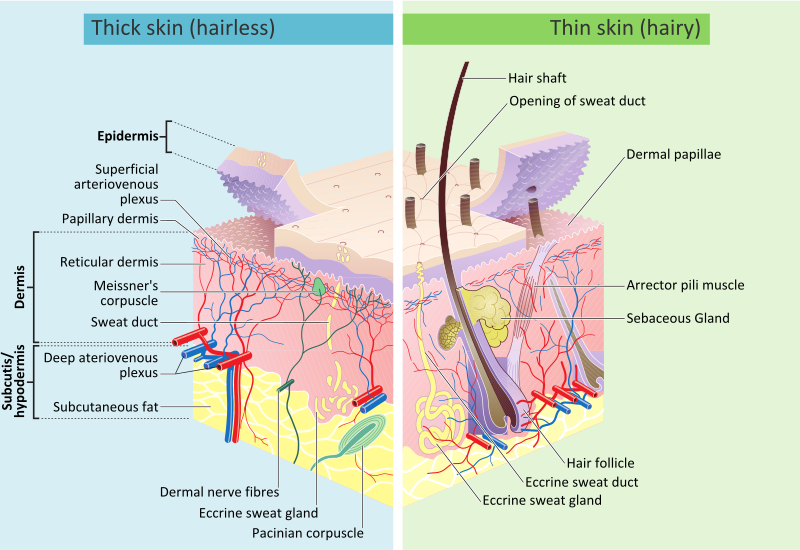
The structure of the human skin can be broken down in many ways -- many layers of complexity. In light of the subject matter, we will start simple and then work our way (through the series) into more detail. Below is the classical structure of human skin taken from the 'Wikipedia' page on "human skin":
At first sight, the image might be daunting. No worries, unless you are a dermatologist or a medical school student, you will not be quizzed over the material. The point of showing the image above is to illustrate that there are different layers of that make up skin. Furthermore, each layer has a specific role to play in the overall function of skin (as we shall see).
In the description of the "structure" of skin, there are numerous facts disjointedly put together. According the "Wikipedia" the structure of skin (section) should contain the following opening two paragraphs (overview) shown below:
Skin has mesodermal cells, pigmentation, such as melanin provided by melanocytes, which absorb some of the potentially dangerous ultraviolet radiation (UV) in sunlight. It also contains DNA repair enzymes that help reverse UV damage, such that people lacking the genes for these enzymes suffer high rates of skin cancer. One form predominantly produced by UV light, malignant melanoma, is particularly invasive, causing it to spread quickly, and can often be deadly. Human skin pigmentation varies among populations in a striking manner. This has led to the classification of people(s) on the basis of skin color.[7]
The skin is the largest organ in the human body. For the average adult human, the skin has a surface area of between 1.5-2.0 square metres (16.1-21.5 sq ft.). The thickness of the skin varies considerably over all parts of the body, and between men and women and the young and the old. An example is the skin on the forearm which is on average 1.3 mm in the male and 1.26 mm in the female.[8] The average square inch (6.5 cm²) of skin holds 650 sweat glands, 20 blood vessels, 60,000 melanocytes, and more than 1,000 nerve endings.[9][better source needed] The average human skin cell is about 30 micrometers in diameter, but there are variants. A skin cell usually ranges from 25-40 micrometers (squared), depending on a variety of factors.
Skin is composed of three primary layers: the epidermis, the dermis and the hypodermis.[8]
The description of the structure above is fragmented to illustrate the far reaching parts of the structure of skin. Although, there are good pieces of information and should not be dismissed in any manner. In all fairness to the authors of the content on the page, the breakdown and descriptions go into greater detail as the reader progresses down the page (with a lot of information).
From the standpoint of the purpose of the series on science and aging skin, the following questions must be answered to tie the current blog post to the 'Anti-Aging Skin Series':
1) What is pertinent about structure to understand anti-aging of the skin?
2) What is the function of each pertinent element of the structure of skin?
While the two questions above are important to address in the context of the blog post series, the function of the skin is the basis for the structure of the skin. Structure (of the skin) defines function! That is a very important point to keep in mind. Especially, when concerning oneself with the application of skin care products. Not all skin care products are good for the skin -- in regards to the function of the skin. Remember what the functions (purposes) skin serves for the human body:
1) keeping water in and chemicals out -- natural barrier toward infection
2) serves as padding for bones and other organs
3) serves as a temperature control system for the body
Conclusion...
Obviously, as a scientist, I like to learn as much as possible. Although, in the interest of brevity, I will stick to answering the two questions above. As we move forward in future posts, I will refer back to this page and add to the stated information in greater detail as the information pertains to answering the global question: Can Science Really Reverse Aging Skin?
Starting off easy -- i.e., from a global perspective will give you a chance to think critically about the skin care products that are on the market that advertise any benefits in terms of 'anti-aging' properties. If by chance I skip over any, please feel free to leave questions and comments in the comments section and I will try to incorporate them into the series.
Remember, I am a chemist. Skin care formulation is not my profession. I am an instrument manager at a University. Analysis of research is my area currently -- seeing that I maintain the usual army of instruments that you would find in any chemistry laboratory across the world. One of the main reasons that I am writing this series is to demonstrate that the majority (98%) of my sources will be open source or information that is online. I hope that in writing these posts, I pass on the confidence onto you to search and do research 'online' for yourself into the hazards associated with the chemicals found in consumer products.