Friday, June 16, 2017
Does Alcoholics Anonymous Work?
Alcoholics Anonymous is probably most famously known through the lens of hollywood films. A majority of newcomers have great misconceptions about the program. Today represents my fourth year of Sobriety -- in effect -- Happy 4th Birthday Mike! Right about now, you may be wondering the following question:
Why is he revealing his sobriety and the program of A.A.?
Simple, the reason that I am able to write this blog post is due to the last four years of working on sobriety. I just wanted to touch on a few aspects about the program without revealing the program in its entirety or discussing other members of the program. Anonymity is the key to the program. Why? Because having the label of an 'alcoholic' can be stigmatizing to say the least. And when some people find out that you are in the program, adverse effects can happen due to their insecurity or misunderstanding of the program.
I am blessed to be able to tell you about my sobriety. I feel much different (in a good way) than I did 4 years ago. My story is not very much different than others inside the program. The underlying theme is that alcohol became the focal point or central part of our lives. Think about the analogous situation of being an 'over eater'. Eating becomes the central point of your life. Live for eating. Not eating to live.
The most vital point of A.A. is to understand that you have let some 'vice' take over your life. Entering the program can be equivalent to a 'reset' on your life. To bring you back to equilibrium. The program is centered around 12 steps -- which according to my interpretation are a way back toward living like a 'normal' member of society. Coming from a place where a 'vice' dictated your life, this understanding is crucial.
For me, living by the 12 steps is equivalent to living life like an ordinary citizen. Which is to say, pay taxes, take responsibility for your wrong doings, and admit when you are wrong. Additionally, be of service to another person either entering the program or suffering with living according to the 12 steps. If I take a step back from the veil of A.A. on the title of the program, I tend to ask myself the following question:
Why would every person not want to live by the 12 steps?
The world might be a better place if so. Why? Because, admitting that each of us have the tendency to take a 'vice' (eating, drinking, smoking, etc.) to the limits of where the addiction dictates our life is a serious issue. I believe that each of us could do great with a small amount of daily 'introspection' in our lives.
Having the ability to look inward and admit your own faults is critical to living a healthy life. Blaming others for mistakes only takes the person back in time. Which means that progress forward is now going to be much more difficult. Let me tell you about the last four years (briefly) and you can judge for yourself.
Upon entering the program (A.A.), my wife and I were "partiers" - who loved to socialize and drink to extreme. I have discussed our ability to live life to the extreme in other blog posts before. This is nothing new. We placed partying above other activities.
We were in debt (with taxes, credit card debt, etc.) to say the least. The first couple of years were spent on pulling ourselves back together financially while educating ourselves about the role of a 'vice' can play in our lives. Any 'vice' or addiction can be taken to the extreme. As soon as each of us realize this, then action can be taken to restore us to sanity sooner. But know this, work is involved on everyones part.
Today, our life is 180 degrees different (better) than four years ago. Education is a critical component toward success. You might say..."Mike, you are educated with a Ph.D.?" The education which I am talking about cannot be taught in school. This education requires each person to look within themselves and inspect for 'deficiencies' -- which is extremely unsatisfying during the initial process. Although, after a while the process gets much easier and better.
Where are we now?
As I just mentioned, daily work is required to maintain a good standing in society. I used to suffer from bad anxiety. Today, my anxiety is a small percentage of what it used to be. Furthermore, my wife and I rarely argue due to the absence of alcohol in our lives.
The overarching guiding principle for us was to understand the following:
Alcohol did not relieve us of our issues (problems). Alcohol enhanced and amplified our problems. Furthermore, alcohol prevented us from finding solutions to problems. Today, problems are met with solutions much easier than 4 years ago.
In closing, I would like to welcome you to the program if you have gone to a meeting recently. Do not worry about the process of 'identifying' as an alcoholic' at first. The more important realization is the following:
You do not have to take another drink again!
Have a great weekend!

Friday, June 9, 2017
T.G.I.F., Anti-Aging Skin Care, Bicycle Riding, and more.
This morning I realized while riding to school on my bicycle that regardless of how tired I am, there is so much to be thankful for in life. Why now? Why not everyday? Well, as I was cruising across campus on my bicycle with the breeze running across my face staring at the horizon where the sun was making an appearance, I suddenly had this feeling of gratitude rush over me. Of course, the fact that today is Friday and the weekend is upon us helps tremendously....T.G.I.F.
Boosting your energy level with a short bicycle ride or walk instead of driving can bring a sense of accomplishment before the work day happens. I am reminded of Admiral William H. McRaven's commencement speech at University of Texas in 2014. His speech is filled with wonderful suggestions for success in life. One of which is to 'make your bed each day'. This is important because if you accomplish nothing else that day, at least you have accomplished one task -- made your bed. This thought has stuck with me for a while now. Additionally, this can be applied to walking or bicycling to work. Each day provides an opportunity to experience these little accomplishments. Plus, this one task leads us to want to accomplish another task. Think about it.
Lately, I have had a small amount of 'writers block' with regard to the series which I started last year on deconstructing products in 'anti-aging skin care' products. I wrote about the last few weeks in a previous blog post - here. I decided to just keep getting back to writing the series. Unbeknownst to me, another person would be contacting me to review a 'Master's Thesis' on 'Anti-Aging' skin care creams. Last week, I started reviewing a friend's thesis on peptides in skin care cosmetics. The hope was to incorporate peptides into the cream in order to stimulate the production of 'collagen' in skin which is a 'holy grail' of the anti-aging industry. I will write more about this thesis when I am done reviewing and revising the document for my friend.
On top of all of this stagnation and writer's block came the 'norovirus'. My wife and I contracted the virus which is 48 hours of sitting near a toilet sick as all get out. This was depressing to say the least. Not being able to read, write, or go anywhere. Although, during these times, there is time to reflect and think about the wonderful aspects of life. Today, was a celebration of re-entering life -- getting over being sick. Hooray!!!!!!!
I look forward to return to writing on the skincare series that I have started. I hope that each of you have a wonderful weekend.
Thursday, May 25, 2017
Mike's Mental Awareness Journey: Changing Your Environment!
Here is a simple question for you to ask yourself:
Are you content with your life?
If the answer is no, then ask yourself what part of your environment needs to change. I recently had the experience of changing environments and realized the great difference that such a change can provide. If you want to understand why the recent blog posts in the series "Anti-Aging Skin Series" then read this short post. Of course, to read my new entry into Mike's Mental Awareness Journey, you will have to click on the following link -- click here.
If you are looking to change your environment and need to see if the time is correct, then read what happened to me. Remember to have an open mind and be willing to change to accommodate a new environment. Push forward and the future will be better if the change is correct for you. I look forward to continuing the "anti-aging skin series" very soon. Stay tuned.
Until next time, have a great day!
Friday, May 5, 2017
Anti-Aging Skin Series Post 9: What Is The Difference Between Products?
Up to the present blog post, we have really covered quite a bit -- even if that does not seem to be the case. The original article (blog post) was filled with a couple of solutions toward aging which have since come into question. I say question since the information in the last 8 blog posts is comprehensive in resources and broad in questions regarding cosmetic chemistry. You can access the feed of previous posts by clicking here. Included in those posts are two products -- skin care products -- which were deconstructed as far as ingredients. In the present post, I would like to "roughly" compare the two products.
At this point, you might be thinking the following: Mike, you are comparing two different manufacturers 'skincare' solutions (i.e., Moisturizing, skin tightening, hydration, etc.). That is analogous to comparing 'apples to oranges.' Typically, a comparison might involve two different products made by the same manufacturer. One would be an advancement in front of the other -- or an evolution from an earlier product. In the present blog post, I am choosing to look at the ingredient profile of two different products. After reading this post, you should be able to look at a couple of different skin lotions and identify some common ingredients. With that in mind, lets dive into looking at two products that were deconstructed in the following posts: 5, 6, 7, and 8.
The first product to be deconstructed was "Jergens Skin Firming Moisturizing Lotion" in the picture shown below:

The ingredients were deconstructed over the next four posts: (1) Post #5 (ingredient list), (2) Post #6 (Glossary of functions), and (3) Post #7 (ingredient analysis) and (4) Post #7-part#3 (toxicological introduction). Additionally, I used this product to discuss the toxicology resources available on the internet in post #8. After deconstructing Jergens, I thought the next product which would be relevant would be from a different manufacturer but with the same intention. I chose a product called "Suave Skin Solutions - Lotion" which is shown in the picture below:
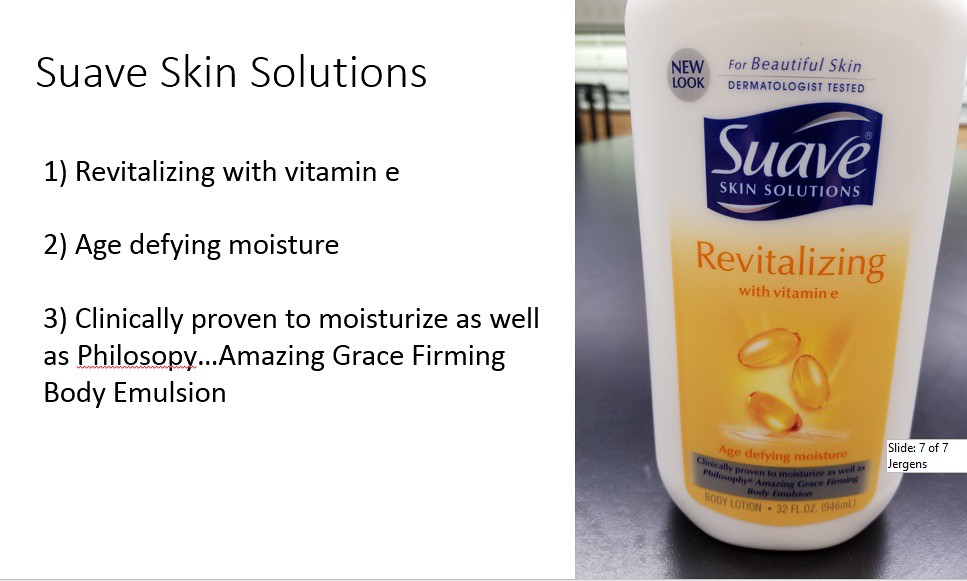
The post was relatively straight forward in that the ingredients were listed along with the functions of the ingredients. I left the classifications of 'non-polar', 'polar', and emulsifier up to the reader to compare. Once we get through a few different lotions, you should be able to look at the back of any product and have an initial idea as to the function of the ingredient. This is a start.
If we take both products and show their ingredient list side by side, we could then get a better understanding of the similarities and differences in each. Both products should deviate to an extent since their claims will be slightly different along with the obvious observation that their manufacturers are different. Here is a picture of the ingredient lists side by side shown below:
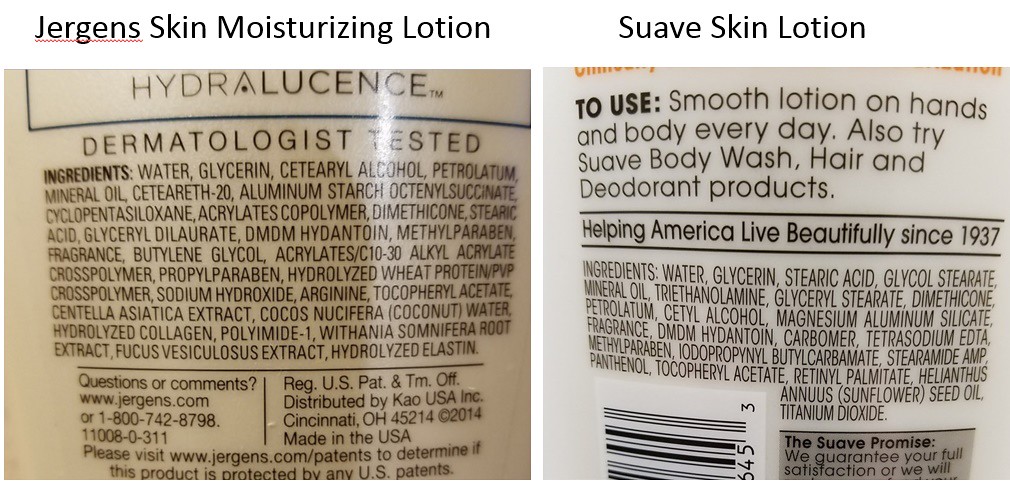
When comparing ingredient lists, naturally, one immediately looks for similarities in the ingredients used in each product. A list is shown below of the "common ingredients" from each product:

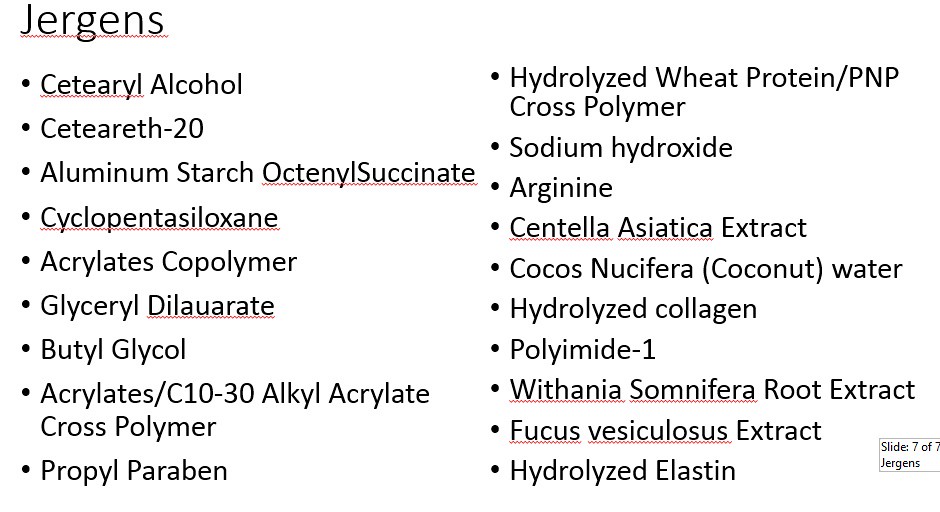
And the leftover ingredients from each define the distinct differences to each products -- not including the product claims -- which we will get to in the next post. The remaining ingredients for the Jergens lotion are shown below:
The remaining ingredients for the Suave skin care lotion are shown below:

As you can see, there are more in the Jergens lotion -- which should not mean anything in particular. In order to define the fine differences between the two products, we must look to the claims on the front and back as shown below:

And for Suave:

As you can see, there are a few different chemicals (ingredients) which are unique to each brand. In order to differentiate between the two, a closer inspection into the ingredients along with the claims made by each brand needs to be performed.
In the next post, I will discuss "claims" which are written in the images (or photos) on each brand and their relevance to the overall differences between the two products. Both products aim to provide smooth, soft, and young looking skin. By breaking down the differences in each ingredients along with the claims, the purpose of adding each ingredients will become better known. Alternately, by inspecting the different ingredients, we will learn more about each ingredient and how it can be used in other skin care products.
Until next time, have a great day!
At this point, you might be thinking the following: Mike, you are comparing two different manufacturers 'skincare' solutions (i.e., Moisturizing, skin tightening, hydration, etc.). That is analogous to comparing 'apples to oranges.' Typically, a comparison might involve two different products made by the same manufacturer. One would be an advancement in front of the other -- or an evolution from an earlier product. In the present blog post, I am choosing to look at the ingredient profile of two different products. After reading this post, you should be able to look at a couple of different skin lotions and identify some common ingredients. With that in mind, lets dive into looking at two products that were deconstructed in the following posts: 5, 6, 7, and 8.
Skin Moisturizing
The first product to be deconstructed was "Jergens Skin Firming Moisturizing Lotion" in the picture shown below:
The ingredients were deconstructed over the next four posts: (1) Post #5 (ingredient list), (2) Post #6 (Glossary of functions), and (3) Post #7 (ingredient analysis) and (4) Post #7-part#3 (toxicological introduction). Additionally, I used this product to discuss the toxicology resources available on the internet in post #8. After deconstructing Jergens, I thought the next product which would be relevant would be from a different manufacturer but with the same intention. I chose a product called "Suave Skin Solutions - Lotion" which is shown in the picture below:
The post was relatively straight forward in that the ingredients were listed along with the functions of the ingredients. I left the classifications of 'non-polar', 'polar', and emulsifier up to the reader to compare. Once we get through a few different lotions, you should be able to look at the back of any product and have an initial idea as to the function of the ingredient. This is a start.
If we take both products and show their ingredient list side by side, we could then get a better understanding of the similarities and differences in each. Both products should deviate to an extent since their claims will be slightly different along with the obvious observation that their manufacturers are different. Here is a picture of the ingredient lists side by side shown below:
When comparing ingredient lists, naturally, one immediately looks for similarities in the ingredients used in each product. A list is shown below of the "common ingredients" from each product:
And the leftover ingredients from each define the distinct differences to each products -- not including the product claims -- which we will get to in the next post. The remaining ingredients for the Jergens lotion are shown below:
The remaining ingredients for the Suave skin care lotion are shown below:
As you can see, there are more in the Jergens lotion -- which should not mean anything in particular. In order to define the fine differences between the two products, we must look to the claims on the front and back as shown below:
And for Suave:
As you can see, there are a few different chemicals (ingredients) which are unique to each brand. In order to differentiate between the two, a closer inspection into the ingredients along with the claims made by each brand needs to be performed.
In the next post, I will discuss "claims" which are written in the images (or photos) on each brand and their relevance to the overall differences between the two products. Both products aim to provide smooth, soft, and young looking skin. By breaking down the differences in each ingredients along with the claims, the purpose of adding each ingredients will become better known. Alternately, by inspecting the different ingredients, we will learn more about each ingredient and how it can be used in other skin care products.
Until next time, have a great day!
Friday, April 28, 2017
Superbloom
Adapting to the drought was difficult, since I have a desire to grow edible fruits and vegetables in my (front and) backyard. I picked up mainly succlents and cacti in 2016. But then we got to the start of 2017, which turned out to be the sixteenth wettest stretch in Southern California since World War II.

Take for example, this container I planted several years in a row with California and New Mexico native wildflowers. This year, a spray of Lasthenia californica (common name: goldfields) & Eschscholzia californica (common name: golden poppy) appeared. The photo above was taken on March 31, two weeks after settling in our new location in Northridge, CA.

The container garden made the move with us, and all the plants have survived relocation. Many of my succulents are flowering, Graptopetalum paraguayense (common name: Ghost plant) has pretty grey leaves with a pinkish cast and a delicate little flowers on an extended stem. You can see a bit of Senecio mandraliscae (common name: Blue chalk sticks) below.

I love the chocolatey color of Echeveria compressicaulis leaves and it looks like it's putting out an impressive raceme. I can't wait to see how the flowers look when they open. It is framed in this photo by Crassula tetragona (left), Crassula argentea (right), Sedum pachyphyllum (upper right), and Portulacaria afra (above).

I love how this photo makes it look like the perimeter of each leaf is hand-stitched. This is Crassula pellucida subsp. marginalis 'Variegata' (nickname: Calico Kitten). If that's not one of the sweetest things you've ever seen, I don't know what's wrong with you. You get just a glimpse of Graptopetalum paraguayense to the left.

The beauty above started flowering before we moved. Sedum clavatum is comprised of frosty blue-green rosettes named for 'clava' meaning "club" for the baseball shape of the sepals. The complexity of these tiny flowers is mesmerizing. A compact inflorescence of many white star-shaped flowers appears in spring to early summer that take a pink hue with age.

I always know the end of the school year is near when I see my Echinopsis chamaecereus (common name: peanut cactus) flowering (see prev. post). You can also see a handy pollinator. I've already had good luck with harvesting seeds, so I know the winged creatures are doing good work. We've also seen many of the crane fly this season, but they are not attributed with much pollination work.

I love the more squat Rebutia krainziana and its bold orange flower. I've been reading about the sacral chakra and the mantras associated with it: I am inspired.I am creative.I am joyful.I am in control.I am unique.I am special.I Feel. RIP to my Opuntia basilaris and Gymnocalycium mihanovichii. One got too much water and I'm not sure what happened to the other, but they're both shriveled up and dead now.

Take for example, this container I planted several years in a row with California and New Mexico native wildflowers. This year, a spray of Lasthenia californica (common name: goldfields) & Eschscholzia californica (common name: golden poppy) appeared. The photo above was taken on March 31, two weeks after settling in our new location in Northridge, CA.
The container garden made the move with us, and all the plants have survived relocation. Many of my succulents are flowering, Graptopetalum paraguayense (common name: Ghost plant) has pretty grey leaves with a pinkish cast and a delicate little flowers on an extended stem. You can see a bit of Senecio mandraliscae (common name: Blue chalk sticks) below.
I love the chocolatey color of Echeveria compressicaulis leaves and it looks like it's putting out an impressive raceme. I can't wait to see how the flowers look when they open. It is framed in this photo by Crassula tetragona (left), Crassula argentea (right), Sedum pachyphyllum (upper right), and Portulacaria afra (above).
I love how this photo makes it look like the perimeter of each leaf is hand-stitched. This is Crassula pellucida subsp. marginalis 'Variegata' (nickname: Calico Kitten). If that's not one of the sweetest things you've ever seen, I don't know what's wrong with you. You get just a glimpse of Graptopetalum paraguayense to the left.
The beauty above started flowering before we moved. Sedum clavatum is comprised of frosty blue-green rosettes named for 'clava' meaning "club" for the baseball shape of the sepals. The complexity of these tiny flowers is mesmerizing. A compact inflorescence of many white star-shaped flowers appears in spring to early summer that take a pink hue with age.
I always know the end of the school year is near when I see my Echinopsis chamaecereus (common name: peanut cactus) flowering (see prev. post). You can also see a handy pollinator. I've already had good luck with harvesting seeds, so I know the winged creatures are doing good work. We've also seen many of the crane fly this season, but they are not attributed with much pollination work.
I love the more squat Rebutia krainziana and its bold orange flower. I've been reading about the sacral chakra and the mantras associated with it: I am inspired.I am creative.I am joyful.I am in control.I am unique.I am special.I Feel. RIP to my Opuntia basilaris and Gymnocalycium mihanovichii. One got too much water and I'm not sure what happened to the other, but they're both shriveled up and dead now.
Last but not least, I will leave you with a flower of Capsicum annuum. Three out of the seven pepper plants I had last year survived the winter. However, I won't really know which is which until they produce fruit! The tomato (Solanum lycopersicum) 'Cosmic Eclipse' is still producing as well. I don't know how they'll fare in the heat of the summer, but I'll enjoy them for as long as they live.
Monday, April 10, 2017
Where Is The Next Anti-Aging Post?
In case you have been wondering when the next post on the 'Anti-Aging Skin Series' will appear, I would like to let you know that will be soon. I have been busy traveling over the last few weeks and have had difficulty sitting down to analyze the differences between the two products which I deconstructed. Look for a new post in the next week or so. Remember to review where we have come from so far.
You will recall that the first product was Jergen's Skin Firming Moisturizing Lotion. Whereas the second product was the Suave Skin Solutions. Since both have been deconstructed as far as ingredients are concerned, in the next post I will look at the fine differences between the ingredients and claims on each product. I just wanted to give you an update and let you know that I have not forgotten about the series and look forward to continuing the series.
Until next time, have a great day!
Wednesday, March 15, 2017
Anti-Aging Skin Series Post 8: Suave Skin Solutions
Anti-Aging skin care solutions are still controversial to say the least. In the last two posts, I covered a product - Jergen's Skin Firming Moisturizing Lotion. You got to see the function of each ingredient from the list on the rear of the bottle of lotion. An intermediate post was to clarify the functions of each ingredient with a short glossary of terms. The second part of the analysis was concerned with the toxicity of the ingredients in the bottle. From that analysis, the take away message was to inspect the ingredients on the back of each bottle. Chances are that the concentration of a 'unwanted' ingredient (toxic) is less than the lethal level (LD50). Although, in that post, I illustrated different avenues by which to find out toxicity information on a given ingredient.
The posts listed above are part of the "Anti-Aging Skin Series" which originated out of a lengthy post on the state of anti-aging in science -- an introductory post. From this post, a further deconstruction was needed which resulted in a series which will evaluate different products with claims of "Anti-Aging" capabilities. I will dig into the science of the claims if possible or at least shed light. Regardless, the reader (you) will learn a large amount of information about the various ingredients listed on the back side of the product containers. With that in mind, time to move onto the next product.
Now that the first product was deconstructed, I thought that the time has come to move onto another product. The next product is also a lotion -- Suave Skin Solutions -- with claims of "Revitalizing with vitamin E". The picture of the front of the bottle is shown below:
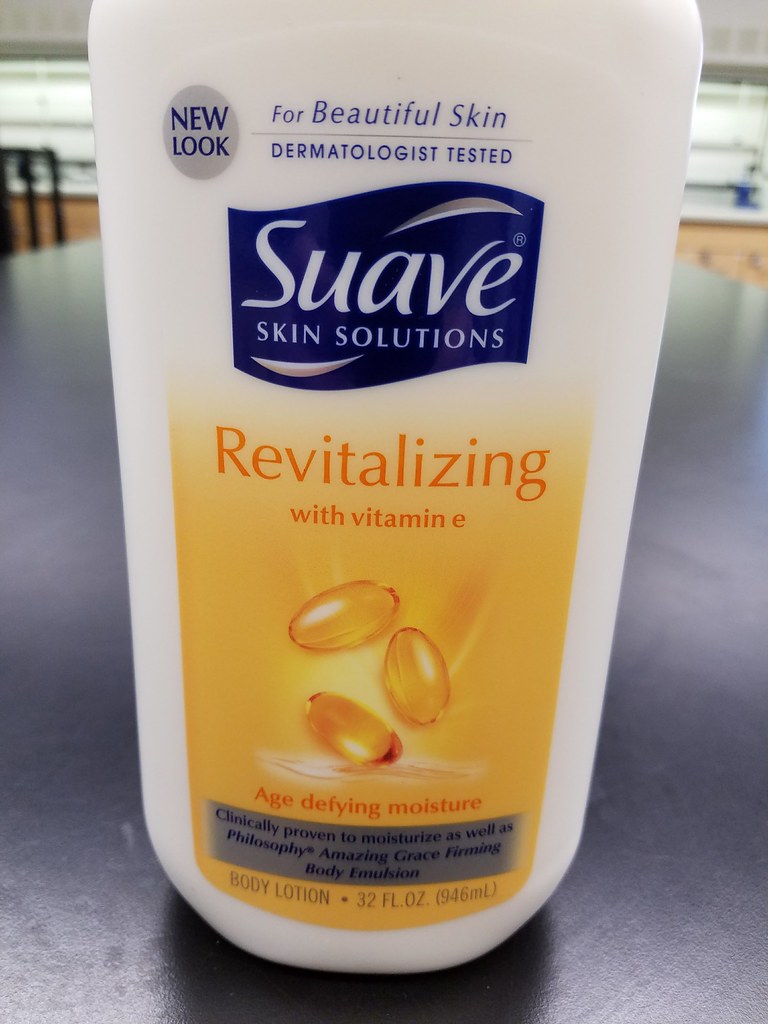
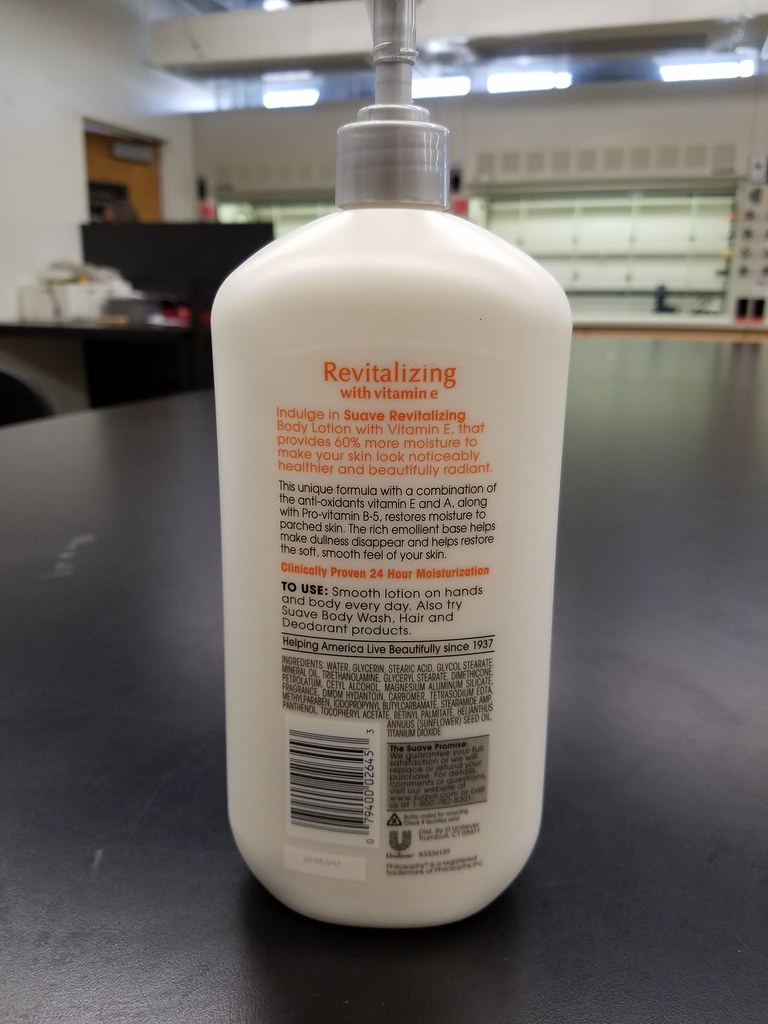
According to the print on the front face of the bottle, the following claims are made: "Dermatologist tested", "Age defying moisture", .... Here is a photo of the back of the bottle:
and if the ingredient list is zoomed in on, the following picture is shown of the ingredient list:
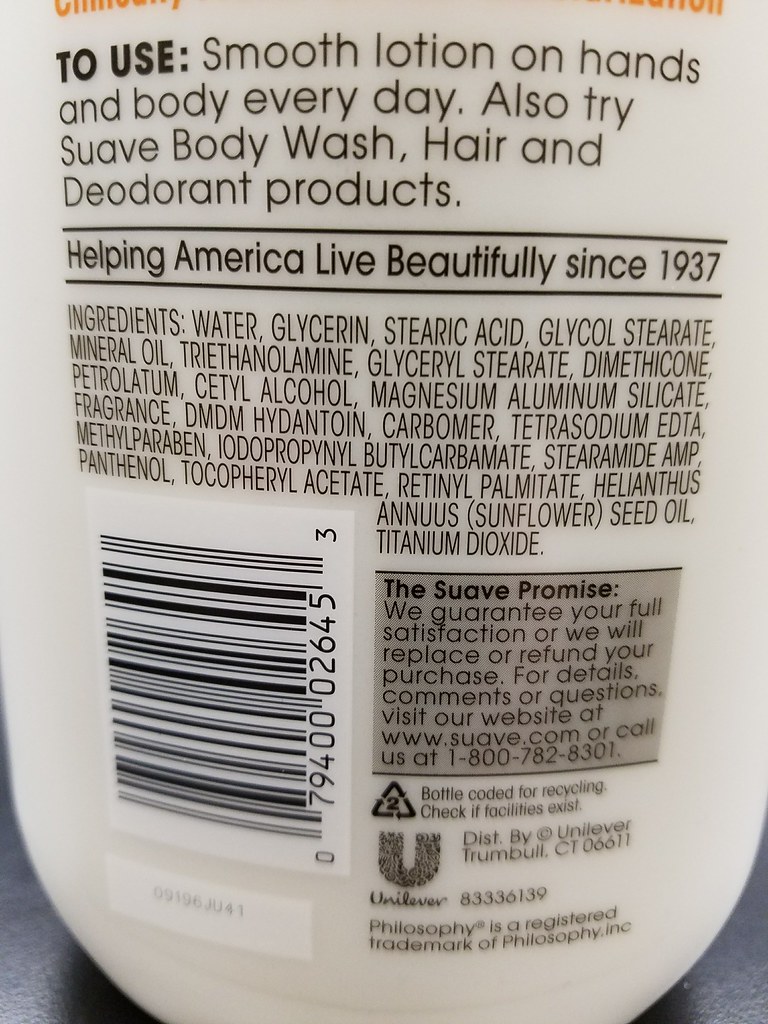
The following list is of the ingredients on the back of the bottle of Suave Skin Solutions Lotion. Data shown below is taken from the website EWG.
1) Cetyl Alcohol:
2) Carbomer:
3) Dimethicone:
4) DMDM Hydantoin:
5) Fragrance:
6) Glycerin:
7) Glyceryl Stearate:
8) Glycol Stearate:
9) Helianthus Annuus (sunflower) seed oil:
10) Iodopropynyl Butylcarbamate:
11) Magnesium Aluminum Silicate:
12) Methylparaben:
13) Mineral Oil:
14) Panthenol:
15) Petrolatum:
16) Retinyl Palmitate:
17) Stearamide AMP:
18) Stearic Acid:
19) Tetrasodium EDTA:
20) Titanium Dioxide:
21) Tocopheryl Acetate:
22) Triethanolamine:
23) Water:
These are the ingredients listed on the backside of the bottle of Suave Lotion (image shown above). The toxicities were not listed in this post. As I mentioned in the last post, the toxicities can be found on the EWG - Environmental Working Group website that I hyperlinked for each ingredient. In the next post, I will discuss the anti-aging claims made in this lotion which have some credibility from science.
What is interesting is that the same ingredient that is claimed to have anti-aging properties in this product also has the greatest toxicity associated with the product.
Can you guess or determine which ingredient I am speaking of?
In the paragraphs above, I listed the ingredients in the second product -- Suave Lotion - that is deconstructed as part of our 'anti-aging skin series'. Additionally, the names of synonymous ingredient names were given with each chemical. This is helpful when product manufacturers would like to distinguish their product aside from other popular lotions (moisturizers) on the market.
In the next post, I will discuss the differences between Suave Lotion and Jergen's Skin Firming Moisturizing Lotion. Additionally, I will answer the question regarding which ingredient is the anti-aging chemical and also holds the award for being the most 'toxic' ingredient in the formulation.
Until next time, have a great day.
The posts listed above are part of the "Anti-Aging Skin Series" which originated out of a lengthy post on the state of anti-aging in science -- an introductory post. From this post, a further deconstruction was needed which resulted in a series which will evaluate different products with claims of "Anti-Aging" capabilities. I will dig into the science of the claims if possible or at least shed light. Regardless, the reader (you) will learn a large amount of information about the various ingredients listed on the back side of the product containers. With that in mind, time to move onto the next product.
Now that the first product was deconstructed, I thought that the time has come to move onto another product. The next product is also a lotion -- Suave Skin Solutions -- with claims of "Revitalizing with vitamin E". The picture of the front of the bottle is shown below:
According to the print on the front face of the bottle, the following claims are made: "Dermatologist tested", "Age defying moisture", .... Here is a photo of the back of the bottle:
and if the ingredient list is zoomed in on, the following picture is shown of the ingredient list:
Ingredients:
The following list is of the ingredients on the back of the bottle of Suave Skin Solutions Lotion. Data shown below is taken from the website EWG.
1) Cetyl Alcohol:
About CETYL ALCOHOL: Cetyl alcohol is a long chain organic alcohol; according to the PETA's Caring Consumer guide, this ingredient can be of either animal or plant origin.This ingredient may be derived from animals. From PETA's Caring Consumer: Wax found in spermaceti from sperm whales or dolphins. Alternatives: Vegetable cetyl alcohol (e.g., coconut), synthetic spermaceti.Function(s): Emulsion Stabilizer; Fragrance Ingredient; Opacifying Agent; Surfactant - Emulsifying Agent;Surfactant - Foam Booster; Viscosity Increasing Agent - Aqueous; Viscosity Increasing Agent -Nonaqueous; EMOLLIENT; EMULSION STABILISING; FOAM BOOSTING; MASKING; VISCOSITY CONTROLLINGSynonym(s): 1-HEXADECANOL; CETANOL; HEXADECAN-1-OL; N-HEXADECYL ALCOHOL; PALMITYL ALCOHOL; ADOL; ADOL 52; ADOL 520; ADOL 54; ALCOHOL C-16; ATALCO C
2) Carbomer:
About CARBOMER: Carbomer is a large polymeric chemical composed of acrylic acid monomers.Function(s): Emulsion Stabilizer; Viscosity Increasing Agent - Aqueous; EMULSION STABILISING; GEL FORMING; VISCOSITY CONTROLLINGSynonym(s): CARBOMER 934; CARBOMER 934 P; CARBOMER 941; CARBOPOL 910; CARBOXYVINYLPOLYMER; CARBOMER 934; CARBOPOL 934; CARBOPOL 941
3) Dimethicone:
About DIMETHICONE: Dimethicone (also called polymethylsiloxane) is a silicon-based polymer used as a lubricant and conditioning agent.Function(s): Antifoaming Agent; Skin-Conditioning Agent - Occlusive; Skin Protectant; EMOLLIENT; SKIN CONDITIONING; SKIN PROTECTINGSynonym(s): DIMETHICONE COPOLYOL; DIMETHYL SILICONE; HIGHLY POLYMERIZED METHYL POLYSILOXANE; METHYL POLYSILOXANE; SILICONE L-45; DC 1664; DIMETHICONE 350; DIMETICONE; DOW CORNING 1664; MIRASIL DM 20; VISCASIL 5M
4) DMDM Hydantoin:
About DMDM HYDANTOIN (FORMALDEHYDE RELEASER): DMDM hydantoin is an antimicrobial formaldehyde releaser preservative. People exposed to such formaldehyde-releasing ingredients may develop a formaldehyde allergy or an allergy to the ingredient itself and its decomposition products. In the U.S., approximately 20% of cosmetics and personal care products contain a formaldehyde-releaser and the frequency of contact allergy to these ingredients is much higher among Americans compared to studies in Europe.Function(s): PreservativeSynonym(s): DMDM HYDANTOIN, 1,3-BIS (HYDROXYMETHYL) -5,5-DIMETHYL- 2,4-IMIDAZOLIDINEDIONE; 1,3-BIS (HYDROXYMETHYL) -5,5-DIMETHYLIMIDAZOLIDINE-2,4-DIONE; 1,3-BIS (HYDROXYMETHYL) -5,5-DIMETHYLIMIDAZOLIDINE-2,4-DIONE (+) ; 1,3-DIHYDROXYMETHYL-5,5 DIMETHYLHYDANTOIN; 1,3-DIMETHYLOL-5,5-DIMETHYL HYDANTOIN; 2,4-IMIDAZOLIDINEDIONE, 1,3-BIS (HYDROXYMETHYL) -5,5-DIMETHYL-; 2,4IMIDAZOLIDINEDIONE, 1,3BIS (HYDROXYMETHYL) 5,5DIMETHYL; 1,3-BIS (HYDROXYMETHYL) -5,5-DIMETHYLHYDANTOIN; 2,4-IMIDAZOLIDINEDIONE, 1,3-BIS (HYDROXYMETHYL) -5,5-DIMETHYL- (9CI) ; DANTOIN DMDMH 55; DIMETHYLOL-5,5-DIMETHYLHYDANTOIN
5) Fragrance:
About FRAGRANCE: The word "fragrance" or "parfum" on the product label represents an undisclosed mixture of various scent chemicals and ingredients used as fragrance dispersants such as diethyl phthalate. Fragrance mixes have been associated with allergies, dermatitis, respiratory distress and potential effects on the reproductive system.Function(s): DEODORANT; MASKING; PERFUMINGSynonym(s): AROMA; PARFUM
6) Glycerin:
About GLYCERIN: Glycerin (also called glycerol) is a naturally occurring alcohol compound and a component of many lipids. Glycerin may be of animal or vegetable origin. This ingredient is listed in the PETA's Caring Consumer guide as a byproduct of soap manufacture which typically uses animal fat.This ingredient may be derived from animals. From PETA's Caring Consumer: A byproduct of soap manufacture (normally uses animal fat). In cosmetics, foods, mouthwashes, chewing gum, toothpastes, soaps, ointments, medicines, lubricants, transmission and brake fluid, and plastics. Derivatives: Glycerides, Glyceryls, Glycreth-26, Polyglycerol. Alternatives: vegetable glycerin—a byproduct of vegetable oil soap. Derivatives of seaweed, petroleum.Function(s): Denaturant; Fragrance Ingredient; Hair Conditioning Agent; Humectant; Oral Care Agent;Oral Health Care Drug; Skin-Conditioning Agent - Humectant; Skin Protectant; Viscosity Decreasing Agent; PERFUMING; SOLVENTSynonym(s): 1,2,3-PROPANETRIOL; 1,2,3-TRIHYDROXYPROPANE; 1,2,3PROPANETRIOL; CONCENTRATED GLYCERIN; GLYCERINE; GLYCEROL; GLYCYL ALCOHOL; 1,2,3-PROPANETRIOL; 1,2,3-TRIHYDROXYPROPANE; 90 TECHNICAL GLYCERINE; CITIFLUOR AF 2
7) Glyceryl Stearate:
About GLYCERYL STEARATE SE: Glyceryl Stearate SE (self-emulsifying) is a lipid used as surfactant and emulsifying agent.Function(s): Surfactant - Emulsifying AgentSynonym(s): OCTADECANOIC ACID, ESTER WITH 1,2,3PROPANETRIOL; SELF-EMULSIFYING GLYCERYL MONOSTEARATE; STEARINE
8) Glycol Stearate:
About GLYCOL STEARATE: Glycol Stearate is composed ethylene glycol and stearic acid, a naturally occurring fatty acid.Function(s): Emulsion Stabilizer; Opacifying Agent; Skin-Conditioning Agent - Emollient; EMULSIFYING; SURFACTANTSynonym(s): 2-HYDROXYETHYL ESTER OCTADECANOIC ACID; 2-HYDROXYETHYL ESTER STEARIC ACID; 2-HYDROXYETHYL OCTADECANOATE; 2-HYDROXYETHYL STEARATE; ETHYLENE GLYCOL MONOSTEARATE; GLYCOL MONOSTEARATE; OCTADECANOIC ACID, 2-HYDROXYETHYL ESTER; OCTADECANOIC ACID, 2HYDROXYETHYL ESTER; STEARIC ACID, 2-HYDROXYETHYL ESTER; CLINDROL SEG; EMEREST 2350
9) Helianthus Annuus (sunflower) seed oil:
About HELIANTHUS ANNUUS (SUNFLOWER) OIL: Sunflower oil is extracted from the seeds of the sunflower, Helianthus annuus.Function(s): Skin-Conditioning Agent - Miscellaneous; Skin-Conditioning Agent - Occlusive; EMOLLIENTSynonym(s): HELIANTHUS ANNUUS (SUNFLOWER) SEED OIL, SUNFLOWER OIL; HELIANTHUS ANNUUS OIL; OILS, SUNFLOWER SEED; SOLVENT SUNFLOWER OIL; SUNFLOWER OIL; SUNFLOWER OIL; SUNFLOWER SEED OIL; SUNFLOWER SEED OILS
10) Iodopropynyl Butylcarbamate:
About IODOPROPYNYL BUTYLCARBAMATE: Iodopropynyl butylcarbamate is used as a preservative in cosmetic formulations; it is acutely toxic by inhalation and should not be used in products that can be aerosolized or inhaled.Function(s): PRESERVATIVESynonym(s): 3-IODO-2-PROPYNYL BUTYLCARBAMATE; BUTYL-3-IODO-2-PROPYNYL ESTER CARBAMIC ACID; BUTYL-3-IODO-2-PROPYNYLCARBAMATE; BUTYLCARBAMIC ACID, 3-IODO-2-PROPYNYL ESTER; CARBAMIC ACID, BUTYL, 3IODO2PROPYNYL ESTER; CARBAMIC ACID, BUTYL-3-IODO-2-PROPYNYL ESTER; IDOPROPYNL BUTYLCARBAMATE; IODOPROPYL BUTYLCARBAMATE; IODOPROPYNL BUTYLCARBAMATE; IPBC
11) Magnesium Aluminum Silicate:
About MAGNESIUM ALUMINUM SILICATE: Magnesium Aluminum Silicate is a complex silicate refined from naturally occurring minerals.Function(s): Absorbent; Anticaking Agent; Opacifying Agent; Slip Modifier; Viscosity Increasing Agent -Aqueous; VISCOSITY CONTROLLINGSynonym(s): ALUMINIUM MAGNESIUM SILICATE (2:1:2) ; ALUMINUM MAGNESIUM SALT SILICIC ACID; ALUMINUM MAGNESIUM SILICATE; ALUMINUM MAGNESIUM SILICON OXIDE; SILICIC ACID, ALUMINUM MAGNESIUM SALT; VEEGUM; ALUMINOSILICIC ACID, MAGNESIUM SALT; ALUMINUM MAGNESIUM SILICATE
12) Methylparaben:
About METHYLPARABEN: Methylparaben is in the paraben family of preservatives used by the food, pharmaceutical, and personal care product industries. Parabens mimic estrogen and can act as potential hormone (endocrine) system disruptors.Possible impurity in: CITRUS GRANDIS (GRAPEFRUIT) SEED EXTRACT (895 products), CITRUS PARADISI (GRAPEFRUIT) SEED EXTRACT (4 products), see all ingredients | productsFunction(s): Fragrance Ingredient; PreservativeSynonym(s): 4-HYDROXY- METHYL ESTER BENZOIC ACID; 4-HYDROXYBENZOIC ACID, METHYL ESTER; 4-HYDROXYBENZOIC ACID, METHYL ESTER, POTASSIUM SALT; BENZOIC ACID, 4-HYDROXY-, METHYL ESTER; BENZOIC ACID, 4-HYDROXY-, METHYL ESTER, POTASSIUM SALT; BENZOIC ACID, 4-HYDROXY-, METHYL ESTER, SODIUM SALT; BENZOIC ACID, 4HYDROXY, METHYL ESTER; BENZOIC ACID, 4HYDROXY, METHYL ESTER, SODIUM SALT; METHYL 4-HYDROXYBENZOATE; METHYL ESTER 4-HYDROXYBENZOIC ACID; METHYL ESTER BENZOIC ACID, 4-HYDROXY-
13) Mineral Oil:
Other MODERATE concerns: Organ system toxicity (non-reproductive)About MINERAL OIL: Mineral Oil is a liquid mixture of hydrocarbons obtained from petroleum.Function(s): Fragrance Ingredient; Hair Conditioning Agent; Skin-Conditioning Agent - Emollient;Skin-Conditioning Agent - Occlusive; Skin Protectant; Solvent; ANTISTATIC; PERFUMING; SKIN PROTECTINGSynonym(s): DEOBASE; HEAVY MINERAL OIL; LIGHT MINERAL OIL; LIQUID PARAFFIN; LIQUID PETROLATUM; PARAFFIN OIL; PARAFFIN OILS; PARAFFINUM LIQUIDUM; PETROLEUM WHITE MINERAL OIL; PROLATUM OIL; WHITE MINERAL OIL, PETROLEUM
14) Panthenol:
About PANTHENOL: Panthenol is a form of vitamin B5, used as a moisturizer and lubricating compound. This ingredient is listed in the PETA's Caring Consumer guide as a substance that can be of either animal or plant origin.This ingredient may be derived from animals. From PETA's Caring Consumer: Can come from animal or plant sources or synthetics. In shampoos, supplements, emollients, etc. In foods. Derivative: Panthenyl. Alternatives: synthetics, plants.Function(s): Hair Conditioning Agent; ANTISTATIC; SKIN CONDITIONINGSynonym(s): D-PANTOTHENYL ALCOHOL; DEXPANTHENOL; DL-PANTOTHENYL ALCOHOL; PANTHENOL , DL-FORM; PANTOTHENOL; PANTOTHENYL ALCOHOL; PROVITAMIN B5; (+-) -PANTOTHENYL ALCOHOL; ALCOOL DL-PANTOTENILICO (ITALIAN) ; DL-PANTOTHENYL ALCOHOL; PANTENOL
15) Petrolatum:
About PETROLATUM: Petrolatum is a semisolid mixture of hydrocarbons obtained from petroleum.Function(s): Hair Conditioning Agent; Skin-Conditioning Agent - Occlusive; Skin Protectant; EMOLLIENT; MOISTURISING; UV ABSORBERSynonym(s): MINERAL GREASE (PETROLATUM) ; MINERAL JELLY; PETROLATUM AMBER; PETROLATUM WHITE; PETROLEUM JELLY; YELLOW PETROLATUM
16) Retinyl Palmitate:
About RETINYL PALMITATE (VITAMIN A PALMITATE): Retinyl palmitate is an ingredient composed of palmitic acid and retinol (Vitamin A). Data from an FDA study indicate that retinyl palmitate, when applied to the skin in the presence of sunlight, may speed the development of skin tumors and lesions. FDA, Norwegian and German health agencies have raised a concern that daily skin application of vitamin A creams may contribute to excessive vitamin A intake for pregnant women and other populations.Function(s): Skin-Conditioning Agent - Miscellaneous; SKIN CONDITIONINGSynonym(s): RETINYL PALMITATE, AXEROPHTHOL PALMITATE; HEXADECANOATE RETINOL; RETINOL PALMITATE; RETINOL, HEXADECANOATE; VITAMIN A PALMITATE; AQUASOL A; AROVIT; OPTOVIT-A; RETINOL PALMITATE; VITAMIN A PALMITATE
17) Stearamide AMP:
Function(s): Surfactant - Foam Booster; Viscosity Increasing Agent - Aqueous; FOAM BOOSTING; VISCOSITY CONTROLLINGSynonym(s): N- (2-HYDROXY-1,1-DIMETHYLETHYL) - OCTADECANAMIDE; N- (2-HYDROXY-1,1-DIMETHYLETHYL) OCTADECANAMIDE; OCTADECANAMIDE, N- (2-HYDROXY-1,1-DIMETHYLETHYL) -
18) Stearic Acid:
About STEARIC ACID: Stearic acid is a naturally occurring fatty acid. It is listed in the PETA's Caring Consumer guide as a substance of animal origin, since stearic acid is primarily derived from rendered fat of farm and domestic animals.This ingredient may be derived from animals. From PETA's Caring Consumer: Fat from cows and sheep and from dogs and cats euthanized in animal shelters, etc. Most often refers to a fatty substance taken from the stomachs of pigs. Can be harsh, irritating. Used in cosmetics, ... read moreFunction(s): Fragrance Ingredient; Surfactant - Cleansing Agent; Surfactant - Emulsifying AgentSurfactant-Cleansing Agent is included as a function for the soap form of Stearic Acid.; EMULSION STABILISING; MASKING; REFATTINGSynonym(s): N-OCTADECANOIC ACID; OCTADECANOIC ACID; 1-HEPTADECANECARBOXYLIC ACID; CENTURY 1240; CETYLACETIC ACID; DAR-CHEM 14; EMERSOL 120; EMERSOL 132; EMERSOL 150; FORMULA 300; GLYCON DP
19) Tetrasodium EDTA:
About TETRASODIUM EDTA: EDTA (ethylenediaminetetraacetic acid) is a chelating agent, used to sequester and decrease the reactivity of metal ions that may be present in a product.Function(s): Chelating AgentSynonym(s): EDETATE SODIUM; ETHYLENEDIAMINETETRAACETIC ACID TETRASODIUM SALT; GLYCINE, N,N 1,2ETHANEDIYLBIS [N (CARBOXYMETHYL) , TETRASODIUM SALT; GLYCINE, N,N'-1,2-ETHANEDIYLBIS [N- (CARBOXYMETHYL) -, TETRASODIUM SALT; N,N'-1,2-ETHANEDIYL BIS [N- (CARBOXYMETHYL) GLYCINE, TETRASODIUM SALT; N,N'-1,2-ETHANEDIYLBIS [N- (CARBOXYMETHYL) - TETRASODIUM SALT GLYCINE; N,N'-1,2-ETHANEDIYLBIS [N- (CARBOXYMETHYL) GLYCINE] , TETRASODIUM SALT; SODIUM EDETATE; TETRASODIUM EDE TATE TETRAHYDRATE; TETRASODIUM EDETATE; TETRASODIUM EDETATE DIHYDRATE
20) Titanium Dioxide:
About TITANIUM DIOXIDE: Titanium dioxide is an inorganic compound used in a range of body care products such as sunscreens and makeup. It appears to have low skin penetration but inhalation is a concern.Function(s): Colorant; Opacifying Agent; Sunscreen Agent; Ultraviolet Light AbsorberSynonym(s): 1385RN 59; 1700 WHITE; 234DA; 500HD; 63B1 WHITE; A 200 (PIGMENT) ; A 330 (PIGMENT) ; A-FIL; A-FIL CREAM; A-FN 3; AEROLYST 7710
21) Tocopheryl Acetate:
About TOCOPHERYL ACETATE: Tocopheryl acetate is a chemical compound that consists of acetic acid and tocopherol (vitamin E)Function(s): Antioxidant; Skin-Conditioning Agent - Miscellaneous; SKIN CONDITIONINGSynonym(s): 3,4-DIHYDRO-2,5,7,8-TETRAMETHYL-2- (4,8,12-TRIMETHYLTRIDECYL) -2H-BENZOPYRAN-6-YL ACETATE; 3,4-DIHYDRO-2,5,7,8-TETRAMETHYL-2- (4,8,12-TRIMETHYLTRIDECYL-2H-BENZOPYRAN-6-OL, ACETATE; ACETATE 3,4-DIHYDRO-2,5,7,8-TETRAMETHYL-2- (4,8,12-TRIMETHYLTRIDECYL-2H-BENZOPYRAN-6-OL; ALPHA-TOCOPHERYL ACETATE; D-A-TOCOPHERYL ACETATE; D-ALPHA-TOCOPHERYL ACETATE; DL-A -TOCOPHERYL ACETATE; DL-ALPHA TOCOPHERYL ACETATE; DL-ALPHA-TOCOPHERYL ACETATE; TOCOPHEROL ACETATE; TOCOPHERYL ACETATE, DL-ALPHA
22) Triethanolamine:
About TRIETHANOLAMINE: Triethanolamine is a strongly alkaline substance used as surfactant and pH adjusting chemical.Function(s): Fragrance Ingredient; pH Adjuster; Surfactant - Emulsifying Agent; BUFFERING; MASKINGSynonym(s): 2,2',2"-NITRILOTRIS [ETHANOL] ; 2,2',2''-NITRILOTRIETHANOL; ETHANOL, 2,2 ,2 NITRILOTRIS; ETHANOL, 2,2',2"-NITRILOTRIS-; TEA; TROLAMINE; 2,2',2''-NITRILOTRIETHANOL; ALKANOLAMINE 244; DALTOGEN; NITRILO-2,2',2''-TRIETHANOL; STEROLAMIDE
23) Water:
Function(s): SOLVENTSynonym(s): AQUA; DEIONIZED WATER; DISTILLED WATER; ONSEN-SUI; PURIFIED WATER; DIHYDROGEN OXIDE; DISTILLED WATER
These are the ingredients listed on the backside of the bottle of Suave Lotion (image shown above). The toxicities were not listed in this post. As I mentioned in the last post, the toxicities can be found on the EWG - Environmental Working Group website that I hyperlinked for each ingredient. In the next post, I will discuss the anti-aging claims made in this lotion which have some credibility from science.
What is interesting is that the same ingredient that is claimed to have anti-aging properties in this product also has the greatest toxicity associated with the product.
Can you guess or determine which ingredient I am speaking of?
Conclusion...
In the paragraphs above, I listed the ingredients in the second product -- Suave Lotion - that is deconstructed as part of our 'anti-aging skin series'. Additionally, the names of synonymous ingredient names were given with each chemical. This is helpful when product manufacturers would like to distinguish their product aside from other popular lotions (moisturizers) on the market.
In the next post, I will discuss the differences between Suave Lotion and Jergen's Skin Firming Moisturizing Lotion. Additionally, I will answer the question regarding which ingredient is the anti-aging chemical and also holds the award for being the most 'toxic' ingredient in the formulation.
Until next time, have a great day.
Subscribe to:
Posts (Atom)