Wednesday, March 28, 2018

Summer Garden 2018

I may have started too late for a summer garden of my dreams. I'm still trying to get used to the weather here in the valley.

From the winter garden I started in August of last year there remains: chard, kale, radish, okra and marigold. The poor eggplant seemed great and then died suddenly. Maybe it was cold stress, drought stress, or light stress.

A post shared by Kayla Kaiser (@hamerk02) on

I don't remember when I started organizing my seed into plant families, I guess it was just starting to grow out of control and I couldn't find anything. Making a label on the outside of the bag was a great way to find exactly what type of plant I was looking for without digging through every single bag. The bags I get free during Clinique bonus week and since I'm not really a make-up-a-holic, I use the bags to sort and store my seeds. I put all these little bags into a camo backpack that I can sometimes take with me to the Seed Library of Los Angeles (SLOLA) meetings.

This past month we had a talk from David King the founder of SLOLA and he spoke about planning for our summer gardens. He specifically went over the considerations for seed-saving. He is a teacher through UCLA Extension and the garden master at the Venice High School Learning Garden.

David encouraged us to set a goal and be clear at the start of a project (or season). That way you know when you are approaching, meeting and exceeding your goal. He said that it's easy to give away seeds, but it's hard to be persistent. In other words, it's not always the first time around that you will be able to get a yield of seeds back from what you plant.

For us in the valley, a concern is that pollen is killed at temperatures above 85 degrees F so that you will have to get up early if you want to hand-pollinate your plants.

Beans - let them become very dry on the plant. Put them in a plastic bag and freeze for 3 days. You can get seeds from the grocery store bulk bins. They will germinate.

Peppers - can cross pollinate. To prevent unintended hybridization, put cloth bags around the flowers. They are "perfect flowers" because they can self-fertilize.

Tomatoes - can cross pollinate. Pollination is typically by wind. Cherry tomatoes cross pollinate by insects. They also can self-fertilize.

Squash - susceptible to powdery mildew. If you plant now, you can harvest in July. Then plant in July for a winter harvest. You need male and female flowers, so plant as many as you can.

Tomatillo - similar to tomato and pepper. It's not as common so there's low risk of cross-pollination. Unlikely that your neighbors will be growing it.

Amaranthaceae - includes spinach, sugar beet, chard, quinoa. These are wind pollinated. The pollen can travel up to 25 miles.

Corn - typically hand pollinated. Combine 3-5 tassles in a paper bag. Shake it. Dump the pollen on the silk. This yielded him 35 kernels per ear. Corn pollen can travel 250 miles under ideal conditions.


Here's what seeds I've planted. So far the lettuces have popped right up. A variety of the flowers have also sprouted but I mixed them up so I doubt I'll know which is which until they get larger. You can follow the progress of these plants in my facebook album.


Also, I only planned to plant the spinach and eggplant, but never did it (oops) will try to get those on (in) soil today or tomorrow. Happy Cesar Chavez day, California!


I feel as though the plants have entrusted me to be a steward of their progress. I am constantly humbled by some plants' ability to survive under my lack of care. And I am surprised when those plants reward me with their fruits. I made the most amazing salad of radish and chard for the SLOLA meeting! 🌱

Monday, March 19, 2018

How resilient is your body toward infection?

Source: CDC


Have you ever had the following thoughts while 'under the weather' due to a cold or flu: "Why is this cold/flu holding my body hostage so long?  Why is my body taking so long to fight this cold?  I normally recover within a couple of days....this flu/cold must be a big one."  If so, I would like to bring up a few points inspired by a discussion a few days ago with a colleague regarding the body's resiliency in fighting infections.  Enjoy!


Why am I sick?


Why am I sick?  The answer to this question lies in the ability of a person's immune system to mount an attack on an infection (a foreign invader) into your body at any given time.  Of course, at any given time, through the acts of breathing, seeing, hearing, eating, skin absorption, invaders are attacking our bodies mounting an invasion on our system.


Stop to think about this.  Just opening your eyes, opening your mouth, breathing in, covering yourself with clothes or being naked, invaders are trying to get into your body.   You may be wondering why I am thinking about this subject at all?  First, we are in the midst of an influenza frenzy -- the spread of which is fast and wide.  Schools are hotbeds for the spread of the influenza virus this season.  I got the virus after participating as a 'science judge' a few weeks ago at an elementary school.  I even got the flu shot this season.


Turns out that there are four strains of the influenza virus circulating this season.  Three of which are wiped out by the 'flu shot' -- which is great.  The downside is that the worst strain of the virus is the fourth which has mutated and built up a resistance to the 'flu shot' - not great.  The Center for Disease Control and Prevention (CDC) offers the following explanation regarding the viruses ability to change over time:


Influenza viruses are constantly evolving, in fact all influenza viruses undergo genetic changes over time (for more information, see How the Flu Virus Can Change: “Drift” and “Shift”). An influenza virus’ genome consists of all genes that make up the virus. CDC conducts year-round surveillance of circulating influenza viruses to monitor changes to the genome (or parts of the genome) of these viruses. This work is performed as part of routine U.S. influenza surveillance and as part of CDC’s role as a World Health Organization (WHO) Collaborating Center for Reference and Research on Influenza. The information CDC collects from studying genetic changes (also known as “substitutions,” “variants” or “mutations”) in influenza viruses plays an important public health role by helping to determine whether existing vaccines and medical countermeasures (e.g., antiviral drugs) will work against new influenza viruses, as well as helping to determine the potential for influenza viruses in animals to infect humans.
Genome sequencing reveals the sequence of the nucleotides in a gene, like alphabet letters in words. Comparing the composition of nucleotides in one virus gene with the order of nucleotides in a different virus gene can reveal variations between the two viruses.
Genetic variations are important because they affect the structure of an influenza virus’ surface proteins. Proteins are made of sequences of amino acids.
The substitution of one amino acid for another can affect properties of a virus, such as how well a virus transmits between people, and how susceptible the virus is to antiviral drugs or current vaccines.
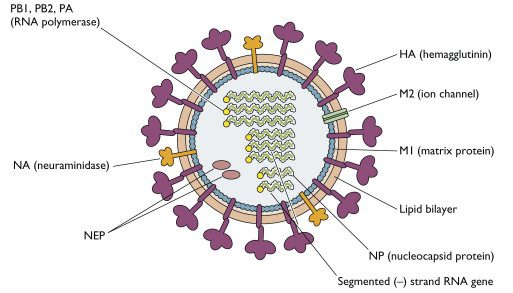
Influenza A and B viruses – the primary influenza viruses that infect people – are RNA viruses that have eight gene segments. These genes contain ‘instructions’ for making new viruses, and it’s these instructions that an influenza virus uses once it infects a human cell to trick the cell into producing more influenza viruses, thereby spreading infection.


Not all people receive the form of the influenza virus which has mutated or changed and is resistant to the 'flu shot.'  Although, the few that have and still get sick (like myself) have the risk of giving up days of productive work to allow our bodies to repair our immune system to restore the ability to mount a counter attack against influenza virus.  The majority of folks that have been subjected to taking time off due to illness (sick days) -- wanted or unwanted.  This virus has a real kick and can put a person down in bed for several days.


In the worst case scenario, a few unfortunate elderly people have transitioned from serious illness caused by the influenza virus to the actual stage of an pneumonia - which in some cases can be life-threatening.  A colleague of mine just mentioned the other day that he has attended this year  3 funerals of friends who have died as a result of a serious progression of the virus into a pneumonia and onto death.  What a tragedy that is.  I expressed my sorrow for his losses.  I also took the time to insert a message of gratitude for those of us who have survived.  Not to be disrespectful of those unfortunate people that passed as a result.


The Human Body is Resilient Toward Infections


In most cases the human body is resilient toward infection.  As I mentioned above, the human body is constantly being bombarded with attacks from foreign invaders.   And our immune system is in turn mounting attacks against foreign invaders at what seems like the speed of light (not literally).  Our ability to comprehend the extreme resiliency of our immune systems ability to mount counter attacks is greatly lacking.  Let me give you an example to explain why this is the case.


Present Day Syria


Immigration is a hot issue presently throughout the world.  There are 65 million displaced migrants moving throughout the world today.  A significant portion of the moving migrant are moving from the civil war that has plagued Syria over the last few years.  Here is a picture shown below of a previously largely populated city of (in Syria - pre-civil war):


Source: Sputnik News


This picture is of the city of Aleppo pre-civil war with a population of 1.6 million people.  Of course, after years of the civil war, the city now appears as shown below:


Source: CNN


Wow!  Imagine if the human body was unable to fight an infection.  Imagine if the human body worked on the time scale of the human ability to rebuild a city like Aleppo after a civil war.  Our ability on the human level (physical scale) is lacking.  Building up a city like Aleppo will take years to return to normalcy if ever.


On the microscopic scale (virus level), our bodies have to be much more resilient to fighting disease.  The ability to rebuild our destroyed cells or other cellular machinery is of the upmost importance and needs to be accomplished immediately. Again, you may be wondering the following question:


What is the connection to the city of Aleppo and the human body's immune system?


The point that I would like to drive home is that we should respect the our body more.  Furthermore, in the event that the influenza virus invades our body successfully and causes us to miss work, respect your body and let your immune system do its intended job.  Think about this blog post while you rest in bed.  Let your body repair your system.  If you choose to not respect your immune system and let the system do the job of counter attacking the virus, you could move the virus into the stage of an pneumonia -- and possibly progress onto death.


Conclusion...


Respect your body.  Amazingly enough, your body's ability to mount a counter attack is super efficient compared to the human scale activities shown above.  Imagine if your body operated on the scale of us as humans operating on a daily basis.  You would be sick for years.


Secondly, remember that your body fights the virus every few weeks after you recover.  Therefore, if you recover and start to abuse your body (let your immune system be compromised) by not taking care of yourself, you will find yourself sick again.  What?  Is that possible?  Yes, it is.  Don't believe me?  See if this happens in the future after you recover from your present sick state.


I hope that each of you choose to respect and let your body heal itself on the appropriate time scale.  Remember to think about how amazing your system is to be able to recover in a matter of days.  What is the equivalent process that occurs on the human physical scale?  Is there such a comparison?  I do not believe that one has been uncovered.  We have a lot to learn in science to be able to mimic the body's ability to recover.  Until next time, have a great day.


Friday, February 23, 2018

What Happened To The Anti-Aging Skin Series?

Are you ready for the continuation of the Anti-Aging Skin Series?  I know, the delay has been quite long.  Over the winter break, I was thinking about the change which I had proposed at the end of last year.  The new series (or continuation) of the old is going to focus on (for the time being) products off of a friends website -- XOM3.com.


The reason being (as I explained in the last post) was to include more information about the formulation in the blog post from the actual formulator/manufacturer.   In this case, the formulator is a great friend -- Mandy -- as you will see.  Additionally, another reason for the change is to uncover more information about the ingredient profile along with the benefits of ingredients infused into the product.  At the same time, this will allow the reader (you) to comment and ask questions which I can relay to the formulator about a given product.  The dialogue or channels of communication can be further opened regarding skin care products.


With the start of a new year, life can be busy coordinating responses and questions between two people who are busy.  Be patient with us.  The first product I will be showcasing is shown below:


Source: xom3.com


The product is a facial moisturizer called "You Can Dew It".  Take a look at the product description before you read the next blog post.  Formulate your own opinion and questions regarding the product.  See if the next blog post answers the questions/assumptions/opinions that you have formed.


Additionally, in the mean time, if you would like to access previous posts in the "Anti-Aging Skin Series" feel free to click here to access an index page.


Are you ready?  I know that you are.  As soon as I incorporate Mandy's comments into my blog post which is partially done, you will see the next blog post.  Stay tuned and have a wonderful weekend.


Sunday, January 14, 2018

Grains, beans, nuts and seeds

This year, we are trying a regimen of whole-grain cooking. To this end, I am learning more about grains, beans, nuts and seeds. Actually each of these are the seed of a different plant, so they all contain nutrients needed to sustain life.
"Grains are the seeds of grasses. Examples include: wheat, corn, oats, and rice. Beans are the seeds of legumes. Examples include: peas, lentils, soybeans, and chickpeas. Nuts are the seeds of trees. Examples include walnuts, hazelnuts, and pecans. And seeds are…well…seeds. Examples include sesame seeds, poppy seeds, and sunflower seeds."

Food

Latin Name

Order
Glycemic Index
Barley* Hordeum vulgare Poales 25
Wheat berry*Triticum aestivum Poales 45
Bulgar wheat*Triticum aestivum Poales 47
Wheat bran* Triticum aestivum Poales 60
Couscous* Triticum aestivum Poales 65
Chickpea Cicer arietinum Fabales 10
Soybean Glycine max Fabales 18
Lentil Lens culinaris Fabales 28
Black bean Phaseolus vulgaris Fabales 30
Pinto bean Phaseolus vulgaris Fabales 30
Sunflower seed Helianthus annuusAsterales <20
Poppy seed Papaver somniferum Ranunculales <20
Chia Salvia hispanica  Lamiales <20
Sesame seed Sesamum indicum Lamiales <20
Flax Linum usitatissimum Malpighiales <20
Buckwheat Fagopyrum esculentum Caryophyllales 45
Quinoa Chenopodium quinoa Caryophyllales 53
Hominy Zea Mays Poales 40
Polenta Zea Mays Poales 68
Rice Oryza sativa Poales 50
Oats Avena sativa Poales 55
Millet Pennisetum glaucum Poales 67

* Contains Gluten

We've had a successful 2017 with our Kaiser Wellness Center tumblr recipe blog. With the addition of a George Foreman grill and a pressure cooker, I hope to continue adding successful healthy recipes throughout 2018. See previous post for a discussion of glycemic index.


If you're wondering where to find whole grains at a low price, look no further than WinCo Foods. Note: you must be comfortable buying from bulk bins.

Whole Foods, Porter Ranch
Removing the items not available at one or more stores, that leaves us with 15 items which can be purchased at all 4 stores. If you purchased one pound of each item, the total cost is shown below for comparison. For us, we would have to drive almost 40 miles to any of the nearest WinCo stores, but since we get 40 mpg that is just 2 gallons of gas (approximately $8), well worth the price difference. And we just have to remember to visit WinCo when we visit family, when we're making the trip already.

WinCo             $21.45
Walmart           $61.95
Whole Foods   $66.53
Von's                $65.23

Also, some of the items (e.g. couscous and polenta) must be ordered online for in-store pick-up at WalMart and delivery via Amazon for Whole Foods and is not routinely stocked at our nearest store location.  WinCo has all these items in stock, in the bulk section, with the exception of poppy seeds.


Brown rice, pearled barley, green lentils

Comparing the prices of some dry beans

Removing the items not available at one or more stores, that leaves us with 7 items which can be purchased at all 4 stores.

WinCo             $  7.27
Walmart           $10.52
Whole Foods   $21.23
Von's                $16.13

The beans below were purchased in Long Beach while Mike was attending the CSULB Student Sustainability Coalition meeting on Friday, April 20th.


References


Joseph Mercola and Kendra Degen Pearsall. Healthy Recipes for Your Nutritional Type (The Perfect Companion to Dr. Mercola's book Take Control of Your Health). 2007, Mercola.com, p 261.

Judith Finlayson. The complete whole grains cookbook. 2008, R. Robert, p 218.

Sheryl London and Mel London. The versatile grain and the elegant bean: a celebration of the world's most healthful foods. 1992, Simon & Schuster.

Thursday, January 11, 2018

Winter Garden Progress

As a teacher, I'm always optimistic at the start of the semester! It seems appropriate to start a batch of seeds and watch tangible growth as the academic year progresses. The image below shows the layout of my seed starting trays, filled with seed-starting soil. I don't know if it is actually critical to have this type of setup, but I usually have good results with it.


I also have indicated the year in which the seeds were harvested (or printed date if the seeds were not collected by myself). I did a bit of research on the optimum germination conditions and timing for the seeds I planted. Fall 2017 overall was unusually warm, so I don't know if that effected my plants in a good way or in a bad way.


I can say that I borrowed seed stocks from the Seed Library of Los Angeles (grey zucchini squash, Tondo di Piacenza squash, and Rosa Bianca eggplant). I arranged the trays in a window box (extremely sunny) inside our house (not too hot) and right near the sink (to not forget to water them).


I kept a tally of which seeds germinated, and roughly how long the seedlings took to emerge. In October, I transferred them outdoors in hopes that we would have cooler wetter weather on the way. However, cooler weather was not in the forecast (hindsight is 20/20).


It looks like the Tondo di Piacenza squash maybe needs warmer weather or longer days to encourage germination? Possibly same with lettuces? Or maybe the bean seeds need to be scarified. Or maybe I planted them too deep, lettuce seeds need light to signal germination. Or maybe the Red Lettuce is too old or didn't fill its seeds well when it was setting on seeds.


I killed that praying mantis by putting her outside on the blacktop, then did a bit of reading and found out that she would not have been harmful to the garden. Still feeling a bit guilty about doing that. I did have an aphid infestation, but left it for months untreated since it's only advised to apply dormant oil when the temperature is above 40 deg F but below 90 deg F. Thus I have only applied it this past weekend (Jan 7, 2018).


A post shared by Kayla Kaiser (@hamerk02) on


I made an idealized layout of where everything should end up, which is important because certain plants protect other plants from pests (for example marigold is an effective trap crop). And some plants engage in chemical warfare with each other, preventing one or the other from growing optimally (for example geranium is not good for solanales). Some plants bring out the best in other plants, so they should be nearby each other (basil is said to be beneficial for tomato).


You can see actual photos of the seedlings here: Winter Garden Album on Facebook

The Bad News: The geranium finally died, so it has been removed. The peppers also have been retired. I never found any zinnia. There's no basil. I have never had luck germinating beans, so there are none of those. The squash didn't survive, not sure why. I didn't plant any carrots or peas. The mustard didn't survive. The tomato is long gone by now. The lettuces didn't survive.

The Good News: Starting in the upper left corner of the map above, one okra plant is alive. A strong crop of chard is nearby. Everything on the upper right corner of the map above has been retired or relocated.  The lower left corner holds 2 Rosa Bianca eggplant, 2 French (dwarf) marigolds, 1 large radish and 7 smaller ones. We have 2 Lacinato kale plants and 1 Red Russian kale that survived.


I'm so happy we're past the winter solstice. I can feel each day being longer than the preceeding one and before we know it, we'll be back in summer! I am planning to plant some seeds soon, to get another round of lettuce, spinach, herbs, squash, tomatoes and peppers. I have posted some gardening guides on our Kaiser Wellness Center website, which I refer back to often when deciding what to plant and when. Since I don't have a public garden anymore, I really have given up tagging each plant with a QR code. Maybe I'll repurpose the QR codes for some other application.

Wednesday, December 20, 2017

Taking On Too Much Work Will Lead To Burn Out

Have you every felt over worked?  Have you exhausted yourself by committing yourself to too many activities in a given period?  This semester has been a semester in which the answers to the prior two questions is an overwhelming YES.  Additionally, having the ability to say "yes" or "no" to over committing the available time each of us have in a given day is critical to a person's health and that of the health of those around them.  The following post will highlight the need to learn how to say "yes" and "no" to various commitments in life on a daily, monthly, yearly basis.


This semester has been one hell of a deal for our household.  Kayla took on a tremendous task which involved cooking for 24 students twice a week.  In addition, she was teaching a couple of classes at Pasadena City College two nights a week.  What a hectic schedule?  In the 10 years of our marriage, I have thought that I had seen her wear herself out.  This semester was the semester to kick her rear end.  How do I know – she asked one day over lunch?  There were subtle signs.


For instance, on the weekends, she usually is up early making coffee and ready to achieve around 20 tasks throughout the day.  On more than one occasion, I noticed her sleeping past 10 am which is highly unusual for her.  Secondly, she had to remain on task to a large degree which meant that we as a couple had to minimize what extracurricular activities that we could commit to in the future following each week.  I had a challenging semester without constantly being around Kayla.  If you recall, both Kayla and I work at California State University at Northridge (CSUN) in the Chemistry/Biochemistry Department.  I am an instrument manager while Kayla teaches general chemistry along with upper division lab classes.


Working Two Jobs at Two Different Schools?


This semester Kayla asked me how I felt if she worked at two different schools – Pasadena City College and CSUN.  The reason why she even asked was to be considerate as a partner sharing a household.  Which was super thoughtful of her.  I always want to support her career advancement opportunities.  The only question that I had was the following: Are you going to burn yourself out with so many classes?  Not to mention the extra task of cooking for 24 students twice a week – which I will explain shortly.  I am just trying to look out for her health.  Sometimes a person gets very ambitious in their career goals that the possibility of ‘running themselves (health wise) is clouded by success.’  She agreed to dial back on commitments if they were too much at any time.  I knew that the comment was genuine but not going to happen.   Therefore, I decided to let her work herself into the ground and then she will eventually learn to pace herself.  I was not looking forward to watching her do that, but these are lessons which each of us have to learn at one point in our lives.


With this in mind, I was able to have a large amount of “me time” this semester.  Part of the alone time was with her cooking away in the kitchen while I read in another room.  I will explain why I did not participate shortly.  While the other part of the alone time was when she was physically at the College Teaching on Tuesday and Thursday nights.  Part of the loneliness was stressful, since I knew that when she arrived home each Tuesday and Thursday, I would be in bed already.  Going to bed with your spouse already in bed is difficult at times.  The same occurs when one spouse has work early in the morning and leave a spouse is sleeping.  Which has occurred over the years to each of us at times.


The point I am trying to convey to a large extent was that having time to myself was not necessarily ‘leisurely’.  I chose to read as much as I could which was a great improvement for me.  I have probably read more books this year than total in my life before 20 years old.  I used to be confined mainly to the great outdoors since we had wonderful weather and my parents agreed that no child should sit idle in front of the television and waste time.  Go outdoors release endorphins by physical activity.  Look and absorb nature and get some vitamin D while you are at it.  That was my impression of childhood in Southern California.


Learning to be comfortable with being alone is both interesting and challenging at times.  How many times have you caught yourself wondering or thinking the following thought during challenging times at work… “If I only had some free time, I would totally spend or accomplish___?”  Yep, we are all victims of that thought at one time or another.  Yet, when the time comes to “pamper” or have alone time, we choose to spend the time thinking of the other person or future goals – to name a few.  My thoughts and reasons are not necessarily bad.  I just believe that I have overcome anxiety of accomplishing goals by actually setting out and achieving my hobbies during any alone time.  This was a success for me.  Typically, I am a ‘people pleaser’ and have a difficult time having time to myself.  Not that I did not struggle a bit this semester.  I just made more progress than last semester.  I needed the time alone to realize or ask myself – do I really want to have this hobby or read that book?  Yes, and I did.


Cooking for 24 Students Twice A Week:


As I mentioned above, earlier in the semester, Kayla took on a monumental task of cooking for each of her students twice a week.  What did this entail?  She had a class of 24 students.  On the first day, she decided to give them an assignment (homework) to go and write down their favorite meal – the recipe.  When the students returned to class the next meeting, she informed them that she would cook a meal for each class.  What?  Yep, you read correctly.  The intention was to expand her cooking abilities, but more importantly, connect with the students on a more personal level.  By sharing a meal, humans form a special bond.  Kayla decided that no meal (holiday meal or not) was too challenging for her to prepare.


I should back up a bit and tell you about a time when Kayla reached the end of her cooking spree – early on in our marriage.  We were in graduate school together when we met.  We dated for around a year before we got married.  Anyways, we lived together early on and would have friends over to eat.  We would laugh and eat a meal which took hours to prepare for a few graduate students (5-10 students).  Over time, we realized that two rules needed to made and followed in the years to come:


1) Don’t complain about dishes in the sink, if you are not willing to clean them yourself.
2) Don’t agree to have a meal with guests if you are not willing to participate in the cooking.
3) Don’t agree to host a meal without consulting your partner first.


Over the years, these three rules have been enforced to minimize any argument or resentments which might arise.  Plus, when each person agrees to a task, the task is more enjoyable to carry out.  Right about now, you may be wondering what the relevance the three rules are to the current semester. Well, let me explain.


Kayla came home from the first class with her 24 students and announced her brilliant assignment to me.  I asked her why she decided to take on this monumental task.  She stated the intentions of ‘connecting with the students through food’ as mentioned above.  Additionally, she said learning all of the meals would be great for us.  I reminded her of the 3 rules which we had agreed upon above regarding promising meals to guests.  She said that she would cook all of the meals by herself.  Fine, lets see that happen – was my initial thought.  This led to another achievement on my part – or personal growth.  My control issues.


The first meal took around 6 hours to cook.  From around 5 pm til 11 pm.  I was trying to read in the living room to practice “disconnecting” or not controlling the situation.  Over the course of the semester, I had achieved a milestone in my life – which was to let her do her thing.  Let her do the work.  I know that might sound selfish at first.  But remember, as a “people pleaser” I am constantly trying to help others and have no time for myself.  On top of no time for myself, I tend to get in the way of progress by trying help.  I decided that this time, I was going to let go and try to read and not bother her while she was cooking.  This I must admit was difficult in the beginning – but became increasingly easier as I made small achievements over time.  To be honest, had she asked me to help, I might have helped – just kidding, I would have.  While reminding her of the 3 rules – what a husband I am – LOL.  By the way, all of the recipes are available on our Tumblr website – here.  Enjoy!!


Conclusion…


The process of change takes time.  Just like the idea of ‘control’ manifests itself in many forms.  When Kayla was teaching at night I would wonder how her class was going.  A form of control – really?  The act of “letting go” and achieving your own goals is difficult.  Although, as I learned over the course of this semester, each week is a new opportunity to work on achieving goals not yet accomplished.  Furthermore, the students at CSUN had a few wonderful meals throughout the semester.  Kayla was able to challenge herself in terms of career advancement and on a personal level by learning new recipes.  She does genuinely love to cook.  I like to cook the same thing – Macaroni and Cheese.  That gets old each night.  Therefore, I am in training learning to expand my horizons in the kitchen.  I admit that I am a huge work in progress.  The semester has been difficult.  But who ever said that personal growth would occur without effort.


Luckily, we are headed for the holidays.  Which means that work will come to a temporary halt for vacation.  Thank goodness for the time off.  We will use the time to ‘recharge our batteries’.  I hope that each of you have a safe set of holidays and I look forward to returning to blogging about cosmetic products and my mental growth in 2018.  Happy Holidays!
Until next time, have a great day!!!


Tuesday, December 12, 2017

#DefineYourself! -- Define Your Unique Self Or Else Others Will Define You...


In today's fast paced and ever changing world, the concept of "defining oneself" is more critical than ever. That is why I came up with the hashtag of #DefineYourself! It is a clarification and a celebration of what a person stands for. Let me explain further briefly below.

Each of us would like you think that we are extremely unique in this world.  WRONG.  We are more similar in our desires and needs than we would like to think. That is not to say that each of us are not unique. 

The hashtag #DefineYourself! is a designation (a marker if you will) to tell the world how you are unique relative to the rest of us.  If you type in the hashtag #DefineYourself into either 'Twitter' of 'Instagram' the results will be mainly about your physical appearance -- which is critical toward defining oneself.  Although, I would add that there exists many other 'dimensions' in which a person can define themselves which have nothing to do with appearance and are just as important -- if not more so.


In adding these multiple dimensions of 'uniqueness' -- the addition of the exclamation point "!" to the hashtag #DefineYourself.  Why you might ask?  If you type into 'Wikipedia' the phrase "exclamation mark" -- the following result is shown below in the introduction:


The exclamation mark (British English and Commonwealth English) or exclamation point (American English) is a punctuation mark usually used after an interjection or exclamation to indicate strong feelings or high volume (shouting), shows emphasis and often marks the end of a sentence. Example: "Watch out!" Similarly, a bare exclamation mark (with nothing before or after) is often used in warning signs.


The example in the excerpt is "Watch Out!" -- which is appropriate to emphasize the use of the exclamation mark.  Similarly, instead of restricting a definition of oneself to a single dimension -- i.e. physical appearance -- which is now commonly used on social media, the exclamation mark in the hashtag #DefineYourself! is a cry out to use a more 'complete' definition including the many other definitions of 'uniqueness' that each person holds in the world.


At this point, you may be wondering what type of 'uniqueness' can each of us highlight in our lives.  An example of this might be highlighting the 'unique' components of a cosmetic formulation as highlighted in the series Anti-Aging Skin Series (which I write) on this blog site.  On a more personal level, a person could write about their Mental Awareness Journey through life -- with updates and learning experiences in real time.  Another example might be a 'dimensional analysis' blog post written about the total number of Turkey's sold in the United States on Thanksgiving Holiday -- highlighting the excess of food of the meal.  Other example might be a short 'Tweet' on 'Twitter' (or other social media outlets) highlighting your unique qualities or outlook on life. The point is that the hashtag is meant to highlight your uniqueness in the world today.


With this in mind, use the hashtag and tell the world about yourself. Otherwise ... others will try to define you in their terms. Have a great day.