Monday, June 11, 2018

Hacking Google Fit

Let's say you are dorkin' out on your fitness tracking. Or maybe the technology you have isn't helping you stay fit. That's what happened to me. I still use the GoPro Hero4 but not as much as I did when we first got it (3 years ago).


I really enjoyed my Nike+ sport band for tracking runs (9 years ago). That is when I actually went for runs. Its limitation was that it was limited to step counting. Then dear husband bought me a Garmin Forerunner (7 years ago), which could track both runs and bike rides. Its limitation was that over time the plastic band got worn down so that I had to safety pin it to my handlebars, and during one bike ride (2 years ago) it fell off. Shortly thereafter, we upgraded our phones and I started using apps to track fitness.


We had the Samsung Galaxy S7 for two years and have now upgraded to Samsung Galaxy S9. We didn't get the S9+ because it was even bigger. Honestly, your technology is only as good as it is useful. The phone is powerful but kind of large and definitely doesn't fit into most of our bike bags. My sister-in-law bought me a product called buddy pouch, but the phone is so heavy I feel like it will pull my yoga pants down if I tried to run with it.
I'm actually enjoying the REI Co-op Trail 2 Waistpack quite a bit more. The waistband is sufficiently wide and doesn't cut into my skin, it's long enough to fit my circumference. I can fit my phone, wallet, keys and poop bags for dog walks in there. I have also stuffed a light jacket or pants extenders if I have to. It's not really large enough for a water bottle, so I carry that in my hand. I wear it rollerskating ALL THE TIME.

We purchased a Lenovo ThinkCentre M72e Tiny Desktop with Intel i3-3220 CPU @ 3.30GHz and 8.00 GB RAM running Windows 10 Home 64 bit with 2 TB hard-disk space and LG 24M38H-B Monitor (1920 x 1080 resolution) from Fry’s. It makes my home computer (5 years old) seem clunky. I'm sure it doesn't help that the 5 year old computer is completely full of GoPro footage and other photos that should probably be uploaded to the cloud. One good thing about the new computer is that I edit video using Camtasia. I screen-capture video directly OR use the webcam on my AsusT100 OR use my Samsung S9 phone.
I used to use my teeny mp3 player, Sansa Clip (6 years old) to record audio files, but now that's completely unnecessary. From my phone, I can record audio and get a transcript, then email those files to myself and I don't even need a cable to transfer it. I bought the Sansa Clip to use with my Smart Car audio (there's a USB input in the glovebox) but the car doesn't recognize it. I haven't tried to interface the Samsung S9 with the car yet, maybe I'll try that soon.
Strangely enough, the car will recognize my super-old SanDisk mp3 player which sadly only holds 128kB of data (14 years old). In case you're wondering, that's like 2 albums of music or 12 podcasts nowadays. It's so passe to download files now anyway, most people use streaming services like Spotify to get their music. I have an older Pandora account (8 years old) that I still use when I really need to buckle down and get something done that does not require writing, such as housework. I do use the Pandora app on my phone for stair-climbing workouts.

I bought this handlebar bag to hold the phone on bike rides (2 years old) and one of the two zippers recently broke. The thing I like about it is that it can be worn as a purse or fanny pack, which is definitely something I looked for. When you lock your bike and walk away, it's convenient to take your valuables with you. I also detach the GoPro from my handlebars and slip it in here. I liked that it has some reflective detailing and there are mesh pockets on the outside for holding used Kleenex or sticky Clif bar wrappers. It's a great size for holding sunscreen, snacks, sunglasses, wallet, keys, phone and it is large enough for a 500mL water bottle. One drawback, besides the cheap zipper, is that when you have the bag facing you, the sun reflects off the plastic and can be blinding. I am considering making a fabric cover for the plastic part. Also, when you try to run Strava or Google Maps during your ride and the sun is shining, the phone will overheat and shut off. When the phone is inside the bag, this doesn't happen, but it's not always handy for navigating when you want to see the map on your phone as you ride. I have used the plastic window for a printed routeslip, so if you don't mind using old fashioned paper, this bag is great. On some bikes I Velcro the bag to the handlebars on the same side as the top tube and on other bikes I do it the other way. It depends on how close your knees are to the handlebars and your body position when climbing hills. It was originally designed for a folding bike.


One last item I'm obsessed with is the BESKYDDA safety vest from IKEA. When you don't need it, the vest folds up into its own pocket making a cute little sachet. When unfolded, you can put your phone in the pocket with the speaker facing out and let the Google Maps tell you where to turn. As long as you don't need to look at the map and the traffic isn't too loud, this works great. I'm not a fan of using headphones while walking, biking, cycling or rollerskating. I am a big fan of wearing safety yellow and reflectors.

Today, I've updated my Fitness Logs for 2016, 2017 and 2018 using data from the smartphone
https://sites.google.com/site/kaiserwellnesscenter/home/fitness-awareness/fitness-log

It took me a moment to find out how to get the data from Google Fit into a spreadsheet
https://www.maketecheasier.com/export-google-fit-data/

The data will be in a zip folder, which you need to unzip. Then look in the following directory:
Takeout\Fit\Daily Aggregations\Daily Summaries

After that, you can delete any rows/columns that aren't useful to you. The default units are meters and milliseconds for distance and time, which I thought was kind of strange.

I used Strava and Google Photos to remember what some of those workouts were, unfortunately Google Fit doesn't automatically create any kind of description of what you did. Also, you have to manually log things like our Commit To Be Fit (CTBF) program. I guess that would be one advantage to going back to a watch-based activity tracker. What do you use and what are the benefits and limitations?

Monday, April 30, 2018

Clean Up the Environment with a Lunge, a Squat while Running!

Source: EPA - West Virginia


Do you like to lunge?  How about squats?  Oh my, I am a work in progress on both of those exercises.  Running is alright as long as I can keep going and not stop.  Needless to say, I need to definitely improve on both my lunges and squats in order to build up certain yoga poses.  At least, that is what my wife says.  Maybe I should try what is happening in Europe to see if my opinion toward lunges and squats will change with incorporating a little clean up of the local surroundings?


Instead of turning a blind eye or my head when I encounter litter while walking, maybe I could squat and pick some up?  How about running and stopping to pick up a few pieces of litter?  That is what one running group is doing in Europe and seems to be having a positive impact to say the least.  In the video below - just under 2 minutes, a group's routine is highlighted for their positive impact on the environment while exercising:


I love it.  What are you doing to improve your health and the environment?  I usually separate these activities.  Until I saw this video.  Now, I feel inspired to try to do the same.  Maybe you can too?  incorporating alternative activities into your workout just might spice up the routine to make the process that much more easier (and fun).  It is very easy.


Tuesday, April 17, 2018

What is Rosacea?

Rosacea is a painful skin condition that runs in my family. Women between ages 30 and 50 with fair skin can suffer from rosacea that is aggravated by sunlight, diet soda, stress and heat. I contacted my friend Sepi from CT Organics in 2016 when my skin was in such a bad state that I was at my wit's end.

I've been using Clinique "Redness Solutions Soothing Cleanser With Probiotic Technology" since around 2007. I also use Clinique "Broad Spectrum SPF 50 Sunscreen Face Cream" and more recently Clinique "SPF 50 Mineral Sunscreen Fluid For Face." They say the mineral sunscreen is virtually invisible, which is to say that it is like wearing clown white makeup. But for days when I'm out in the sun all day, I feel it provides better protection than the face cream.

To treat the skin irritation, Sepi first gave me a sample of pure borage oil to make sure that wouldn't aggrevate the condition. Then she gave me a sample of Borage Pearl Powder cream to try. I've been applying it only to the areas of extreme redness. It's definitely working. The redness in my cheeks is less but I still get irritation on my chin that I'm trying to tame. I think maybe the chin is something that still gets sun even when the rest of my face is covered by a hat. Also, I was using only SPF 30 for awhile but I've gone back up to SPF 50.

Oct 2016
Nov 2016
March 2017

April 2018
I can't say enough wonderful things about the Borage Pearl Powder cream. The only thing I need to do is make sure I have a travel size. Last month, when I went to New Orleans (on a plane) I was limiting myself in terms of how many ounces I brought in my carry-on luggage. 3-1-1 for carry-ons = 3.4 ounce (100ml) bottle or less (by volume) ; 1 quart-sized, clear, plastic, zip-top bag; 1 bag per passenger placed in screening bin. The thing is that I brought a bunch of hair products which left less room for skin care in the 1 quart bag. Priorities~!

March 2018, New Orleans
Every day on top of the Borage Pearl Powder cream, I put Clinique "Dramatically Different Moisturizing Lotion+" and I use that to cover areas outside of the T-zone where my rosacea isn't. I sometimes use Clinique "All About Eyes" but not every day. Especially since I hardly go anywhere without my glasses these days, and then on top of that I wear goggles in lab 5 days a week. So nobody is really looking at my crow's feet. Then I put "Broad Spectrum SPF 30 Sunscreen Face Cream" on top of all that. Or SPF 50 if I'm planning to be outside for more than 20 minutes at a time.

When I've got TOO much sun or TOO much wind or if I've done TOO much gardening and my skin has been hit with dirt, I use Clinique "Moisture Surge™ Intense Skin Fortifying Hydrator" together with Clinique "Repairwear Laser Focus™ Wrinkle Correcting Eye Cream." I keep this on overnight or all weekend (plus staying indoors) to let the skin heal itself.

But I will say that this entire regimen WITHOUT the Borage Pearl Powder cream didn't work.


According to CT Organics website, borage seed oil contains high amount of gamma-linolenic acid (GLA) fatty acids that help reduce inflammation naturally.


I could say more about a BUNCH of other CT Organics products that I love, but that's all the time I have for today AND this product has been a game changer for me.

Tuesday, April 3, 2018

Anti-Aging Skin Series 14: You Can Dew It by XoM3

Happy New Year to everyone!!!!  Sorry for the delay in response, I have been busy with other projects.  I have been thinking about the direction of the 'Anti-Aging Skin Series' quite a bit over the break.  Up until now, the products which I have chosen to deconstruct have been off the store shelf.  A few months ago, I met Mandy of XoM3 products.  My last blog post was on her and how this year I would incorporate her products into the 'Anti-Aging Skin Series'.  Why?


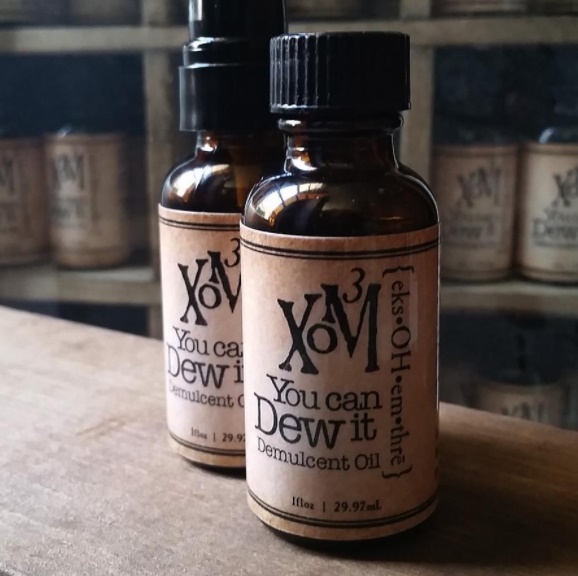
Specifically, because in addition to deconstructing the ingredient list on the bottle of a given product, we can find out exclusive information not yet known to the public about the formulator's (creators) intention in designing the skin care product.  Which makes us the consumers feel even a step closer to the process and the product.  Without further ado, lets dive into the first product from XoM3 product line: "You Can Dew It" as shown below:


Remember, if you are interested in reading any previous posts contained in the 'Anti-Aging Skin Series' please either choose the hyperlink "Aging" on the cover page (in the right hand corner) or click here.


"You Can Dew It"


First, to put the product into context from her website, Mandy has a product description which I directly quoted below from her website:


Seasonal and dry weather, time, or biology can do a number on delicate facial skin. Handcrafted You Can Dew It Demulcent Oil can help. Lush with organic and ethical ingredients, precious jojoba, rosehip seed, argon and evening primrose oils are infused with skin loving botanicals and essential oils of frankincense and ylang ylang to deliver a velvety, dew kissed finish for glowing results. 


Upon asking Mandy for a complete ingredient list, she was super kind to be open with her products.  She is interested in bringing awareness to the community of consumers in the skin care industry that she stands by her products and has nothing to hide.  She is very knowledgeable regarding the exact reason why a given ingredient is used in one of her products.  Which makes her product line even more attractive.


To start with, I will list each ingredient and list the function as I have done in past blog posts.  If the ingredients are 'highlighted or hyperlinked' then the reference page is from 'Environmental Working Group'.  Otherwise, the ingredient information reference number will be given along with the corresponding reference listed at the end of the blog post in the bibliography.  Below is a list of ingredients in "You Can Dew It":


1) Jojoba Oil:

About SIMMONDSIA CHINENSIS (JOJOBA) SEED OIL: Jojoba oil is extracted from seeds of the desert shrub, Simmondsia chinensis, native to California, Arizona and Mexico.

Function(s): Hair Conditioning Agent; Skin-Conditioning Agent - Occlusive; EMOLLIENT; SKIN CONDITIONING; VISCOSITY CONTROLLING


2) Yarrow:

A strong-scented, spicy, wild herb used in astringents and shampoos. (Ref.2)

Note: Astringent:  a substance that causes the contraction of body tissues, typically used to protect the skin and to reduce bleeding from minor abrasions. (Ref.3)


3) Argan Oil:

The oil is high in lipids, including the omega-9 oleic acid and the omega-6 linoleic acid as well as vitamin E.  Argan oil has anti-inflammatory properties. (Ref.3)


4) Calendula Officinalis (POT MARIGOLD) Flower Oil:

About CALENDULA OFFICINALIS (POT MARIGOLD) FLOWER OIL: Calendula Officinalis Flower Oil is an oil derived from the flowers of Calendula officinalis.

Function(s): Fragrance Ingredient; MASKING; SKIN CONDITIONING


5) Comfrey Extract:

The leaf and root contain allantoin, mucilage, tannins, starch, inulin, steroidal saponins, and pyrrolizine alkaloids. (Ref. 2)


6) Fankincense Oil:

Fragrant component used in skincare products; it can be a skin sensitizer, but is not considered a potent one. There is no research showing frankincense has any benefit for skin. (Ref.4)


7) Ylang Ylang:

About CANANGA ODORATA (YLANG YLANG) OIL: Oil obtained from the flowers of the ylang-ylang tree Cananga odorata.

Function(s): Fragrance Ingredient; MASKING


8) Primrose Oil:

About OENOTHERA BIENNIS (EVENING PRIMROSE) OIL: Evening Primrose oil is extracted from Oenothera biennis, a plant native to North America.

Function(s): Skin-Conditioning Agent - Miscellaneous; EMOLLIENT


That completes the ingredient list for the product "You Can Dew It" by XoM3 Botanical Solutions. On the bottom of the front of the bottle is the label -- "Demulcent Oil" which means -- "(of a substance) relieving inflammation or irritation."


Conclusion...


In the next post, I will provide a little background into the benefits of natural oils based on science.  I recently stumbled upon an article which I would like to work through to see the evidence of the benefits aside or along with those listed in the ingredients (functions) list above.


I also promised at the beginning of the series (this year) to include Mandy (the producer, formulator) opinion on the product.  I have to rescind that for the present time.  We are both looking into the Food & Drug Regulations guidelines on 'interviews' and 'product discussions.'  I will hopefully have more on that topic in the near future.


For the time being, I will move onto a new product after I discuss some benefits of natural oils in the next post.  Until next time, have a wonderful day.


Reference Bibliography:

1) Environmental Working Group

2) Cosmetic Dictionary

3) Google Dictionary

4) Paula's Choice 


Wednesday, March 28, 2018

Summer Garden 2018

I may have started too late for a summer garden of my dreams. I'm still trying to get used to the weather here in the valley.

From the winter garden I started in August of last year there remains: chard, kale, radish, okra and marigold. The poor eggplant seemed great and then died suddenly. Maybe it was cold stress, drought stress, or light stress.

A post shared by Kayla Kaiser (@hamerk02) on

I don't remember when I started organizing my seed into plant families, I guess it was just starting to grow out of control and I couldn't find anything. Making a label on the outside of the bag was a great way to find exactly what type of plant I was looking for without digging through every single bag. The bags I get free during Clinique bonus week and since I'm not really a make-up-a-holic, I use the bags to sort and store my seeds. I put all these little bags into a camo backpack that I can sometimes take with me to the Seed Library of Los Angeles (SLOLA) meetings.

This past month we had a talk from David King the founder of SLOLA and he spoke about planning for our summer gardens. He specifically went over the considerations for seed-saving. He is a teacher through UCLA Extension and the garden master at the Venice High School Learning Garden.

David encouraged us to set a goal and be clear at the start of a project (or season). That way you know when you are approaching, meeting and exceeding your goal. He said that it's easy to give away seeds, but it's hard to be persistent. In other words, it's not always the first time around that you will be able to get a yield of seeds back from what you plant.

For us in the valley, a concern is that pollen is killed at temperatures above 85 degrees F so that you will have to get up early if you want to hand-pollinate your plants.

Beans - let them become very dry on the plant. Put them in a plastic bag and freeze for 3 days. You can get seeds from the grocery store bulk bins. They will germinate.

Peppers - can cross pollinate. To prevent unintended hybridization, put cloth bags around the flowers. They are "perfect flowers" because they can self-fertilize.

Tomatoes - can cross pollinate. Pollination is typically by wind. Cherry tomatoes cross pollinate by insects. They also can self-fertilize.

Squash - susceptible to powdery mildew. If you plant now, you can harvest in July. Then plant in July for a winter harvest. You need male and female flowers, so plant as many as you can.

Tomatillo - similar to tomato and pepper. It's not as common so there's low risk of cross-pollination. Unlikely that your neighbors will be growing it.

Amaranthaceae - includes spinach, sugar beet, chard, quinoa. These are wind pollinated. The pollen can travel up to 25 miles.

Corn - typically hand pollinated. Combine 3-5 tassles in a paper bag. Shake it. Dump the pollen on the silk. This yielded him 35 kernels per ear. Corn pollen can travel 250 miles under ideal conditions.


Here's what seeds I've planted. So far the lettuces have popped right up. A variety of the flowers have also sprouted but I mixed them up so I doubt I'll know which is which until they get larger. You can follow the progress of these plants in my facebook album.


Also, I only planned to plant the spinach and eggplant, but never did it (oops) will try to get those on (in) soil today or tomorrow. Happy Cesar Chavez day, California!


I feel as though the plants have entrusted me to be a steward of their progress. I am constantly humbled by some plants' ability to survive under my lack of care. And I am surprised when those plants reward me with their fruits. I made the most amazing salad of radish and chard for the SLOLA meeting! 🌱

Monday, March 19, 2018

How resilient is your body toward infection?

Source: CDC


Have you ever had the following thoughts while 'under the weather' due to a cold or flu: "Why is this cold/flu holding my body hostage so long?  Why is my body taking so long to fight this cold?  I normally recover within a couple of days....this flu/cold must be a big one."  If so, I would like to bring up a few points inspired by a discussion a few days ago with a colleague regarding the body's resiliency in fighting infections.  Enjoy!


Why am I sick?


Why am I sick?  The answer to this question lies in the ability of a person's immune system to mount an attack on an infection (a foreign invader) into your body at any given time.  Of course, at any given time, through the acts of breathing, seeing, hearing, eating, skin absorption, invaders are attacking our bodies mounting an invasion on our system.


Stop to think about this.  Just opening your eyes, opening your mouth, breathing in, covering yourself with clothes or being naked, invaders are trying to get into your body.   You may be wondering why I am thinking about this subject at all?  First, we are in the midst of an influenza frenzy -- the spread of which is fast and wide.  Schools are hotbeds for the spread of the influenza virus this season.  I got the virus after participating as a 'science judge' a few weeks ago at an elementary school.  I even got the flu shot this season.


Turns out that there are four strains of the influenza virus circulating this season.  Three of which are wiped out by the 'flu shot' -- which is great.  The downside is that the worst strain of the virus is the fourth which has mutated and built up a resistance to the 'flu shot' - not great.  The Center for Disease Control and Prevention (CDC) offers the following explanation regarding the viruses ability to change over time:


Influenza viruses are constantly evolving, in fact all influenza viruses undergo genetic changes over time (for more information, see How the Flu Virus Can Change: “Drift” and “Shift”). An influenza virus’ genome consists of all genes that make up the virus. CDC conducts year-round surveillance of circulating influenza viruses to monitor changes to the genome (or parts of the genome) of these viruses. This work is performed as part of routine U.S. influenza surveillance and as part of CDC’s role as a World Health Organization (WHO) Collaborating Center for Reference and Research on Influenza. The information CDC collects from studying genetic changes (also known as “substitutions,” “variants” or “mutations”) in influenza viruses plays an important public health role by helping to determine whether existing vaccines and medical countermeasures (e.g., antiviral drugs) will work against new influenza viruses, as well as helping to determine the potential for influenza viruses in animals to infect humans.
Genome sequencing reveals the sequence of the nucleotides in a gene, like alphabet letters in words. Comparing the composition of nucleotides in one virus gene with the order of nucleotides in a different virus gene can reveal variations between the two viruses.
Genetic variations are important because they affect the structure of an influenza virus’ surface proteins. Proteins are made of sequences of amino acids.
The substitution of one amino acid for another can affect properties of a virus, such as how well a virus transmits between people, and how susceptible the virus is to antiviral drugs or current vaccines.
Influenza A and B viruses – the primary influenza viruses that infect people – are RNA viruses that have eight gene segments. These genes contain ‘instructions’ for making new viruses, and it’s these instructions that an influenza virus uses once it infects a human cell to trick the cell into producing more influenza viruses, thereby spreading infection.


Not all people receive the form of the influenza virus which has mutated or changed and is resistant to the 'flu shot.'  Although, the few that have and still get sick (like myself) have the risk of giving up days of productive work to allow our bodies to repair our immune system to restore the ability to mount a counter attack against influenza virus.  The majority of folks that have been subjected to taking time off due to illness (sick days) -- wanted or unwanted.  This virus has a real kick and can put a person down in bed for several days.


In the worst case scenario, a few unfortunate elderly people have transitioned from serious illness caused by the influenza virus to the actual stage of an pneumonia - which in some cases can be life-threatening.  A colleague of mine just mentioned the other day that he has attended this year  3 funerals of friends who have died as a result of a serious progression of the virus into a pneumonia and onto death.  What a tragedy that is.  I expressed my sorrow for his losses.  I also took the time to insert a message of gratitude for those of us who have survived.  Not to be disrespectful of those unfortunate people that passed as a result.


The Human Body is Resilient Toward Infections


In most cases the human body is resilient toward infection.  As I mentioned above, the human body is constantly being bombarded with attacks from foreign invaders.   And our immune system is in turn mounting attacks against foreign invaders at what seems like the speed of light (not literally).  Our ability to comprehend the extreme resiliency of our immune systems ability to mount counter attacks is greatly lacking.  Let me give you an example to explain why this is the case.


Present Day Syria


Immigration is a hot issue presently throughout the world.  There are 65 million displaced migrants moving throughout the world today.  A significant portion of the moving migrant are moving from the civil war that has plagued Syria over the last few years.  Here is a picture shown below of a previously largely populated city of (in Syria - pre-civil war):


Source: Sputnik News


This picture is of the city of Aleppo pre-civil war with a population of 1.6 million people.  Of course, after years of the civil war, the city now appears as shown below:


Source: CNN


Wow!  Imagine if the human body was unable to fight an infection.  Imagine if the human body worked on the time scale of the human ability to rebuild a city like Aleppo after a civil war.  Our ability on the human level (physical scale) is lacking.  Building up a city like Aleppo will take years to return to normalcy if ever.


On the microscopic scale (virus level), our bodies have to be much more resilient to fighting disease.  The ability to rebuild our destroyed cells or other cellular machinery is of the upmost importance and needs to be accomplished immediately. Again, you may be wondering the following question:


What is the connection to the city of Aleppo and the human body's immune system?


The point that I would like to drive home is that we should respect the our body more.  Furthermore, in the event that the influenza virus invades our body successfully and causes us to miss work, respect your body and let your immune system do its intended job.  Think about this blog post while you rest in bed.  Let your body repair your system.  If you choose to not respect your immune system and let the system do the job of counter attacking the virus, you could move the virus into the stage of an pneumonia -- and possibly progress onto death.


Conclusion...


Respect your body.  Amazingly enough, your body's ability to mount a counter attack is super efficient compared to the human scale activities shown above.  Imagine if your body operated on the scale of us as humans operating on a daily basis.  You would be sick for years.


Secondly, remember that your body fights the virus every few weeks after you recover.  Therefore, if you recover and start to abuse your body (let your immune system be compromised) by not taking care of yourself, you will find yourself sick again.  What?  Is that possible?  Yes, it is.  Don't believe me?  See if this happens in the future after you recover from your present sick state.


I hope that each of you choose to respect and let your body heal itself on the appropriate time scale.  Remember to think about how amazing your system is to be able to recover in a matter of days.  What is the equivalent process that occurs on the human physical scale?  Is there such a comparison?  I do not believe that one has been uncovered.  We have a lot to learn in science to be able to mimic the body's ability to recover.  Until next time, have a great day.


Friday, February 23, 2018

What Happened To The Anti-Aging Skin Series?

Are you ready for the continuation of the Anti-Aging Skin Series?  I know, the delay has been quite long.  Over the winter break, I was thinking about the change which I had proposed at the end of last year.  The new series (or continuation) of the old is going to focus on (for the time being) products off of a friends website -- XOM3.com.


The reason being (as I explained in the last post) was to include more information about the formulation in the blog post from the actual formulator/manufacturer.   In this case, the formulator is a great friend -- Mandy -- as you will see.  Additionally, another reason for the change is to uncover more information about the ingredient profile along with the benefits of ingredients infused into the product.  At the same time, this will allow the reader (you) to comment and ask questions which I can relay to the formulator about a given product.  The dialogue or channels of communication can be further opened regarding skin care products.


With the start of a new year, life can be busy coordinating responses and questions between two people who are busy.  Be patient with us.  The first product I will be showcasing is shown below:


Source: xom3.com


The product is a facial moisturizer called "You Can Dew It".  Take a look at the product description before you read the next blog post.  Formulate your own opinion and questions regarding the product.  See if the next blog post answers the questions/assumptions/opinions that you have formed.


Additionally, in the mean time, if you would like to access previous posts in the "Anti-Aging Skin Series" feel free to click here to access an index page.


Are you ready?  I know that you are.  As soon as I incorporate Mandy's comments into my blog post which is partially done, you will see the next blog post.  Stay tuned and have a wonderful weekend.